Thank you for visiting SNEWPapers!
Sign up free
Editorial
December 28, 1782
The New Hampshire Gazette And General Advertiser
Portsmouth, Exeter, Rockingham County, New Hampshire
What is this article about?
An editorial critiquing the political intrigues surrounding the formation of the Rockingham ministry in March 1782, praising its Whig principles and short-lived achievements, lamenting the death of a virtuous leader (likely Rockingham), and urging Lord Shelburne to recognize American independence for peace, while warning against oppressing the people.
Clipping
OCR Quality
95%
Excellent
Full Text
From the London Courant.
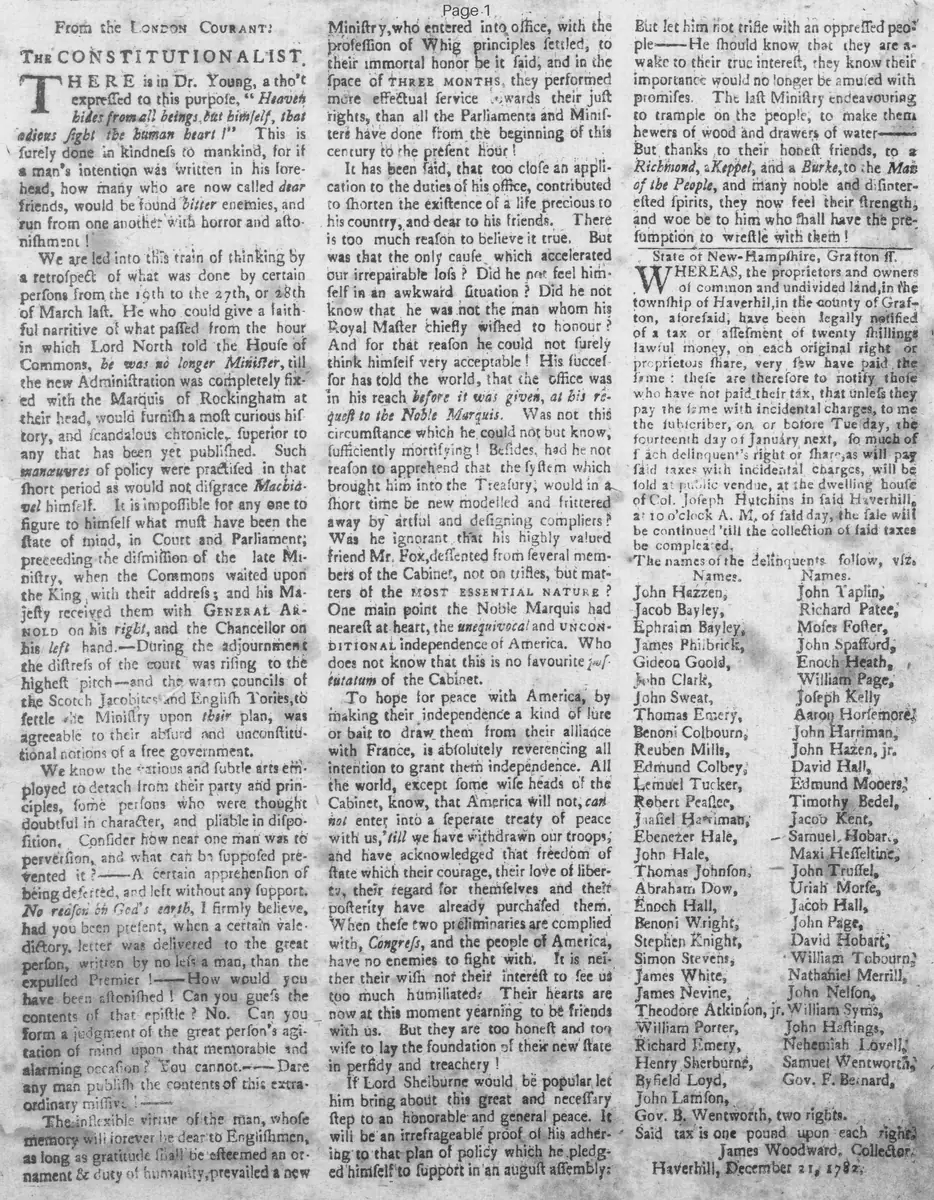
THE CONSTITUTIONALIST
Here is in Dr. Young a thought expressed to this purpose, "Heaven hides from all beings but himself that odious sight the human heart!" This is surely done in kindness to mankind, for if a man's intention was written in his forehead, how many who are now called dear friends, would be found bitter enemies, and run from one another with horror and astonishment!
We are led into this train of thinking by a retrospect of what was done by certain persons from the 19th to the 27th, or 28th of March last. He who could give a faithful narrative of what passed from the hour in which Lord North told the House of Commons he was no longer Minister, till the new Administration was completely fixed with the Marquis of Rockingham at their head, would furnish a most curious history, and scandalous chronicle, superior to any that has been yet published. Such manoeuvres of policy were practised in that short period as would not disgrace Macbeth himself. It is impossible for any one to figure to himself what must have been the state of mind, in Court and Parliament, preceding the dismission of the late Ministry, when the Commons waited upon the King, with their address: and his Majesty received them with General Arnold on his right, and the Chancellor on his left hand. During the adjournment the distress of the court was rising to the highest pitch—and the warm councils of the Scotch Jacobites and English Tories, to settle a Ministry upon their plan, was agreeable to their absurd and unconstitutional notions of a free government.
We know the cautious and subtle arts employed to detach from their party and principles, some persons who were thought doubtful in character, and pliable in disposition. Consider how near one man was to perversion, and what can be supposed prevented it?—A certain apprehension of being deserted, and left without any support. No reason on God's earth, I firmly believe, had you been present, when a certain valedictory letter was delivered to the great person, written by no less a man, than the expelled Premier!—How would you have been astonished! Can you guess the contents of that epistle? No. Can you form a judgment of the great person's agitation of mind upon that memorable and alarming occasion? You cannot.—Dare any man publish the contents of this extraordinary missive?
The inflexible virtue of the man, whose memory will forever be dear to Englishmen, as long as gratitude shall be esteemed an ornament & duty of humanity, prevailed over a new Ministry, who entered into office, with the profession of Whig principles settled, to their immortal honor be it said, and in the space of THREE MONTHS, they performed more effectual service towards their just rights, than all the Parliaments and Ministers have done from the beginning of this century to the present hour!
It has been said, that too close an application to the duties of his office, contributed to shorten the existence of a life precious to his country, and dear to his friends. There is too much reason to believe it true. But was that the only cause which accelerated our irreparable loss? Did he not feel himself in an awkward situation? Did he not know that he was not the man whom his Royal Master chiefly wished to honour? And for that reason he could not surely think himself very acceptable! His successor has told the world, that the office was in his reach before it was given, at his request to the Noble Marquis. Was not this circumstance which he could not but know, sufficiently mortifying! Besides, had he not reason to apprehend that the system which brought him into the Treasury; would in a short time be new modelled and frittered away by artful and designing compliers? Was he ignorant that his highly valued friend Mr. Fox, dissented from several members of the Cabinet, not on trifles, but matters of the MOST ESSENTIAL NATURE?
One main point the Noble Marquis had nearest at heart, the unequivocal and unconditional independence of America. Who does not know that this is no favourite subject of the Cabinet. To hope for peace with America, by making their independence a kind of lure or bait to draw them from their alliance with France, is absolutely renouncing all intention to grant them independence. All the world, except some wise heads of the Cabinet, know, that America will not, can not enter into a separate treaty of peace with us, till we have withdrawn our troops, and have acknowledged that freedom of state which their courage, their love of liberty, their regard for themselves and their posterity have already purchased them. When these two preliminaries are complied with, Congress, and the people of America, have no enemies to fight with. It is neither their wish nor their interest to see us too much humiliated: Their hearts are now at this moment yearning to be friends with us. But they are too honest and too wise to lay the foundation of their new state in perfidy and treachery!
If Lord Shelburne would be popular let him bring about this great and necessary step to an honorable and general peace. It will be an irrefragable proof of his adhering to that plan of policy which he pledged himself to support in an august assembly:
But let him not trifle with an oppressed people more—He should know, that they are awake to their true interest. They know their importance would no longer be amused with promises. The last Ministry endeavouring to trample on the people: to make them hewers of wood and drawers of water—but thanks to their honest friends, to a Richmond, a Keppel, and a Burke, to the Man of the People, and many noble and disinterested spirits, they now feel their strength; and woe be to him who shall have the presumption to wrestle with them!
THE CONSTITUTIONALIST
Here is in Dr. Young a thought expressed to this purpose, "Heaven hides from all beings but himself that odious sight the human heart!" This is surely done in kindness to mankind, for if a man's intention was written in his forehead, how many who are now called dear friends, would be found bitter enemies, and run from one another with horror and astonishment!
We are led into this train of thinking by a retrospect of what was done by certain persons from the 19th to the 27th, or 28th of March last. He who could give a faithful narrative of what passed from the hour in which Lord North told the House of Commons he was no longer Minister, till the new Administration was completely fixed with the Marquis of Rockingham at their head, would furnish a most curious history, and scandalous chronicle, superior to any that has been yet published. Such manoeuvres of policy were practised in that short period as would not disgrace Macbeth himself. It is impossible for any one to figure to himself what must have been the state of mind, in Court and Parliament, preceding the dismission of the late Ministry, when the Commons waited upon the King, with their address: and his Majesty received them with General Arnold on his right, and the Chancellor on his left hand. During the adjournment the distress of the court was rising to the highest pitch—and the warm councils of the Scotch Jacobites and English Tories, to settle a Ministry upon their plan, was agreeable to their absurd and unconstitutional notions of a free government.
We know the cautious and subtle arts employed to detach from their party and principles, some persons who were thought doubtful in character, and pliable in disposition. Consider how near one man was to perversion, and what can be supposed prevented it?—A certain apprehension of being deserted, and left without any support. No reason on God's earth, I firmly believe, had you been present, when a certain valedictory letter was delivered to the great person, written by no less a man, than the expelled Premier!—How would you have been astonished! Can you guess the contents of that epistle? No. Can you form a judgment of the great person's agitation of mind upon that memorable and alarming occasion? You cannot.—Dare any man publish the contents of this extraordinary missive?
The inflexible virtue of the man, whose memory will forever be dear to Englishmen, as long as gratitude shall be esteemed an ornament & duty of humanity, prevailed over a new Ministry, who entered into office, with the profession of Whig principles settled, to their immortal honor be it said, and in the space of THREE MONTHS, they performed more effectual service towards their just rights, than all the Parliaments and Ministers have done from the beginning of this century to the present hour!
It has been said, that too close an application to the duties of his office, contributed to shorten the existence of a life precious to his country, and dear to his friends. There is too much reason to believe it true. But was that the only cause which accelerated our irreparable loss? Did he not feel himself in an awkward situation? Did he not know that he was not the man whom his Royal Master chiefly wished to honour? And for that reason he could not surely think himself very acceptable! His successor has told the world, that the office was in his reach before it was given, at his request to the Noble Marquis. Was not this circumstance which he could not but know, sufficiently mortifying! Besides, had he not reason to apprehend that the system which brought him into the Treasury; would in a short time be new modelled and frittered away by artful and designing compliers? Was he ignorant that his highly valued friend Mr. Fox, dissented from several members of the Cabinet, not on trifles, but matters of the MOST ESSENTIAL NATURE?
One main point the Noble Marquis had nearest at heart, the unequivocal and unconditional independence of America. Who does not know that this is no favourite subject of the Cabinet. To hope for peace with America, by making their independence a kind of lure or bait to draw them from their alliance with France, is absolutely renouncing all intention to grant them independence. All the world, except some wise heads of the Cabinet, know, that America will not, can not enter into a separate treaty of peace with us, till we have withdrawn our troops, and have acknowledged that freedom of state which their courage, their love of liberty, their regard for themselves and their posterity have already purchased them. When these two preliminaries are complied with, Congress, and the people of America, have no enemies to fight with. It is neither their wish nor their interest to see us too much humiliated: Their hearts are now at this moment yearning to be friends with us. But they are too honest and too wise to lay the foundation of their new state in perfidy and treachery!
If Lord Shelburne would be popular let him bring about this great and necessary step to an honorable and general peace. It will be an irrefragable proof of his adhering to that plan of policy which he pledged himself to support in an august assembly:
But let him not trifle with an oppressed people more—He should know, that they are awake to their true interest. They know their importance would no longer be amused with promises. The last Ministry endeavouring to trample on the people: to make them hewers of wood and drawers of water—but thanks to their honest friends, to a Richmond, a Keppel, and a Burke, to the Man of the People, and many noble and disinterested spirits, they now feel their strength; and woe be to him who shall have the presumption to wrestle with them!
What sub-type of article is it?
Partisan Politics
Foreign Affairs
War Or Peace
What keywords are associated?
British Politics
Rockingham Ministry
American Independence
Whig Principles
Lord Shelburne
Peace Negotiations
Political Intrigue
What entities or persons were involved?
Lord North
Marquis Of Rockingham
King
General Arnold
Chancellor
Scotch Jacobites
English Tories
Mr. Fox
Lord Shelburne
Richmond
Keppel
Burke
Man Of The People
Editorial Details
Primary Topic
Political Intrigues In Forming The Rockingham Ministry And Advocacy For Recognizing American Independence
Stance / Tone
Critically Supportive Of Whig Principles, Mourning Rockingham's Death, Urging Peace Through American Independence
Key Figures
Lord North
Marquis Of Rockingham
King
General Arnold
Chancellor
Scotch Jacobites
English Tories
Mr. Fox
Lord Shelburne
Richmond
Keppel
Burke
Man Of The People
Key Arguments
Political Maneuvers During Ministry Change Were Scandalous And Machiavellian.
Rockingham's Virtue And Whig Ministry Achieved More In Three Months Than Predecessors In A Century.
Rockingham's Death Was Hastened By Stress, Unpopularity With The King, And Cabinet Dissent.
True Peace Requires Withdrawing Troops From America And Acknowledging Their Independence Unconditionally.
America Seeks Friendship But Will Not Betray Allies Or Accept Insincere Offers.
Lord Shelburne Should Honor Pledges For Peace To Gain Popularity.
The People, Empowered By Honest Leaders, Will Resist Oppression.