Thank you for visiting SNEWPapers!
Sign up free
Story
November 10, 1928
The Milwaukee Leader
Milwaukee, Milwaukee County, Wisconsin
What is this article about?
El Comancho explains how wild geese migrate north and south by associating the smell of hot mud with food sources, starting from their Yukon River breeding grounds where young learn to fly amid scarce resources.
Clipping
OCR Quality
98%
Excellent
Full Text
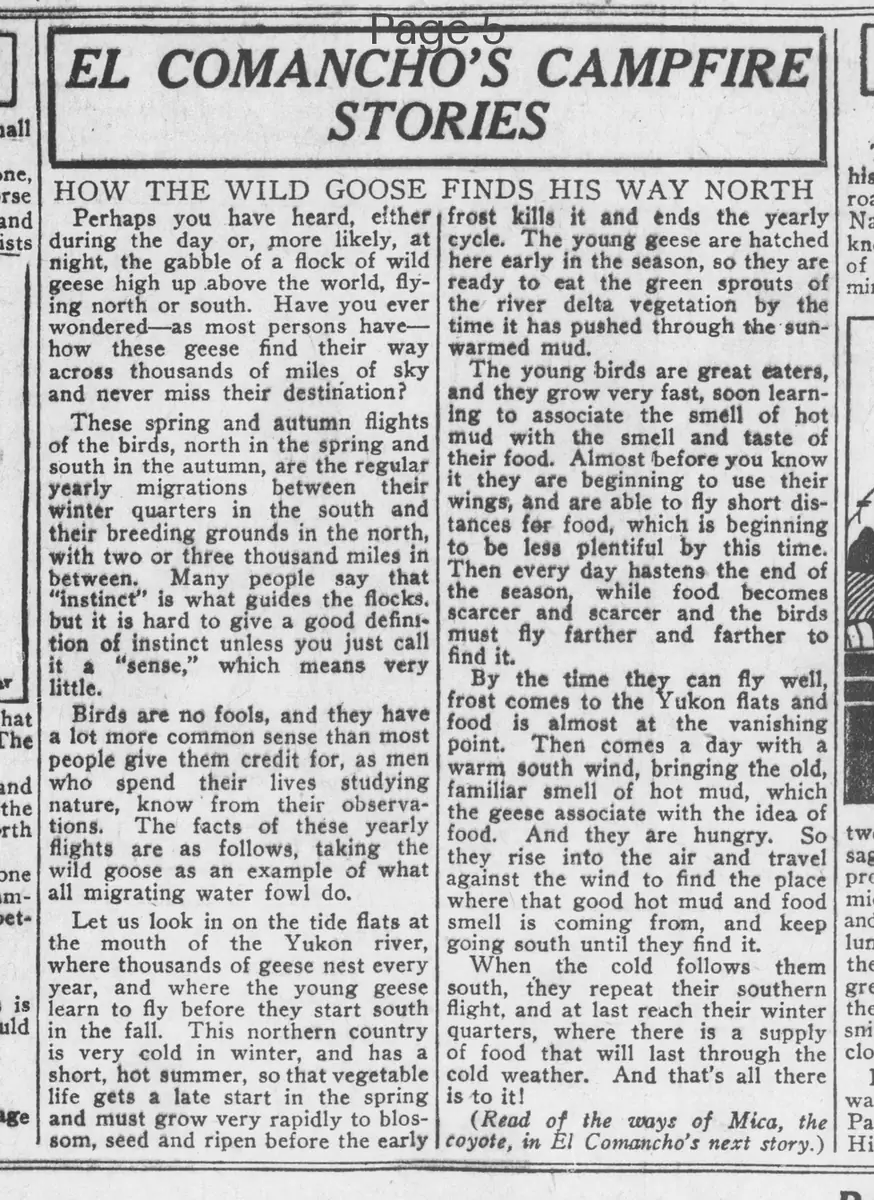
EL COMANCHO'S CAMPFIRE STORIES
HOW THE WILD GOOSE FINDS HIS WAY NORTH
Perhaps you have heard, either during the day or, more likely, at night, the gabble of a flock of wild geese high up above the world, flying north or south. Have you ever wondered-as most persons have-how these geese find their way across thousands of miles of sky and never miss their destination?
These spring and autumn flights of the birds, north in the spring and south in the autumn, are the regular yearly migrations between their winter quarters in the south and their breeding grounds in the north, with two or three thousand miles in between. Many people say that "instinct" is what guides the flocks, but it is hard to give a good definition of instinct unless you just call it a "sense," which means very little.
Birds are no fools, and they have a lot more common sense than most people give them credit for, as men who spend their lives studying nature, know from their observations. The facts of these yearly flights are as follows, taking the wild goose as an example of what all migrating water fowl do.
Let us look in on the tide flats at the mouth of the Yukon river, where thousands of geese nest every year, and where the young geese learn to fly before they start south in the fall. This northern country is very cold in winter, and has a short, hot summer, so that vegetable life gets a late start in the spring and must grow very rapidly to blossom, seed and ripen before the early frost kills it and ends the yearly cycle. The young geese are hatched here early in the season, so they are ready to eat the green sprouts of the river delta vegetation by the time it has pushed through the sun-warmed mud.
The young birds are great eaters, and they grow very fast, soon learning to associate the smell of hot mud with the smell and taste of their food. Almost before you know it they are beginning to use their wings, and are able to fly short distances for food, which is beginning to be less plentiful by this time. Then every day hastens the end of the season, while food becomes scarcer and scarcer and the birds must fly farther and farther to find it.
By the time they can fly well, frost comes to the Yukon flats and food is almost at the vanishing point. Then comes a day with a warm south wind, bringing the old, familiar smell of hot mud, which the geese associate with the idea of food. And they are hungry. So they rise into the air and travel against the wind to find the place where that good hot mud and food smell is coming from, and keep going south until they find it.
When the cold follows them south, they repeat their southern flight, and at last reach their winter quarters, where there is a supply of food that will last through the cold weather. And that's all there is to it!
(Read of the ways of Mica, the coyote, in El Comancho's next story.)
HOW THE WILD GOOSE FINDS HIS WAY NORTH
Perhaps you have heard, either during the day or, more likely, at night, the gabble of a flock of wild geese high up above the world, flying north or south. Have you ever wondered-as most persons have-how these geese find their way across thousands of miles of sky and never miss their destination?
These spring and autumn flights of the birds, north in the spring and south in the autumn, are the regular yearly migrations between their winter quarters in the south and their breeding grounds in the north, with two or three thousand miles in between. Many people say that "instinct" is what guides the flocks, but it is hard to give a good definition of instinct unless you just call it a "sense," which means very little.
Birds are no fools, and they have a lot more common sense than most people give them credit for, as men who spend their lives studying nature, know from their observations. The facts of these yearly flights are as follows, taking the wild goose as an example of what all migrating water fowl do.
Let us look in on the tide flats at the mouth of the Yukon river, where thousands of geese nest every year, and where the young geese learn to fly before they start south in the fall. This northern country is very cold in winter, and has a short, hot summer, so that vegetable life gets a late start in the spring and must grow very rapidly to blossom, seed and ripen before the early frost kills it and ends the yearly cycle. The young geese are hatched here early in the season, so they are ready to eat the green sprouts of the river delta vegetation by the time it has pushed through the sun-warmed mud.
The young birds are great eaters, and they grow very fast, soon learning to associate the smell of hot mud with the smell and taste of their food. Almost before you know it they are beginning to use their wings, and are able to fly short distances for food, which is beginning to be less plentiful by this time. Then every day hastens the end of the season, while food becomes scarcer and scarcer and the birds must fly farther and farther to find it.
By the time they can fly well, frost comes to the Yukon flats and food is almost at the vanishing point. Then comes a day with a warm south wind, bringing the old, familiar smell of hot mud, which the geese associate with the idea of food. And they are hungry. So they rise into the air and travel against the wind to find the place where that good hot mud and food smell is coming from, and keep going south until they find it.
When the cold follows them south, they repeat their southern flight, and at last reach their winter quarters, where there is a supply of food that will last through the cold weather. And that's all there is to it!
(Read of the ways of Mica, the coyote, in El Comancho's next story.)
What sub-type of article is it?
Animal Story
Curiosity
Journey
What themes does it cover?
Nature
Survival
What keywords are associated?
Wild Geese
Migration
Yukon River
Hot Mud Smell
Food Association
Annual Flights
Where did it happen?
Mouth Of The Yukon River, Tide Flats
Story Details
Location
Mouth Of The Yukon River, Tide Flats
Event Date
Yearly Migrations, Spring And Autumn
Story Details
Wild geese migrate by following the smell of hot mud associated with food, learned as young in Yukon breeding grounds; they fly south when frost arrives and food scarce, reaching winter quarters.