Thank you for visiting SNEWPapers!
Sign up free
Summit County Labor News
Akron, Summit County, Ohio
What is this article about?
Labor Secretary Maurice J. Tobin announced improved job opportunities nationwide in late summer and early fall, tightening labor supply to levels not seen since World War II. Several areas reclassified from labor surplus; building trades wages rose 15 cents/hour on average; steel industry earnings hit record $2.206/hour in September.
Merged-components note: Merged continuation of article on job opportunities and labor supply; relabeled to domestic_news as it concerns national labor market conditions.
Clippings
1 of 2
OCR Quality
Full Text
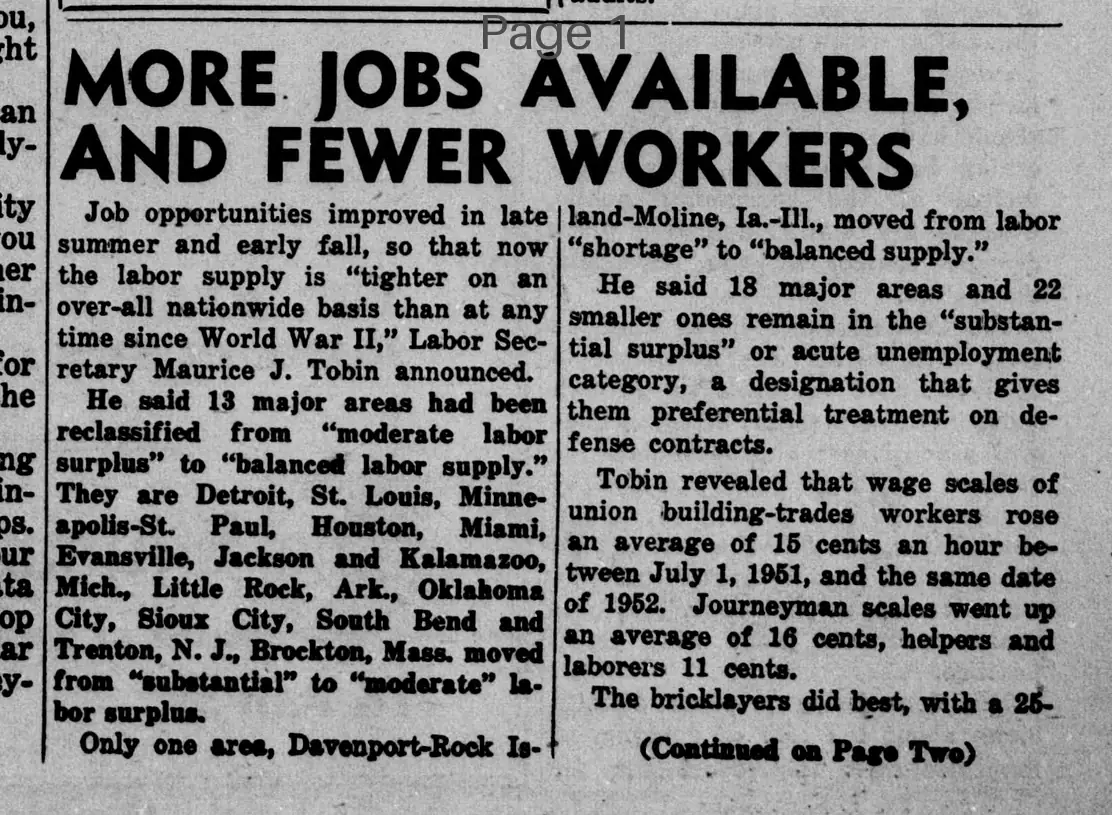
Job opportunities improved in late summer and early fall, so that now the labor supply is "tighter on an over-all nationwide basis than at any time since World War II," Labor Secretary Maurice J. Tobin announced.
He said 13 major areas had been reclassified from "moderate labor surplus" to "balanced labor supply." They are Detroit, St. Louis, Minneapolis-St. Paul, Houston, Miami, Evansville, Jackson and Kalamazoo, Mich., Little Rock, Ark., Oklahoma City, Sioux City, South Bend and Trenton, N. J., Brockton, Mass. moved from "substantial" to "moderate" labor surplus.
Only one area, Davenport-Rock Island-Moline, Ia.-Ill., moved from labor "shortage" to "balanced supply."
He said 18 major areas and 22 smaller ones remain in the "substantial surplus" or acute unemployment category, a designation that gives them preferential treatment on defense contracts.
Tobin revealed that wage scales of union building-trades workers rose an average of 15 cents an hour between July 1, 1951, and the same date of 1952. Journeyman scales went up an average of 16 cents, helpers and laborers 11 cents.
The bricklayers did best, with a 25-cent or 8.5 per cent increase to an average of $3.19 an hour. The smallest increases were for elevator constructors' helpers 7 cents or 3.7 per cent to $2.01, and mosaic and terrazzo workers 9 cents or 3.2 per cent to $2.82. The lowest average scale at the end of the period was for helpers and laborers, $1.84. Apprentice and premium rates were excluded from computations.
The American Iron and Steel Institute said average hourly earnings for wage earners in that industry reached a record $2.206 in September, compared with $2.139 in August, although the September figure was padded somewhat by some companies' spreading the Labor Day costs over the rest of the month.
The industry's wage earners worked an average of 40.3 hours a week in September, compared with 38.2 in August, and total employment rose from 659,800 to 673,600.
The figures were based on reports from 110 firms representing 95 per cent of steelmaking capacity.
What sub-type of article is it?
What keywords are associated?
What entities or persons were involved?
Where did it happen?
Domestic News Details
Primary Location
United States
Event Date
Late Summer And Early Fall
Key Persons
Outcome
labor supply tighter nationwide; 13 areas reclassified to balanced supply; 1 from shortage to balanced; 18 major and 22 smaller areas remain in substantial surplus; building trades wages up 15 cents/hour average; steel earnings $2.206/hour in september, employment up to 673,600
Event Details
Labor Secretary Tobin announced improved job opportunities and tighter labor supply. Reclassifications of labor areas reported. Wage increases in union building trades detailed. Steel industry earnings and employment statistics released.