Thank you for visiting SNEWPapers!
Sign up free
Literary
June 21, 1820
The Hillsborough Recorder
Hillsboro, Orange County, North Carolina
What is this article about?
A satirical poem from the Washington Register mocks Mr. Duval's rigid adherence to etiquette, quoting Lord Chesterfield. Duval warns a stranger, Mr. Thompson, of his burning coat tail only after politely inquiring his name.
Clipping
OCR Quality
98%
Excellent
Full Text
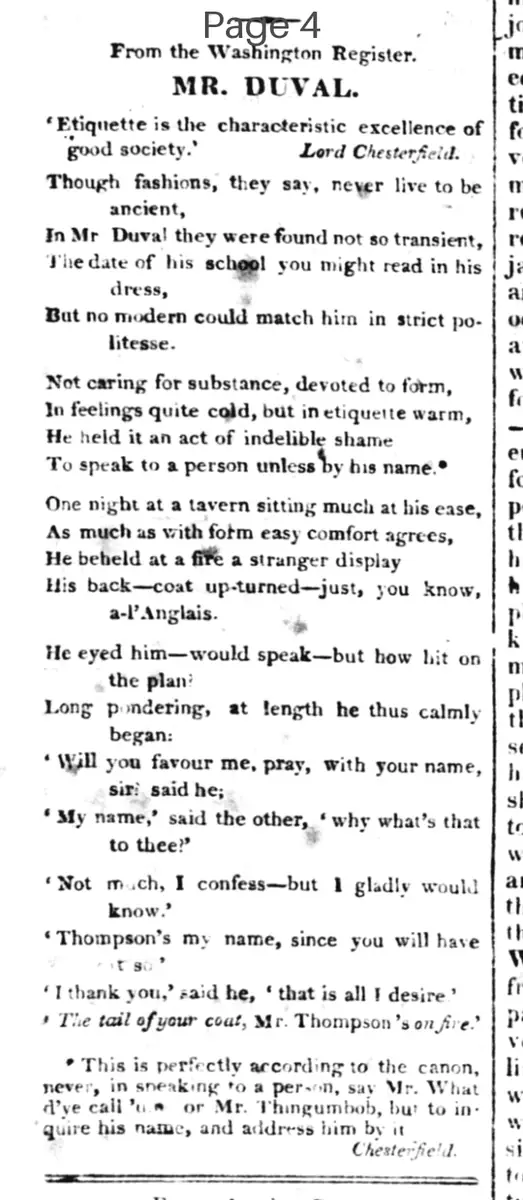
From the Washington Register.
MR. DUVAL.
'Etiquette is the characteristic excellence of good society.'—Lord Chesterfield.
Though fashions, they say, never live to be ancient,
In Mr. Duval they were found not so transient,
The date of his school you might read in his dress,
But no modern could match him in strict politeness.
Not caring for substance, devoted to form,
In feelings quite cold, but in etiquette warm,
He held it an act of indelible shame
To speak to a person unless by his name.
One night at a tavern sitting much at his ease,
As much as with form easy comfort agrees,
He beheld at a fire a stranger display
His back-coat up-turned—just, you know, à l'Anglais.
He eyed him—would speak—but how hit on the plan?
Long pondering, at length he thus calmly began:
'Will you favour me, pray, with your name, sir?' said he;
'My name,' said the other, 'why, what's that to thee?'
'Not much, I confess—but I gladly would know.'
'Thompson's my name, since you will have it so.'
'I thank you,' said he, 'that is all I desire.'
'The tail of your coat, Mr. Thompson's on fire.'
This is perfectly according to the canon,
Never, in speaking to a person, say Mr. What-d'ye-call-you or Mr. Thingumbob, but to inquire his name, and address him by it.—Chesterfield.
MR. DUVAL.
'Etiquette is the characteristic excellence of good society.'—Lord Chesterfield.
Though fashions, they say, never live to be ancient,
In Mr. Duval they were found not so transient,
The date of his school you might read in his dress,
But no modern could match him in strict politeness.
Not caring for substance, devoted to form,
In feelings quite cold, but in etiquette warm,
He held it an act of indelible shame
To speak to a person unless by his name.
One night at a tavern sitting much at his ease,
As much as with form easy comfort agrees,
He beheld at a fire a stranger display
His back-coat up-turned—just, you know, à l'Anglais.
He eyed him—would speak—but how hit on the plan?
Long pondering, at length he thus calmly began:
'Will you favour me, pray, with your name, sir?' said he;
'My name,' said the other, 'why, what's that to thee?'
'Not much, I confess—but I gladly would know.'
'Thompson's my name, since you will have it so.'
'I thank you,' said he, 'that is all I desire.'
'The tail of your coat, Mr. Thompson's on fire.'
This is perfectly according to the canon,
Never, in speaking to a person, say Mr. What-d'ye-call-you or Mr. Thingumbob, but to inquire his name, and address him by it.—Chesterfield.
What sub-type of article is it?
Poem
Satire
What themes does it cover?
Social Manners
What keywords are associated?
Etiquette
Politeness
Satire
Chesterfield
Tavern
Coat Fire
What entities or persons were involved?
From The Washington Register.
Literary Details
Title
Mr. Duval.
Author
From The Washington Register.
Subject
Etiquette Is The Characteristic Excellence Of Good Society.
Form / Style
Satirical Verse On Politeness And Form.
Key Lines
'Will You Favour Me, Pray, With Your Name, Sir?' Said He;
'My Name,' Said The Other, 'Why, What's That To Thee?'
'I Thank You,' Said He, 'That Is All I Desire.'
'The Tail Of Your Coat, Mr. Thompson's On Fire.'