Thank you for visiting SNEWPapers!
Sign up free
Literary
September 1, 1790
Gazette Of The United States
New York, New York County, New York
What is this article about?
Philosophical essay continuation lamenting the disruption of France's aristocratic system by the revolution, which equalized society and threatened traditional hierarchies. Warns of similar perils to Britain's revenue, manufactures, and social order from French influences, critiquing taxation and political changes.
Clipping
OCR Quality
95%
Excellent
Full Text
PHILOSOPHICAL REFLECTIONS
ON THE LATE
REVOLUTION IN FRANCE, &c.
CONTINUATION.
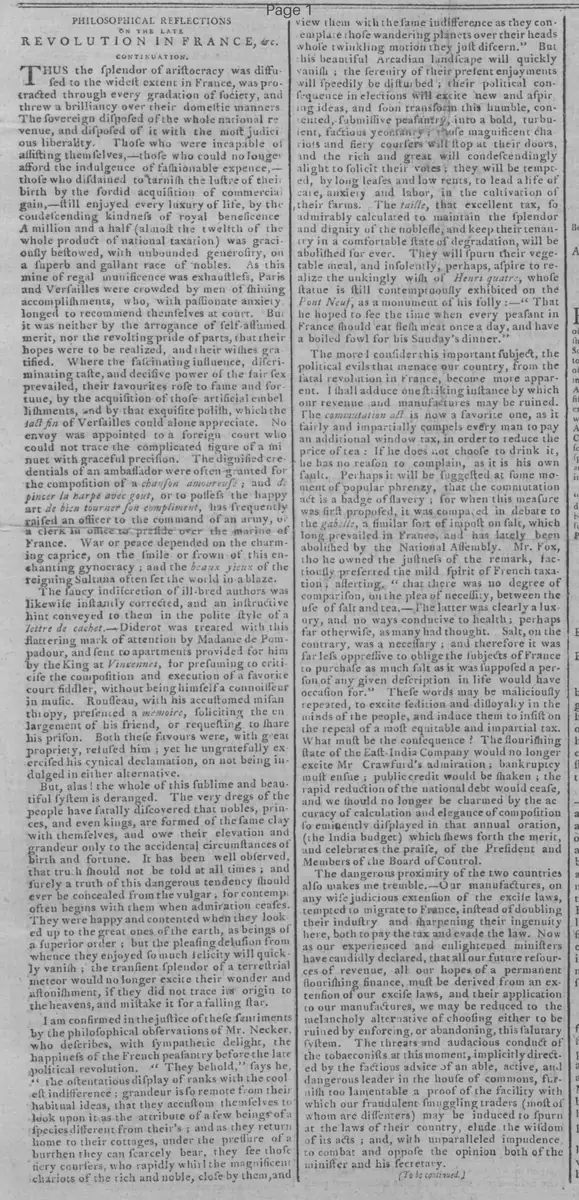
Thus the splendor of aristocracy was diffused to the widest extent in France, was protracted through every gradation of society, and threw a brilliancy over their domestic manners. The sovereign disposed of the whole national revenue, and disposed of it with the most judicious liberality. Those who were incapable of assisting themselves,—those who could no longer afford the indulgence of fashionable expense,—those who disdained to tarnish the lustre of their birth by the sordid acquisition of commercial gain,—still enjoyed every luxury of life, by the condescending kindness of royal beneficence. A million and a half (almost the twelfth of the whole product of national taxation) was graciously bestowed, with unbounded generosity, on a superb and gallant race of nobles. As this mine of regal munificence was exhaustless, Paris and Versailles were crowded by men of shining accomplishments, who, with passionate anxiety, longed to recommend themselves at court. But it was neither by the arrogance of self-assumed merit, nor the revolting pride of parts, that their hopes were to be realized, and their wishes gratified. Where the fascinating influence, discriminating taste, and decisive power of the fair sex prevailed, their favorites rose to fame and fortune, by the acquisition of those artificial embellishments, and by that exquisite polish, which the fastidious taste of Versailles could alone appreciate. No envoy was appointed to a foreign court who could not trace the complicated figure of a minuet with graceful precision. The dignified credentials of an ambassador were often granted for the composition of a chanson amoureuse; and to pincé la harpe avec gout, or to possess the happy art de bien tourner un compliment, has frequently raised an officer to the command of an army, or a clerk in office to preside over the marine of France. War or peace depended on the charming caprice, on the smile or frown of this enchanting gynocracy; and the beaux yeux of the reigning Sultana often set the world in a blaze. The saucy indiscretion of ill-bred authors was likewise instantly corrected, and an instructive hint conveyed to them in the polite style of a lettre de cachet. Diderot was treated with this flattering mark of attention by Madame de Pompadour, and sent to apartments provided for him by the King at Vincennes, for presuming to criticize the composition and execution of a favorite court fiddler, without being himself a connoisseur in music. Rousseau, with his accustomed misanthropy, presented a memoire, soliciting the enlargement of his friend, or requesting to share his prison. Both these favors were, with great propriety, refused him; yet he ungratefully exercised his cynical declamation, on not being indulged in either alternative.
But, alas! the whole of this sublime and beautiful system is deranged. The very dregs of the people have fatally discovered that nobles, princes, and even kings, are formed of the same clay with themselves, and owe their elevation and grandeur only to the accidental circumstances of birth and fortune. It has been well observed, that truth should not be told at all times; and surely a truth of this dangerous tendency should ever be concealed from the vulgar; for contempt often begins with them when admiration ceases. They were happy and contented when they looked up to the great ones of the earth, as beings of a superior order; but the pleasing delusion from whence they enjoyed so much felicity will quickly vanish; the transient splendor of a terrestrial meteor would no longer excite their wonder and astonishment, if they did not trace its origin to the heavens, and mistake it for a falling star. I am confirmed in the justice of these sentiments by the philosophical observations of Mr. Necker, who describes, with sympathetic delight, the happiness of the French peasantry before the late political revolution. "They behold," says he, "the ostentatious display of ranks with the coolest indifference; grandeur is so remote from their habitual ideas, that they accustom themselves to look upon it as the attribute of a few beings of a species different from theirs; and as they return home to their cottages, under the pressure of a burthen they can scarcely bear, they see those fiery coursers, who rapidly whirl the magnificent chariots of the rich and noble, close by them, and view them with the same indifference as they contemplate those wandering planets over their heads whose twinkling motion they just discern." But his beautiful Arcadian landscape will quickly vanish; the serenity of their present enjoyments will speedily be disturbed; their political consequence in elections will excite new and aspiring ideas, and soon transform this humble, contented,—submissive peasantry into a bold, turbulent, factious yeomanry; those magnificent chariots and fiery coursers will stop at their doors, and the rich and great will condescendingly alight to solicit their votes; they will be tempted, by long leases and low rents, to lead a life of care, anxiety and labor, in the cultivation of their farms. The taille, that excellent tax, so admirably calculated to maintain the splendor and dignity of the nobility, and keep their tenantry in a comfortable state of degradation, will be abolished for ever. They will spurn their vegetable meal, and insolently, perhaps, aspire to realize the unkingly wish of Henri Quatre, whose statue is still contemptuously exhibited on the Pont Neuf, as a monument of his folly :—"That he hoped to see the time when every peasant in France should eat flesh meat once a day, and have a boiled fowl for his Sunday's dinner."
The more I consider this important subject, the political evils that menace our country, from the fatal revolution in France, become more apparent. I shall adduce one striking instance by which our revenue and manufactures may be ruined. The commutation act is now a favorite one, as it fairly and impartially compels every man to pay an additional window tax, in order to reduce the price of tea : If he does not choose to drink it, he has no reason to complain, as it is his own fault. Perhaps it will be suggested at some moment of popular phrenzy, that the commutation act is a badge of slavery; for when this measure was first proposed, it was compared in debate to the gabelle, a similar sort of impost on salt, which long prevailed in France, and has lately been abolished by the National Assembly. Mr. Fox, tho he owned the justice of the remark, factiously preferred the mild spirit of French taxation; asserting, "that there was no degree of comparison, on the plea of necessity, between the use of salt and tea.— The latter was clearly a luxury, and no ways conducive to health; perhaps far otherwise, as many had thought. Salt, on the contrary, was a necessary ; and therefore it was far less oppressive to oblige the subjects of France to purchase as much salt as it was supposed a person of any given description in life would have occasion for." These words may be maliciously repeated, to excite sedition and disloyalty in the minds of the people, and induce them to insist on the repeal of a most equitable and impartial tax. What must be the consequence ? The flourishing state of the East-India Company would no longer excite Mr Crawfurd's admiration; bankruptcy must ensue ; public credit would be shaken ; the rapid reduction of the national debt would cease, and we should no longer be charmed by the accuracy of calculation and elegance of composition so eminently displayed in that annual oration, (the India budget) which shews forth the merit, and celebrates the praise, of the President and Members of the Board of Control.
The dangerous proximity of the two countries also makes me tremble.—Our manufactures, on any wise judicious extension of the excise laws, tempted to migrate to France, instead of doubling their industry and sharpening their ingenuity here, both to pay the tax and evade the law. Now as our experienced and enlightened ministers have candidly declared, that all our future resources of revenue, all our hopes of a permanent flourishing finance, must be derived from an extension of our excise laws, and their application to our manufactures, we may be reduced to the melancholy alternative of choosing either to be ruined by enforcing, or abandoning, this salutary system. The threats and audacious conduct of the tobacconists at this moment, implicitly directed by the factious advice of an able, active, and dangerous leader in the house of commons, furnish too lamentable a proof of the facility with which our fraudulent smuggling traders (most of whom are dissenters) may be induced to spurn at the laws of their country, elude the wisdom of its acts ; and, with unparalleled impudence to combat and oppose the opinion both of the minister and his secretary.
(To be continued.)
ON THE LATE
REVOLUTION IN FRANCE, &c.
CONTINUATION.
Thus the splendor of aristocracy was diffused to the widest extent in France, was protracted through every gradation of society, and threw a brilliancy over their domestic manners. The sovereign disposed of the whole national revenue, and disposed of it with the most judicious liberality. Those who were incapable of assisting themselves,—those who could no longer afford the indulgence of fashionable expense,—those who disdained to tarnish the lustre of their birth by the sordid acquisition of commercial gain,—still enjoyed every luxury of life, by the condescending kindness of royal beneficence. A million and a half (almost the twelfth of the whole product of national taxation) was graciously bestowed, with unbounded generosity, on a superb and gallant race of nobles. As this mine of regal munificence was exhaustless, Paris and Versailles were crowded by men of shining accomplishments, who, with passionate anxiety, longed to recommend themselves at court. But it was neither by the arrogance of self-assumed merit, nor the revolting pride of parts, that their hopes were to be realized, and their wishes gratified. Where the fascinating influence, discriminating taste, and decisive power of the fair sex prevailed, their favorites rose to fame and fortune, by the acquisition of those artificial embellishments, and by that exquisite polish, which the fastidious taste of Versailles could alone appreciate. No envoy was appointed to a foreign court who could not trace the complicated figure of a minuet with graceful precision. The dignified credentials of an ambassador were often granted for the composition of a chanson amoureuse; and to pincé la harpe avec gout, or to possess the happy art de bien tourner un compliment, has frequently raised an officer to the command of an army, or a clerk in office to preside over the marine of France. War or peace depended on the charming caprice, on the smile or frown of this enchanting gynocracy; and the beaux yeux of the reigning Sultana often set the world in a blaze. The saucy indiscretion of ill-bred authors was likewise instantly corrected, and an instructive hint conveyed to them in the polite style of a lettre de cachet. Diderot was treated with this flattering mark of attention by Madame de Pompadour, and sent to apartments provided for him by the King at Vincennes, for presuming to criticize the composition and execution of a favorite court fiddler, without being himself a connoisseur in music. Rousseau, with his accustomed misanthropy, presented a memoire, soliciting the enlargement of his friend, or requesting to share his prison. Both these favors were, with great propriety, refused him; yet he ungratefully exercised his cynical declamation, on not being indulged in either alternative.
But, alas! the whole of this sublime and beautiful system is deranged. The very dregs of the people have fatally discovered that nobles, princes, and even kings, are formed of the same clay with themselves, and owe their elevation and grandeur only to the accidental circumstances of birth and fortune. It has been well observed, that truth should not be told at all times; and surely a truth of this dangerous tendency should ever be concealed from the vulgar; for contempt often begins with them when admiration ceases. They were happy and contented when they looked up to the great ones of the earth, as beings of a superior order; but the pleasing delusion from whence they enjoyed so much felicity will quickly vanish; the transient splendor of a terrestrial meteor would no longer excite their wonder and astonishment, if they did not trace its origin to the heavens, and mistake it for a falling star. I am confirmed in the justice of these sentiments by the philosophical observations of Mr. Necker, who describes, with sympathetic delight, the happiness of the French peasantry before the late political revolution. "They behold," says he, "the ostentatious display of ranks with the coolest indifference; grandeur is so remote from their habitual ideas, that they accustom themselves to look upon it as the attribute of a few beings of a species different from theirs; and as they return home to their cottages, under the pressure of a burthen they can scarcely bear, they see those fiery coursers, who rapidly whirl the magnificent chariots of the rich and noble, close by them, and view them with the same indifference as they contemplate those wandering planets over their heads whose twinkling motion they just discern." But his beautiful Arcadian landscape will quickly vanish; the serenity of their present enjoyments will speedily be disturbed; their political consequence in elections will excite new and aspiring ideas, and soon transform this humble, contented,—submissive peasantry into a bold, turbulent, factious yeomanry; those magnificent chariots and fiery coursers will stop at their doors, and the rich and great will condescendingly alight to solicit their votes; they will be tempted, by long leases and low rents, to lead a life of care, anxiety and labor, in the cultivation of their farms. The taille, that excellent tax, so admirably calculated to maintain the splendor and dignity of the nobility, and keep their tenantry in a comfortable state of degradation, will be abolished for ever. They will spurn their vegetable meal, and insolently, perhaps, aspire to realize the unkingly wish of Henri Quatre, whose statue is still contemptuously exhibited on the Pont Neuf, as a monument of his folly :—"That he hoped to see the time when every peasant in France should eat flesh meat once a day, and have a boiled fowl for his Sunday's dinner."
The more I consider this important subject, the political evils that menace our country, from the fatal revolution in France, become more apparent. I shall adduce one striking instance by which our revenue and manufactures may be ruined. The commutation act is now a favorite one, as it fairly and impartially compels every man to pay an additional window tax, in order to reduce the price of tea : If he does not choose to drink it, he has no reason to complain, as it is his own fault. Perhaps it will be suggested at some moment of popular phrenzy, that the commutation act is a badge of slavery; for when this measure was first proposed, it was compared in debate to the gabelle, a similar sort of impost on salt, which long prevailed in France, and has lately been abolished by the National Assembly. Mr. Fox, tho he owned the justice of the remark, factiously preferred the mild spirit of French taxation; asserting, "that there was no degree of comparison, on the plea of necessity, between the use of salt and tea.— The latter was clearly a luxury, and no ways conducive to health; perhaps far otherwise, as many had thought. Salt, on the contrary, was a necessary ; and therefore it was far less oppressive to oblige the subjects of France to purchase as much salt as it was supposed a person of any given description in life would have occasion for." These words may be maliciously repeated, to excite sedition and disloyalty in the minds of the people, and induce them to insist on the repeal of a most equitable and impartial tax. What must be the consequence ? The flourishing state of the East-India Company would no longer excite Mr Crawfurd's admiration; bankruptcy must ensue ; public credit would be shaken ; the rapid reduction of the national debt would cease, and we should no longer be charmed by the accuracy of calculation and elegance of composition so eminently displayed in that annual oration, (the India budget) which shews forth the merit, and celebrates the praise, of the President and Members of the Board of Control.
The dangerous proximity of the two countries also makes me tremble.—Our manufactures, on any wise judicious extension of the excise laws, tempted to migrate to France, instead of doubling their industry and sharpening their ingenuity here, both to pay the tax and evade the law. Now as our experienced and enlightened ministers have candidly declared, that all our future resources of revenue, all our hopes of a permanent flourishing finance, must be derived from an extension of our excise laws, and their application to our manufactures, we may be reduced to the melancholy alternative of choosing either to be ruined by enforcing, or abandoning, this salutary system. The threats and audacious conduct of the tobacconists at this moment, implicitly directed by the factious advice of an able, active, and dangerous leader in the house of commons, furnish too lamentable a proof of the facility with which our fraudulent smuggling traders (most of whom are dissenters) may be induced to spurn at the laws of their country, elude the wisdom of its acts ; and, with unparalleled impudence to combat and oppose the opinion both of the minister and his secretary.
(To be continued.)
What sub-type of article is it?
Essay
Satire
What themes does it cover?
Political
Taxation Oppression
Liberty Freedom
What keywords are associated?
French Revolution
Aristocracy
Taxation
Political Evils
British Society
Peasantry
Commutation Act
Excise Laws
Literary Details
Title
Philosophical Reflections On The Late Revolution In France, &C.
Subject
Continuation On The French Revolution's Impact
Form / Style
Reflective Prose Essay With Satirical Elements
Key Lines
But, Alas! The Whole Of This Sublime And Beautiful System Is Deranged.
They Were Happy And Contented When They Looked Up To The Great Ones Of The Earth, As Beings Of A Superior Order; But The Pleasing Delusion From Whence They Enjoyed So Much Felicity Will Quickly Vanish;
The Taille, That Excellent Tax, So Admirably Calculated To Maintain The Splendor And Dignity Of The Nobility, And Keep Their Tenantry In A Comfortable State Of Degradation, Will Be Abolished For Ever.
The Commutation Act Is Now A Favorite One, As It Fairly And Impartially Compels Every Man To Pay An Additional Window Tax, In Order To Reduce The Price Of Tea : If He Does Not Choose To Drink It, He Has No Reason To Complain, As It Is His Own Fault.