Thank you for visiting SNEWPapers!
Sign up free
The Enquirer
Richmond, Henrico County, Virginia
What is this article about?
Diplomatic correspondence from May-July 1811 between US Charge d'Affaires Jonathan Russell in Paris and Duke of Bassano on Emperor Napoleon's order to admit American cargoes in French ports, lists of vessels, captured ships by French privateers, specific cases like Good-Intent and Friendship, and objections to silk export conditions.
Clipping
OCR Quality
Full Text
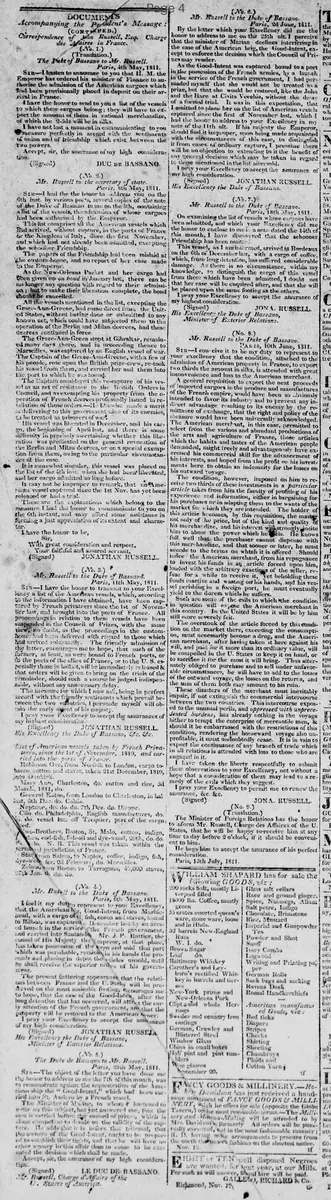
(Continued.)
Correspondence of Jonathan Russell, Esq.
Charge d'Affaires in France.
(No. 1.)
(Translation.)
The Duke of Bassano to Mr. Russell.
Paris, 8th May, 1811.
SIR,--I hasten to announce to you that H. M. the Emperor has ordered his minister of Finance to authorise the admission of the American cargoes which had been provisionally placed in deposit on their arrival in France.
I have the honor to send to you a list of the vessels to which these cargoes belong; they will have to export the amount of them in national merchandise, of which the goods will be in silks.
I have not lost a moment in communicating to you this measure perfectly in accord with the sentiments of union and of friendship which exist between the two powers.
Accept, sir, the assurance of my high consideration.
(Signed)
DUC DE BASSANO.
(No. 2.)
Mr. Russell to the Secretary of State.
Paris, 8th May, 1811.
SIR,--I had the honor to address you on the 6th inst. by various ports, several copies of the note of the Duke of Bassano to me on the 4th, containing a list of the vessels, the admission of whose cargoes had been authorised by the Emperor.
This list comprises all the American vessels which had arrived, without capture, in the ports of France or the Kingdom of Italy, since the first November, and which had not already been admitted, excepting the schooner Friendship.
The papers of the Friendship had been mislaid at the custom-house, and no report of her case made to the Emperor.
As the New-Orleans Packet and her cargo had been given up on bond in January last, there can be no longer any question with regard to their admission; but to make their liberation complete, the bond should be cancelled.
All the vessels mentioned in the list, excepting the Grace-Ann-Greene, had come direct from the United States, without having done or submitted to any known act, which could have subjected them to the operation of the Berlin and Milan decrees, had these decrees continued in force.
The Grace-Ann-Greene stopped at Gibraltar, remained many days there, and in proceeding thence to Marseilles, was captured by an English vessel of war.
The Captain of the Grace-Ann-Greene, with a few of his people, rose upon the British prize-crew, re-took his vessel from them, and carried her and them into the port to which he was bound.
The Captain considered this re-capture of his vessel as an act of resistance to the British Orders in Council, and as exempting his property from the operation of French decrees professedly issued in retaliation of those orders. He likewise made a merit of delivering to this government nine of its enemies, to be treated as prisoners of war.
His vessel was liberated in December, and his cargo, the beginning of April last, and there is some difficulty in precisely ascertaining whether this liberation was predicated on the general revocation of the Berlin and Milan decrees, or on a special exemption from them, owing to the particular circumstances of the case.
It is somewhat singular, this vessel was placed on the list of the 4th inst. when she had been liberated, and her cargo admitted so long before.
I may not be improper to remark, that no American vessel captured since the 1st Nov. has yet been released or had a trial.
These are the explanations which belong to the measure I had the honor to communicate to you on the 6th instant, and may afford some assistance in forming a just appreciation of its extent and character.
I have the honor to be,
Sir,
With great consideration and respect,
Your faithful and assured servant,
(Signed)
JONATHAN RUSSELL.
(No. 3.)
Mr. Russell to the Duke of Bassano.
Paris, 11th May, 1811.
SIR,--I have the honor to transmit to your Excellency a list of the American vessels, which, according to the information I have obtained, have been captured by French privateers since the 1st of November last, and brought into the ports of France. All proceedings in relation to these vessels have been suspended in the Council of Prizes, with the same view, no doubt, as the proceedings in the custom-house had been deferred with regard to those which had arrived voluntarily. The friendly admission of the latter, encourages me to hope, that such of the former, at least, as were bound to French ports, or to the ports of the allies of France, or to the U. S. especially those in ballast, will be immediately released & that orders will be given to bring on the trials of the remainder, should such a course be judged indispensable, without any unnecessary delay.
The measure for which I now ask, being in perfect accord with the friendly sentiments which prevail between the two countries, I persuade myself will obtain the early assent of his majesty.
I pray your Excellency to accept the assurances of my highest consideration.
(Signed)
JONATHAN RUSSELL.
His Excellency the Duke of Bassano, &c. &c.
List of American vessels taken by French Privateers, since the 1st of November, 1810, and carried into the ports of France.
Robinson, from Norfolk to London, cargo tobacco cotton and staves, taken 21st December, 1810, into Dunkirk.
Mary Ann, Charleston, do. cotton and rice, 3d March, 1811, do.
General Eaton, from London to Charleston, in ballast, 8th Dec. do. Calais.
Neptune, do. do. do. 7th Dec. do. Dieppe.
Clio do. Philadelphia, English manufactures, do. o. the vessel lost off Treguier, part of the cargo saved.
Two Brothers, Boston, St. Malo, cotton, indigo, bees, cod-fish, fish-oil and dye-wood, 20th, do. do.
N. B. This vessel was taken within the territorial jurisdiction of France.
Star from Salem, to Naples, coffee, indigo, fish, dye-wood, &c. 6th February, do. Marseilles.
Zelma, from Boston to Tarragona, 40,000 staves, 27th Jan. do. do.
(No. 4.)
Mr. Russell to the Duke of Bassano.
Paris, 6th May, 1811.
I feel it my duty to represent to your Excellency, that the American brig, Good-Intent, from Marblehead, with a cargo of fish, cocoa and staves, bound to Bilboa, was captured December last by an armed launch in the service of the French government, and carried into Santander.
Mr. J. P. Rattiere, the consul of His Majesty the emperor, at that place, has taken possession of the cargo and sold that part which was perishable, retaining in his hands the proceeds and placing in depot the articles unsold, until he shall receive the superior orders of his government.
The present flattering appearance that the relations between France and the U. States will be preserved on the most amicable footing, encourages me to hope, that the case of the Good-Intent, after the long detention that has occurred, will attract the early attention of the French government, and that the property will be restored to the American owner.
I pray your Excellency to accept the assurances of my high consideration.
(Signed)
JONATHAN RUSSELL.
His Excellency the Duke of Bassano,
Minister of Exterior Relations.
(No. 5.)
The Duke de Bassano to Mr. Russell.
Paris, 25th May, 1811.
SIR,--The object of the letter you have done me the honor to address to me the 7th of this month, was to remonstrate against the sequestration of the American ship the "Good-Intent," which had been carried into St. Andero by a French vessel.
The Minister of Marine, to whom I hastened to write on this subject, has just answered me, that the case is carried before the council of prizes, which is alone competent to decide on the validity of the capture. He adds that it is before that tribunal, that the owners of the Good-Intent, ought to be prepared to establish their rights, and that he will have no other agency in this affair than to cause to be executed the decision which shall be made.
Accept, sir, the assurance of my high consideration.
(Signed)
LE DUC DE BASSANO.
Mr. Russell, Charge d'Affaires of the U. States of America.
Mr. Russell to the Duke of Bassano.
Paris, 2d June, 1811.
By the letter which your Excellency did me the honor to address to me on the 25th ult. I perceive that the minister of Marine declines interfering in the case of the American brig, the Good-Intent, except to enforce the decision which the Council of Prizes may render.
As the Good-Intent was captured bound to a port in the possession of the French armies, by a launch in the service of the French government, I had persuaded myself that she would not be treated as a prize, but that she would be restored, like the John and the Hare at Civita Vecchia, without the delay of a formal trial. It was in this expectation, that I omitted to place her on the list of American vessels captured since the first of November last, which I had the honor to address to your Excellency in my note of the 11th ult. If his majesty the Emperor should find it improper, upon being made acquainted with the circumstances of this case, to distinguish it from cases of ordinary capture, I presume there will be no objection to extending to it the benefit of any general decision which may be taken in regard to those mentioned in the list aforesaid.
I pray your Excellency to accept the assurance of my high consideration.
(Signed)
JONATHAN RUSSELL.
His Excellency the Duke of Bassano.
(No. 7.)
Mr. Russell to the Duke of Bassano.
Paris, 18th May, 1811.
On examining the list of vessels whose cargoes have been admitted, and which your Excellency did me the honor to enclose to me in a note dated the 4th of this month, I have discovered that the schooner Friendship has been omitted.
This vessel, as I am informed, arrived at Bordeaux on the 6th of December last, with a cargo of coffee, which, from long detention, has suffered considerable damage. As there is no circumstance, within my knowledge, to distinguish the cargo of this vessel from those which have been admitted, I doubt not that her case will be enquired after, and that she will be placed upon the same footing as the others.
I pray your Excellency to accept the assurances of my highest consideration.
(Signed)
JONA. RUSSELL.
His Excellency the Duke of Bassano,
Minister of Exterior Relations.
(No. 8.)
Mr. Russell to the Duke of Bassano.
Paris, 10th June, 1811.
Sir,--I conceive it to be my duty to represent to your excellency that the condition, attached to the admission of American property in France, to export two thirds the amount in silks, is attended with great inconvenience and loss to the American merchant.
A general requisition to export the neat proceeds of imported cargoes in the produce and manufactures of the French empire, would have been so obviously intended to favor its industry and to prevent any indirect advantage resulting to its enemy by the remittance of exchange, that the right and policy of the measure would have been universally acknowledged.
The American merchant, in this case, permitted to select from the various and abundant productions of the arts and agriculture of France, those articles which the habits and tastes of the American people demanded, might freely and advantageously have exercised his commercial skill for the advancement of his interests, and hoped from the profit on his investments here to obtain an indemnity for the losses on his outward voyage.
The condition, however, imposed on him to receive two thirds of these investments in a particular article takes from him the faculty of profiting of his experience and information, either in bargaining for his purchases or in adapting them to the wants of the market for which they are intended. The holder of this article becomes, by this requisition, the master not only of the price, but of the kind and quality of his merchandise, and his interest will strongly incite him to abuse the power which he holds. He knows full well that the purchaser cannot dispense with this merchandise, and that sooner or later, he must accede to the terms on which it is offered. Should indeed the American merchant, from his repugnance to invest his funds in an article forced upon him, loaded with the arbitrary exactions of the seller, refuse for a while to receive it, yet beholding these funds inactive and wasting on his hands, and his vessel perishing in a foreign port, he must eventually yield to the duress which he suffers.
Such are some of the evils to which the condition in question will expose the American merchant in this country. In the United States it will be by him still more severely felt.
The overstock of the article forced by this condition on the market there, exceeding the consumption, must necessarily become a drug, and the American merchant, after having taken it here against his will, and paid for it more than its ordinary value, will be compelled in the U. States to keep it on hand, or to sacrifice it for the most it will bring. Thus alternately obliged to purchase and to sell under unfavorable circumstances, he will have to add to the losses of the outward voyage, the losses on the returns, and the sum of them both may amount to his ruin.
These disasters of the merchant must inevitably impair, if not extinguish the commercial intercourse between the two countries. This intercourse exposed to the unusual perils, and oppressed with unprecedented burdens, has already nothing in the voyage hither to tempt the enterprise of mercantile men, & should it be embarrassed with the restrictions of this condition, rendering the homeward voyage also unprofitable, it must undoubtedly cease. It is in vain to expect the continuance of any branch of trade which in all relations is attended with loss to those who are engaged in it.
I have taken the liberty respectfully to submit these observations to your Excellency, not without a hope that a consideration of them may lead to a remedy of the evils which they suggest.
I pray your Excellency to permit me to renew the assurance, &c. &c.
(Signed)
JONA. RUSSELL.
(No. 9.)
(Translation.)
The Minister of Foreign Relations has the honor to inform Mr. Russell, Charge d'Affaires of the U. States, that he will be happy to receive him at any time to day before 2 o'clock, if it should be convenient to him.
He begs him to accept the assurance of his perfect consideration.
Paris, 13th July, 1811.
What sub-type of article is it?
What keywords are associated?
What entities or persons were involved?
Where did it happen?
Foreign News Details
Primary Location
Paris
Event Date
May July 1811
Key Persons
Outcome
admission authorized for american cargoes in french ports with condition to export two-thirds in silks; lists of captured vessels provided; specific cases like good-intent referred to council of prizes; friendship omitted but expected to be admitted; objections raised to silk export condition.
Event Details
Series of letters detailing Emperor's order to admit American cargoes arrived since November 1810, excluding captures; explanations of vessel cases including Grace-Ann-Greene's recapture from British; list of nine American vessels captured by French privateers since November 1810; requests for release of captured ships; case of Good-Intent captured by French launch; inquiry about omitted Friendship; complaint about mandatory silk exports causing losses to American merchants.