Thank you for visiting SNEWPapers!
Sign up free
Middletown Transcript
Middletown, New Castle County, Delaware
What is this article about?
Synopsis of a mystery novel involving Judge Ostrander, widow Deborah Scoville seeking to exonerate her executed husband John for murdering Algernon Etheridge, suspicions against the judge's son Oliver, and revelations of John's prior crime at Spencer's Folly. Continued chapters detail Oliver's written confession of witnessing the earlier murder, Deborah's changing views on innocence, and a confrontation with a vengeful man accusing Oliver.
Merged-components note: Merged image with the literary story 'Dark Hollow' due to spatial overlap in bounding boxes and contextual relevance as an illustration within the story's area.
Clipping
OCR Quality
Full Text
A curious crowd of neighbors invade the mysterious home of Judge Ostrander, county judge and eccentric recluse, following a veiled woman who proves to be the widow of a man tried before the judge and electrocuted for murder years before. Her daughter is engaged to the judge's son, from whom he is estranged, but the murder is between the lovers. She plans to clear her husband's memory and asks the judge's aid. Deborah Scoville reads the newspaper clippings telling the story of the murder of Algernon Etheridge by John Scoville in Dark Hollow, twelve years before. The judge and Mrs. Scoville meet at Spencer's Folly and she shows him how, on the day of the murder, she saw the shadow of a man, whittling a stick and wearing a long peaked cap. The judge engages her and her daughter Reuther to live with him in his mysterious home. Deborah and her lawyer, Black, go to the police station and see the stick used to murder Etheridge. She discovers a broken knife-blade point embedded in it. Deborah and Reuther go to live with the judge. Deborah sees a portrait of Oliver, the judge's son, with a black band painted across the eyes. That night she finds, in Oliver's room, a cap with a peak like the shadowed one, and a knife with a broken blade-point. Anonymous letters and a talk with Miss Weeks increase her suspicions and fears. She finds that Oliver was in the ravine on the murder night. Black warns her and shows her other anonymous letters hinting at Oliver's guilt. In the court room the judge is handed an anonymous note. The note is picked up and read aloud. A mob follows the judge to his home. Deborah tells him why suspicion has been aroused against Oliver. The judge shows Deborah a statement written by Oliver years ago telling how he saw her husband murder Spencer at Spencer's Folly on the night the house was burned.
CHAPTER XIII—Continued.
Claymore tavern did change owners. When I heard that a man by the name of Scoville had bought it, I went over to see Scoville. He was the man. Then I began to ask myself what I ought to do with my knowledge, and the more I asked myself this question and the more I brooded over the matter the less did I feel like taking, not the public, but my father, into my confidence.
I had never doubted his love for me, but I had always stood in great awe of his reproof, and I did not know where I was to find courage to tell him all the details of this adventure. There is one thing I did do, however. I made certain inquiries here and there, and soon satisfied myself as to how Scoville had been able to come into town, commit this horrid deed and escape without any one but myself being the wiser. Spencer and he had come from the West en route to New York without any intention of stopping off in Shelby. But once involved in play they had got so interested that when within a few miles of the town, Spencer proposed that they should leave the train and finish the game in his own house. Whether circumstances aided them, or Spencer took some extraordinary precautions against being recognized, will never be known. But certain it is that he escaped all observation at the station and even upon the road. When Scoville returned alone, the storm had reached such a height that the roads were deserted, and he, being an entire stranger here at that time, naturally attracted no attention, and so was able to slip away on the next train with just the drawback of buying a new ticket. I, a boy of fifteen, trespassing where I did not belong, was the only living witness of what had happened on this night of dreadful storm, in the house which was now a ruin.
I realized the unpleasantness of the position in which this put me, but not its responsibility. If I were going to do anything I should have done it at first—so I reasoned, and let the matter slide. I became interested in school and study, and the years passed and I had almost forgotten the occurrence, when suddenly the full remembrance came back upon me with a rush. A man—my father's friend—was found murdered in sight of this spot of old-time horror, and Scoville was accused of the act.
I was older now and saw my fault in all its enormity. I was guilty of that crime—or so I felt in the first heat of my sorrow and despair. I may even have said so—in dreams or in some of my self-absorbed broodings. Though I certainly had not lifted the stick against Mr. Etheridge, I had left the hand free which did, and this was a sufficient occasion for remorse—or so I truly felt.
I was so affected by the thought that even my father, with his own weight of troubles, noticed my careworn face and asked me for an explanation. But I held him off until the verdict was reached, and then I told him. I had not liked his looks for some time; they seemed to convey some doubt of the justice of this man's sentence, and I felt that if he had such doubts, they might be eased by this certainty of Scoville's murderous tendencies and unquestionable greed.
And they were; but as Scoville was already doomed, we decided that it was unnecessary to make public his past offenses. However, with an eye upon future contingencies, my father exacted from me in writing this full account of my adventure, which with all the solemnity of an oath I here declare to be the true story of what befell me in the house called Spencer's Folly, on the night of awful storm September 11, 1895.
OLIVER OSTRANDER.
Witnesses to above signature,
ARCHIBALD OSTRANDER
BELA JEFFERSON.
Shelby, November 7, 1898.
CHAPTER XIV.
The Telegram.
This was the document and these the words which Deborah, widow of the man thus doubly denounced, had been given to read by the father of the writer, in the darkened room which had been and still was to her, an abode of brooding thought and unfathomable mystery.
No wonder that during its reading more than one exclamation of terror and dismay escaped her. There were so many reasons for believing this record to be an absolute relation of the truth.
Incoherent phrases which had fallen from those long-closed lips took on new meaning with this unveiling of an unknown past. Repugnances for which she could not account in those old days, she now saw explained. He would never, even in passing, give a look at the ruin on the bluff, so attractive to every eye but his own. As for entering its gates—she had never dared so much as to ask him to do so.
Then the watch! Deborah knew well that watch. She had often asked him by what stroke of luck he had got so fine a timepiece. God! was her mind veering back to her old idea as to his responsibility for the crime committed in Dark Hollow? Yes; she could not help it. Denial from a monster like this—a man who with such memories and such spoil, could return home to wife and child, with some gay and confused story of a great stroke in speculation which had brought him in the price of the tavern it had long been his ambition to own—what was denial from such lips worth? The judge was right. Oliver—whose ingenuous story had restored his image to her mind, with some of its old graces—had been the victim of circumstances and not John Scoville.
Her thoughts had reached this stage and her hand, in obedience to the new mood, was lightly ruffling up the pages before her, when she felt a light touch on her shoulder and turned with a start.
The judge was at her back. How long he had stood there she did not know, nor did he say, but when upon feeling his hand upon her shoulder she turned, he was there; and while his lips failed to speak, his eyes were eloquent and their question single and imperative.
"What do you think of him now?" they seemed to ask, and rising to her feet, she met him with a smile, ghastly perhaps with the lividness of the shadows through which she had been groping, but encouraging withal and soothing beyond measure to his anxious and harassed soul.
"Oliver is innocent," she declared, turning once more to lay her hand upon the sheets containing his naive confession.
"The dastard who could shoot his host for plunder is capable of a second crime holding out a similar inducement. Nothing now will ever make me connect Oliver with the crime at the bridge. As you said, he was simply near enough the hollow to toss into it the stick he had been whittling. I am his advocate from this minute."
Her eyes were still resting mechanically upon that last page lying spread out before her, and she did not observe in its full glory the first gleam of triumphant joy which, in all probability, Judge Ostrander's countenance had shown in years. Nor did he see, in the glad confusion of the moment, the quick shudder with which she lifted her trembling hand away from those papers and looked up, squarely at last, into his transfigured visage.
"Mrs. Scoville, I love my boy. I— what's that?"
The front doorbell was ringing.
In a flash Deborah was out of the room.
When the judge at last came forth, it was at Reuther's bidding. A gentleman wished to see him in the parlor. With a dark glance, not directed against her, however, the judge bade her run away to the kitchen and as far from all these troubles as she could, then, locking his door behind him, as he always did, he strode towards the front.
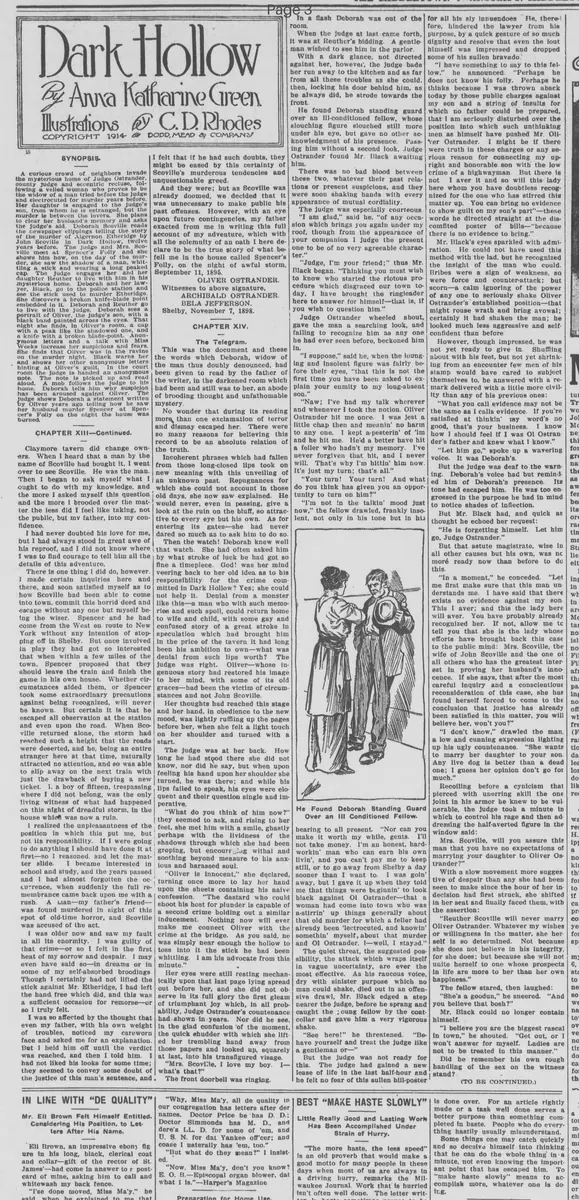
He found Deborah standing guard over an ill-conditioned fellow, whose slouching figure slouched still more under his eye, but gave no other acknowledgment of his presence. Passing him without a second look, Judge Ostrander found Mr. Black awaiting him.
There was no bad blood between these two, whatever their past relations or present suspicions, and they were soon shaking hands with every appearance of mutual cordiality.
The judge was especially courteous.
"I am glad," said he, "of any occasion which brings you again under my roof, though from the appearance of your companion I judge the present one to be of no very agreeable character."
"Judge, I'm your friend;" thus Mr. Black began. "Thinking you must wish to know who started the riotous procedure which disgraced our town today, I have brought the ringleader here to answer for himself—that is, if you wish to question him."
Judge Ostrander wheeled about, gave the man a searching look, and failing to recognize him as any one he had ever seen before, beckoned him in.
"I suppose," said he, when the lounging and insolent figure was fairly before their eyes, "that this is not the first time you have been asked to explain your enmity to my long-absent son."
"Naw; I've had my talk wherever and whenever I took the potion. Oliver Ostrander hit me once. I was jest a little chap then and meanin' no harm to any one. I kept a-pesterin' of 'im and he hit me. He'd a better have hit a feller who hadn't my memory. I've never forgiven that hit, and I never will. That's why I'm hittin' him now. It's just my turn; that's all."
"Your turn! Your turn! And what do you think has given you an opportunity to turn on him?"
"I'm not in the talkin' mood just now," the fellow drawled, frankly insolent, not only in his tone but in his bearing to all present. "Nor can you make it worth my while, gents. I'll not take money. I'm an honest, hard, workin' man who can earn his own livin', and you can't pay me to keep still, or to go away from Shelby a day sooner than I want to. I was goin' away, but I gave it up when they told me that things were beginning to look black against Ol Ostrander—that a woman had come into town who was a-stirrin' up things generally about that old murder for which a feller had already been 'lectrocuted, and knowin' somethin' myself, about that murder and Ol Ostrander, I—well, I stayed."
The quiet threat, the suggested possibility, the attack which wraps itself in vague uncertainty, are ever the most effective. As his raucous voice, dry with sinister purpose which no man could shake, died out in an offensive drawl, Mr. Black edged a step nearer the judge, before he sprang and caught the young fellow by the coat-collar and gave him a very vigorous shake.
"See here!" he threatened. "Behave yourself and treat the judge like a gentleman or—"
But the judge was not ready for this.
The judge had gained a new lease of life in the last half-hour and he felt no fear of this sullen bill-poster.
"He Found Deborah Standing Guard Over an Ill-Conditioned Fellow."
for all his sly innuendoes. He, therefore, hindered the lawyer from his purpose, by a quick gesture of so much dignity and resolve that even the lout himself was impressed and dropped some of his sullen bravado.
"I have something to say to this fellow," he announced. "Perhaps he does not know his folly. Perhaps he thinks because I was thrown aback today by those public charges against my son and a string of insults for which no father could be prepared, that I am seriously disturbed over the position into which such unthinking men as himself have pushed Mr. Oliver Ostrander. I might be if there were truth in these charges or any serious reason for connecting my upright and honorable son with the low crime of a highwayman. But there is not! I aver it and so will this lady here whom you have doubtless recognized for the one who has stirred this matter up. You can bring no evidence to show guilt on my son's part"—these words he directed straight at the discomfited poster of bills—"because there is no evidence to bring."
Mr. Black's eyes sparkled with admiration. He could not have used this method with the lad, but he recognized the insight of the man who could. Bribes were a sign of weakness, so were force and counter-attack; but scorn—a calm ignoring of the power of any one to seriously shake Oliver Ostrander's established position—that might rouse wrath and bring avowal; certainly it had shaken the man; he looked much less aggressive and self-confident than before.
However, though impressed, he was not yet ready to give in. Shuffling about with his feet, but not yet shrinking from an encounter few men of his stamp would have cared to subject themselves to, he answered with a remark delivered with a little more civility than any of his previous ones:
"What you call evidence may not be the same as I calls evidence. If you're satisfied at thinkin' my word's no good, that's your business. I know how I should feel if I was Ol Ostrander's father and knew what I know."
"Let him go," spoke up a wavering voice. It was Deborah's.
But the judge was deaf to the warning. Deborah's voice had but reminded him of Deborah's presence. Its tone had escaped him. He was too engrossed in the purpose he had in mind to notice shades of inflection.
But Mr. Black had, and quick as thought he echoed her request:
"He is forgetting himself. Let him go, Judge Ostrander."
But that astute magistrate, wise in all other causes but his own, was no more ready now than before to do this.
"In a moment," he conceded. "Let me first make sure that this man understands me. I have said that there exists no evidence against my son. This I aver; and this the lady here will aver. You have probably already recognized her. If not, allow me to tell you that she is the lady whose efforts have brought back this case to the public mind: Mrs. Scoville, the wife of John Scoville and the one of all others who has the greatest interest in proving her husband's innocence. If she says, that after the most careful inquiry and a conscientious reconsideration of this case, she has found herself forced to come to the conclusion that justice has already been satisfied in this matter, you will believe her, won't you?"
"I don't know," drawled the man a low and cunning expression lighting up his ugly countenance. "She wants to marry her daughter to your son. Any live dog is better than a dead one; I guess her opinion don't go for much."
Recoiling before a cynicism that pierced with unerring skill the one joint in his armor he knew to be vulnerable, the judge took a minute in which to control his rage and then addressing the half-averted figure in the window said:
Mrs. Scoville, will you assure this man that you have no expectations of marrying your daughter to Oliver Ostrander?
With a slow movement more suggestive of despair than any she had been seen to make since the hour of her indecision had first struck, she shifted in her seat and finally faced them, with the assertion:
"Reuther Scoville will never marry Oliver Ostrander. Whatever my wishes or willingness in the matter, she herself is so determined. Not because she does not believe in his integrity for she does; but because she will not unite herself to one whose prospects in life are more to her than her own happiness."
The fellow stared, then laughed:
"She's a goodun," he sneered. "And you believe that bosh?"
Mr. Black could no longer contain himself.
"I believe you are the biggest rascal in town," he shouted. "Get out, or I won't answer for myself. Ladies are not to be treated in this manner."
Did he remember his own rough handling of the sex on the witness stand?
(TO BE CONTINUED.)
What sub-type of article is it?
What themes does it cover?
What keywords are associated?
Literary Details
Title
Chapter Xiii—Continued And Chapter Xiv: The Telegram
Key Lines