Thank you for visiting SNEWPapers!
Sign up free
Rhode Island Republican
Newport, Newport County, Rhode Island
What is this article about?
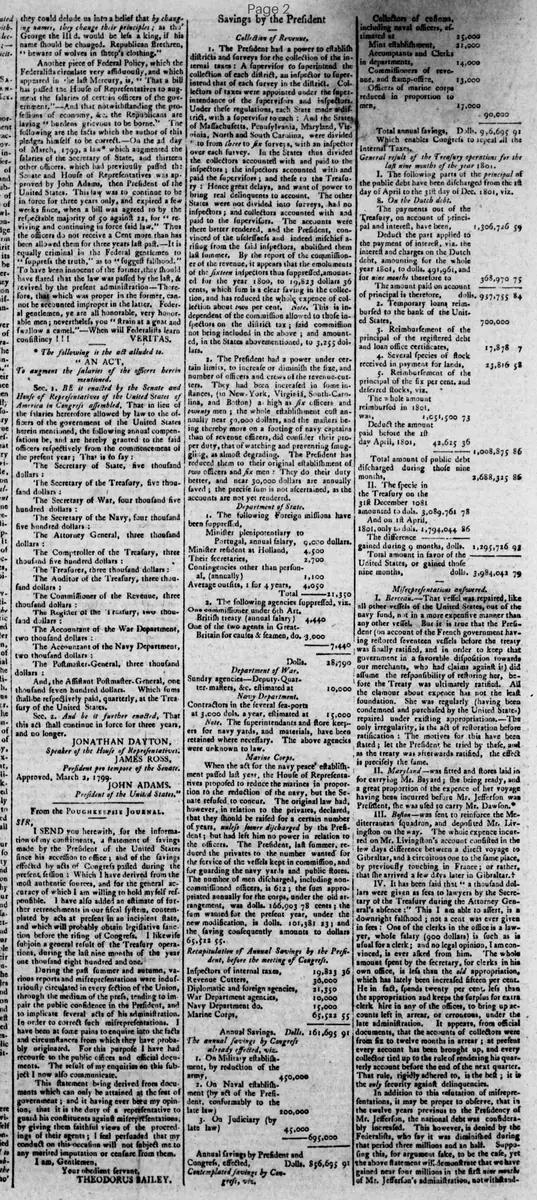
Theodorus Bailey writes to inform constituents of financial savings achieved by President Jefferson and Congress in 1801, including reductions in tax collection, diplomatic missions, military, and navy expenses totaling nearly $947,000 annually. He refutes Federalist press misrepresentations about specific expenditures like the Berceau, Maryland, and Boston ships, emphasizing improved public finances under Jefferson.
Merged-components note: This is a continuation of the letter from Theodorus Bailey across pages 2 and 3; the second part was incorrectly labeled as 'story' but belongs to the same letter_to_editor component.
Clippings
1 of 2
OCR Quality
Full Text
SIR,
I SEND you herewith, for the information of my constituents, a statement of savings made by the President of the United States since his accession to office: and of the savings effected by acts of Congress passed during the present session: Which I have derived from the most authentic sources, and for the general accuracy of which I am willing to hold myself responsible. I have also added an estimate of further retrenchments in our fiscal system, contemplated by acts at present in an incipient state, and which will probably obtain legislative sanction before the rising of Congress. I likewise subjoin a general result of the Treasury operations, during the last nine months of the year one thousand eight hundred and one.
During the past summer and autumn, various reports and misrepresentations were industriously circulated in every section of the Union, through the medium of the press, tending to impair the public confidence in the President, and so implicate several acts of his administration. In order to correct such misrepresentations, I have been at some pains to enquire into the facts and circumstances from which they have probably originated. For this purpose I have had recourse to the public offices and official documents. The result of my enquiries on this subject I now also communicate.
This statement being derived from documents which can only be attained at the seat of government; and it having ever been my opinion, that it is the duty of a representative to guard his constituents against misrepresentations, by giving them faithful views of the proceedings of their agents; I feel persuaded that my conduct on this occasion will not subject me to any merited imputation or censure from them.
I am, Gentlemen,
Your obedient servant,
THEODORUS BAILEY.
Savings by the President
Collection of Revenue.
I. The President had a power to establish districts and surveys for the collection of the internal taxes: A supervisor to superintend the collection of each district, an inspector to superintend that of each survey in the district. Collectors of taxes were appointed under the superintendence of the supervisors and inspectors. Under these regulations, each State made a district, with a Supervisor to each: And the States of Massachusetts, Pennsylvania, Maryland, Virginia, North and South Carolina, were divided into from three to six surveys, with an inspector over each survey. In the States thus divided the collectors accounted with and paid to the inspectors; the inspectors accounted with and paid the supervisors; and these to the Treasury: Hence great delays, and want of power to bring real delinquents to account. The other States were not divided into surveys, had no inspectors; and collectors accounted with and paid to the supervisors. The accounts were there better rendered, and the President, convinced of the uselessness and indeed mischief arising from the said inspectors, abolished them last summer. By the report of the commissioner of the revenue, it appears that the emoluments of the sixteen inspectors thus suppressed, amounted for the year 1800, to 19,823 dollars 36 cents, which sum is a clear saving in the collection, and has reduced the whole expense of collection about two per cent. Note. This is independent of the commission allowed to those inspectors on the direct tax: said commission not being included in the above; and amounted, in the States abovementioned, to 3,255 dollars.
2. The President had a power under certain limits, to increase or diminish the size, and number of officers and crews of the revenue-cutters. They had been increased in some instances, (in New-York, Virginia, South-Carolina, and Boston) as high as six officers and twenty men: the whole establishment cost annually near 50,000 dollars, and the masters being thereby more on a footing of navy captains than of revenue officers, did consider their proper duty, that of watching and preventing smuggling, as almost degrading. The President has reduced them to their original establishment of two officers and six men: They do their duty better, and near 30,000 dollars are annually saved; the precise sum is not ascertained, as the accounts are not yet rendered.
Department of State
I. The following Foreign missions have been suppressed,
Minister plenipotentiary to Portugal, annual salary, 9,000 dollars.
Minister resident at Holland, 4,500
Their secretaries, 2,700
Contingencies other than personal, (annually) 1,100
Average outfits, 1 for 4 years, 4,050
Total 21,350
2. The following agencies suppressed, viz.
One commissioner under 6th Art. British treaty (annual salary) 4,440
One of the two agents in Great-Britain for causes & seamen, do. 3,000
7,440
Dols. 28,790
Department of War.
Sundry agencies—Deputy. Quarter-masters, &c. estimated at 10,000
Navy Department.
Contractors in the several sea-ports at 3,000 dols. a year, estimated at 15,000
Note. The superintendents and store keepers for navy yards, and materials, have been retained where necessary. The above agencies were unknown to law.
Marine Corps.
When the act for the navy peace' establishment passed last year, the House of Representatives proposed to reduce the marines in proportion to the reduction of the navy, but the Senate refused to concur. The original law had, however, in relation to the privates, declared, that they should be raised for a certain number of years, unless sooner discharged by the President; but had left him no power in relation to the officers. The President, last summer, reduced the privates to the number wanted for the service of the vessels kept in commission, and for guarding the navy yards and public stores. The number of men discharged, including non-commissioned officers, is 662; the sum appropriated annually for the corps, under the old arrangement, was dolls. 166,903 78 cents; the sum wanted for the present year, under the new modification, is dolls. 101,381 23; and the saving consequently amounts to dollars 65,522 55.
Recapitulation of Annual Savings by the President, before the meeting of Congress.
Inspectors of internal taxes, 19,823 36
Revenue Cutters, 30,000
Diplomatic and foreign agencies, 21,350
War Department agencies, 10,000
Navy Department do. 15,000
Marine Corps, 65,522 55
Annual Savings.
Dolls. 161,695 91
The annual savings by Congress already effected, viz.
1. On Military establishment, by reduction of the army, 450,000
2. On Naval establishment (by act of the President, conformably to the late law) 200,000
3. On Judiciary (by late law) 45,000
695,000
Annual savings by President and Congress, effected,
Dollars. 856,695 91
Contemplated savings by Congress, viz.
Collection of customs, including naval officers, estimated at 25,000
Mint establishment. 21,000
Accountants and Clerks in departments, 14,000
Commissioners of revenue, and stamp-office, 13,000
Officers of marine corps reduced in proportion to men, 17,000
90,000
Total annual savings,
Dolls. 946,695 91
Which enables Congress to repeal still the Internal Taxes,
General result of the Treasury operations for the last nine months of the year 1801.
I. The following parts of the principal of the public debt have been discharged from the 1st day of April to the 31st day of Dec. 1801, viz.
1. On the Dutch debt,
The payments out of the Treasury, on account of principal and interest, have been, 1,306,726 59
Deduct the part applied to the payment of interest, viz. the interest and charges on the Dutch debt, amounting for the whole year 1801, to dolls. 491,961, and for six months therefore to 368,970 75
The amount paid on account of principal is therefore, dolls. 937,755 84
2. Temporary loans reimbursed to the bank of the United States, 700,000
3. Reimbursement of the principal of the registered debt and loan office certificates, 17,878
4. Several species of stock received in payment for lands, 33,816 51
5. Reimbursement of the principal of the six per cent, and Deferred stocks, viz.
The whole amount reimbursed in 1801, was, 1,051,500 73
Deduct the amount paid before the 1st day April, 1801, 42,625 36
1,008,875 36
Total amount of public debt discharged, during those nine months, 2,688,335 86
II. The specie in the Treasury on the 31st December 1801 amounted to dolls. 3,089,761 78
And on 1st April, 1801, only dolls. 1,794,044 86
The difference, gained during 9 months; dolls. 1,295,726 92
Total amount in favor of the United States, or gained those nine months,
dolls. 3,984,062 78
Misrepresentations answered.
I. Berceau.—That vessel was repaired, like all other vessels of the United States, out of the navy fund, not in a more expensive manner than any other vessel. But it is true that the President (on account of the French government having restored seventeen vessels before the treaty was finally ratified, and in order to keep that government in a favorable disposition towards our merchants, who had claims against it) did assume the responsibility of restoring her, before the Treaty was ultimately ratified. All the clamour about expense has not the least foundation. She was regularly (having been condemned and purchased by the United States) repaired under existing appropriations.—The only irregularity, is the act of restoration before ratification: The motives for this have been stated; let the President be tried by these, and as the treaty was afterwards ratified, the effect is precisely the same.
II. Maryland—was fitted and stores laid in for carrying Mr. Bayard; She being ready, and a great proportion of the expense of her voyage having been incurred before Mr. Jefferson was President, she was used to carry Mr. Dawson.
III. Boston—was sent to reinforce the Mediterranean squadron, and deposited Mr. Livingston on the way. The whole expense incurred on Mr. Livingston's account consisted in the few days difference between a direct voyage to Gibraltar, and a circuitous one to the same place, by previously touching in France: or rather, that she arrived a few days later in Gibraltar.
IV. It has been said that "a thousand dollars were given as fees to lawyers by the Secretary of the Treasury during the Attorney General's absence:" This I am able to assert, is a downright falsehood: not a cent was ever given in fees: One of the clerks in the office is a lawyer, whose salary (900 dollars) is such as is usual for a clerk.: and no legal opinion, I am convinced, is ever asked from him. The whole amount spent by the secretary, for clerks in his own office, is less than the old appropriation, which has lately been increased fifteen per cent. He in fact, spends twenty per cent. less than the appropriation and keeps the surplus for extra clerk hire in any of the offices, to bring up accounts left in arrear, or erroneous, under the late administration. It appears, from official documents, that the accounts of collectors were from six to twelve months in arrear: at present every account has been brought up, and every collector tied up to the rule of rendering his quarterly account before the end of the next quarter. That rule, rigidly adhered to, is the best; it is the only security against delinquencies.
In addition to this refutation of misrepresentations, it may be proper to observe, that in the twelve years previous to the Presidency of Mr. Jefferson, the national debt was considerably increased. This however, is denied by the Federalists, who say it was diminished during that period three millions and a half. Supposing this, for argument sake, to be the case, yet the above statement will demonstrate that we have gained near four millions in the first nine months of Mr. Jefferson's administration, notwithstanding.
Regarding the payments on the deferred debt which exceed one million one hundred thousand dollars a year, only commenced on the first of January. So this additional burden has not been attended to in the comparative view of the economy of the two administrations. And to show that public credit has been appreciated under Mr. Jefferson's administration, in consequence of his wise and salutary arrangements, it will be sufficient to mention this decisive fact: Under Mr. Adams the public debt was never at par; 6 per cent. stock in '98 was as low as 14s. 8d. in the pound; it has been raised to par under Mr. Jefferson.
The following gross misrepresentations are copied from Russell's Boston Centinel:
"A letter from Washington, dated January 23d, among other evidences of the economical arrangements of the present administration, exhibits the following, viz. $20,800 dols. expended on the mission of Mr. Dawson, at $6 dolls. per day, and rations, and a sloop of war to carry him; when the message, as has been practised, might as well have been sent by the captain of a private ship to Mr. Murray: $60,000 dollars expenses of the Boston frigate, to carry Mr. Livingston to France: $1000 dollars extra pay to an attorney for advice to Mr. Gallatin, in the absence of the attorney general" &c. &c.
NOTES.
* Mr. Dawson had no allowance of rations. He partook of the ship's stores already laid in; nor was there an additional cent of disbursement of this kind for his special accommodation. Indeed none such could have been useful or necessary, as the provisions made by Mr. Adams was truly bountiful. Thus it happens that the $20,800 dolls. expended on this mission was a federal measure altogether, and intended, not for the accommodation of Mr. Dawson but for that of Mr. Bayard, whom Mr. Adams had wisely destined to be the bearer of the treaty.
+ $60,000 dollars are said to have been expended on the Boston, to accommodate Mr. Livingston with a passage to France. In this there is not a syllable of truth. The Boston was fitted out for a cruise, and destined for the Mediterranean station, and on her way thither took Mr. Livingston to L'Orient. Even her cabin was unaltered, as she had been previously employed in bringing Gov. Davie and Mr. Swift from France, by order of Mr. Adams. Mr. Livingston's further accommodation did not cost the United States a shilling, as he laid in his own ship stores, &c. &c.
What sub-type of article is it?
What themes does it cover?
What keywords are associated?
What entities or persons were involved?
Letter to Editor Details
Author
Theodorus Bailey
Recipient
Sir
Main Argument
president jefferson's administration has achieved significant fiscal savings through reductions in various government departments and operations, totaling nearly $947,000 annually, enabling the repeal of internal taxes, while refuting federalist misrepresentations about wasteful expenditures.
Notable Details