Thank you for visiting SNEWPapers!
Sign up free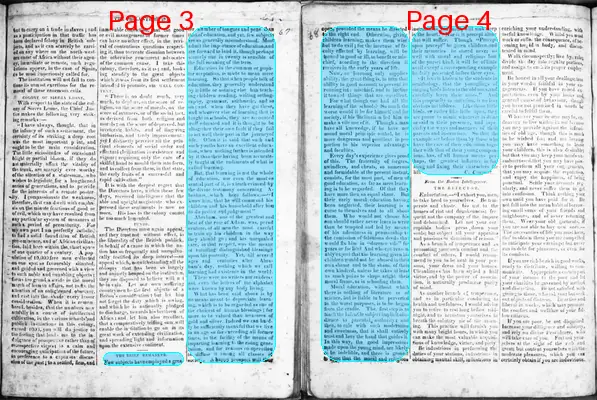
Editorial
May 14, 1818
Philanthropist
Mount Pleasant, Jefferson County, Ohio
What is this article about?
This editorial distinguishes true education as moral and religious training beyond mere academic learning, citing Abraham's example. It warns that without moral guidance, learning can lead to evil, emphasizing parental example and early obedience for character formation.
Merged-components note: Continuation of the editorial on education across pages.
Clippings
1 of 2
OCR Quality
95%
Excellent
Full Text
THE BRIEF REMARKER.
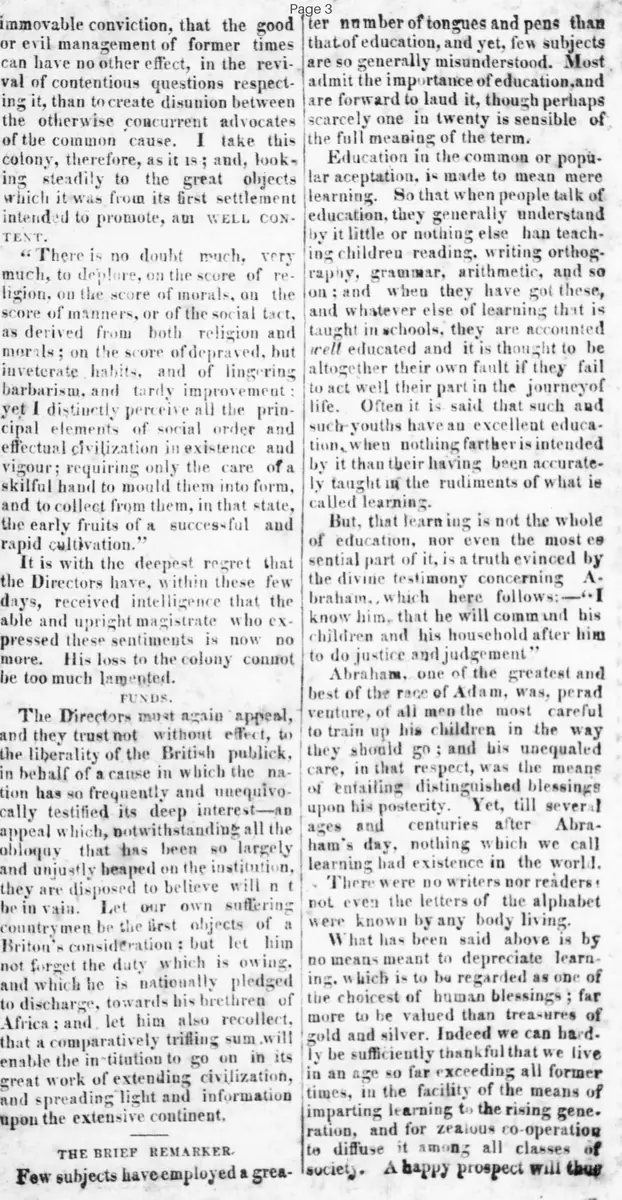
Few subjects have employed a greater number of tongues and pens than that of education, and yet, few subjects are so generally misunderstood. Most admit the importance of education, and are forward to laud it, though perhaps scarcely one in twenty is sensible of the full meaning of the term.
Education in the common or popular acceptation, is made to mean mere learning. So that when people talk of education, they generally understand by it little or nothing else than teaching children reading, writing, orthography, grammar, arithmetic, and so on; and when they have got these, and whatever else of learning that is taught in schools, they are accounted well educated and it is thought to be altogether their own fault if they fail to act well their part in the journey of life. Often it is said that such and such youths have an excellent education, when nothing farther is intended by it than their having been accurately taught in the rudiments of what is called learning.
But, that learning is not the whole of education, nor even the most essential part of it, is a truth evinced by the divine testimony concerning Abraham, which here follows: "I know him, that he will command his children and his household after him to do justice and judgment"
Abraham, one of the greatest and best of the race of Adam, was, peradventure, of all men the most careful to train up his children in the way they should go; and his unequaled care, in that respect, was the means of entailing distinguished blessings upon his posterity.
Yet, till several ages and centuries after Abraham's day, nothing which we call learning had existence in the world. There were no writers nor readers! not even the letters of the alphabet were known by anybody living.
What has been said above is by no means meant to depreciate learning, which is to be regarded as one of the choicest of human blessings; far more to be valued than treasures of gold and silver. Indeed we can hardly be sufficiently thankful that we live in an age so far exceeding all former times, in the facility of the means of imparting learning to the rising generation, and for zealous co-operation to diffuse it among all classes of society. A happy prospect will thus
open, provided the means be directed to the right end. Otherwise, giving children learning, makes them wise but to do evil: for the increase of faculty effected by learning, will be turned to good or ill, to benefit or mischief, according to the direction it receives in the early years of life. Now, as learning only supplies ability, the great thing is, to turn that ability to good account; to prevent its running into mischief, and to incline it toward things that are excellent. For what though one had all the learning of the schools? So much the worse would it be for himself and for society, if his inclination led him to make a vile use of it. Though a man have all knowledge, if he have not sound moral principle withal, he is more dangerous and pestilent in proportion to his superior advantages and faculties.
Every day's experience gives proof of this. The fraternity of forgers, swindlers, and cheats, so numerous and formidable at the present instant, consists, for the most part, of men of good education, as far as mere learning is to be regarded. Of that they have more than an equal share. But their early moral education having been neglected, their learning is a curse to themselves and to all about them. Who would not choose his son should rather never learn to write than be tempted and led by means of his adroitness in penmanship to the commission of felonious deeds that would fix him in "durance vile" for years or for life? And who can reasonably expect that the learning given his children would not be abused to their own shame and to the shame of their own kindred, unless he takes at least as much pains to shape aright their moral frame, as in schooling them.
Moral education, without which there is nothing of literature or of science, but is liable to be perverted to the worst purposes, is to be begun from the cradle. The first step is to teach the infantile subject implicit obedience to parental authority; and then, to rule with such moderation and sweetness, that it shall entirely trust and love the hand that guides it. In this way, the good impressions made upon the young mind, are likely to be indelible, and there is ground to hope that the moral and religious instructions you instil, will sink deep in the heart. Nor is it precept alone that will suffice. Though "Precept upon precept" be given children, and their memories be stored never so well with moral and religious lore of the purest kind, it will be of little avail except a corresponding example be daily presented before their eyes.
"It is well known to the students in ornithology, that the younglings of singing birds listen to the old ones, and carefully learn their notes." And this propensity to imitation, is no less obvious in children. Like those little birds, or rather like little apes, they are prone to mimic whatever is done or said in their presence, and especially the ways and manners of their parents and instructors. So that the example set before them by those who have the care of their education together with that of their young companions, has, of all human means perhaps, the greatest influence in forming and fixing their characters for life.
C. Courant.
Few subjects have employed a greater number of tongues and pens than that of education, and yet, few subjects are so generally misunderstood. Most admit the importance of education, and are forward to laud it, though perhaps scarcely one in twenty is sensible of the full meaning of the term.
Education in the common or popular acceptation, is made to mean mere learning. So that when people talk of education, they generally understand by it little or nothing else than teaching children reading, writing, orthography, grammar, arithmetic, and so on; and when they have got these, and whatever else of learning that is taught in schools, they are accounted well educated and it is thought to be altogether their own fault if they fail to act well their part in the journey of life. Often it is said that such and such youths have an excellent education, when nothing farther is intended by it than their having been accurately taught in the rudiments of what is called learning.
But, that learning is not the whole of education, nor even the most essential part of it, is a truth evinced by the divine testimony concerning Abraham, which here follows: "I know him, that he will command his children and his household after him to do justice and judgment"
Abraham, one of the greatest and best of the race of Adam, was, peradventure, of all men the most careful to train up his children in the way they should go; and his unequaled care, in that respect, was the means of entailing distinguished blessings upon his posterity.
Yet, till several ages and centuries after Abraham's day, nothing which we call learning had existence in the world. There were no writers nor readers! not even the letters of the alphabet were known by anybody living.
What has been said above is by no means meant to depreciate learning, which is to be regarded as one of the choicest of human blessings; far more to be valued than treasures of gold and silver. Indeed we can hardly be sufficiently thankful that we live in an age so far exceeding all former times, in the facility of the means of imparting learning to the rising generation, and for zealous co-operation to diffuse it among all classes of society. A happy prospect will thus
open, provided the means be directed to the right end. Otherwise, giving children learning, makes them wise but to do evil: for the increase of faculty effected by learning, will be turned to good or ill, to benefit or mischief, according to the direction it receives in the early years of life. Now, as learning only supplies ability, the great thing is, to turn that ability to good account; to prevent its running into mischief, and to incline it toward things that are excellent. For what though one had all the learning of the schools? So much the worse would it be for himself and for society, if his inclination led him to make a vile use of it. Though a man have all knowledge, if he have not sound moral principle withal, he is more dangerous and pestilent in proportion to his superior advantages and faculties.
Every day's experience gives proof of this. The fraternity of forgers, swindlers, and cheats, so numerous and formidable at the present instant, consists, for the most part, of men of good education, as far as mere learning is to be regarded. Of that they have more than an equal share. But their early moral education having been neglected, their learning is a curse to themselves and to all about them. Who would not choose his son should rather never learn to write than be tempted and led by means of his adroitness in penmanship to the commission of felonious deeds that would fix him in "durance vile" for years or for life? And who can reasonably expect that the learning given his children would not be abused to their own shame and to the shame of their own kindred, unless he takes at least as much pains to shape aright their moral frame, as in schooling them.
Moral education, without which there is nothing of literature or of science, but is liable to be perverted to the worst purposes, is to be begun from the cradle. The first step is to teach the infantile subject implicit obedience to parental authority; and then, to rule with such moderation and sweetness, that it shall entirely trust and love the hand that guides it. In this way, the good impressions made upon the young mind, are likely to be indelible, and there is ground to hope that the moral and religious instructions you instil, will sink deep in the heart. Nor is it precept alone that will suffice. Though "Precept upon precept" be given children, and their memories be stored never so well with moral and religious lore of the purest kind, it will be of little avail except a corresponding example be daily presented before their eyes.
"It is well known to the students in ornithology, that the younglings of singing birds listen to the old ones, and carefully learn their notes." And this propensity to imitation, is no less obvious in children. Like those little birds, or rather like little apes, they are prone to mimic whatever is done or said in their presence, and especially the ways and manners of their parents and instructors. So that the example set before them by those who have the care of their education together with that of their young companions, has, of all human means perhaps, the greatest influence in forming and fixing their characters for life.
C. Courant.
What sub-type of article is it?
Education
Moral Or Religious
What keywords are associated?
Moral Education
Academic Learning
Parental Example
Religious Instruction
Character Formation
Abraham's Legacy
What entities or persons were involved?
Abraham
Parents
Children
Editorial Details
Primary Topic
Moral Education Beyond Mere Learning
Stance / Tone
Advocacy For Moral And Religious Training In Education
Key Figures
Abraham
Parents
Children
Key Arguments
Education Is Misunderstood As Only Academic Learning
Mere Learning Without Morals Leads To Evil
Abraham Exemplified Moral Training Of Children
Parental Example Is Crucial For Character Formation
Moral Education Starts From Cradle With Obedience And Love
Imitation Of Parents Shapes Children's Morals