Thank you for visiting SNEWPapers!
Sign up free
Literary
April 28, 1827
Literary Cadet And Rhode Island Statesman
Providence, Providence County, Rhode Island
What is this article about?
A narrative poem retelling a chivalric legend from Edward IV's time: a knight swims to an island to fetch forget-me-not flowers for his maiden but drowns near shore, throwing the flowers to her with his dying words 'Forget-me-not,' thus naming the flower. Introduced with historical preface from Mills' work on chivalry.
Clipping
OCR Quality
95%
Excellent
Full Text
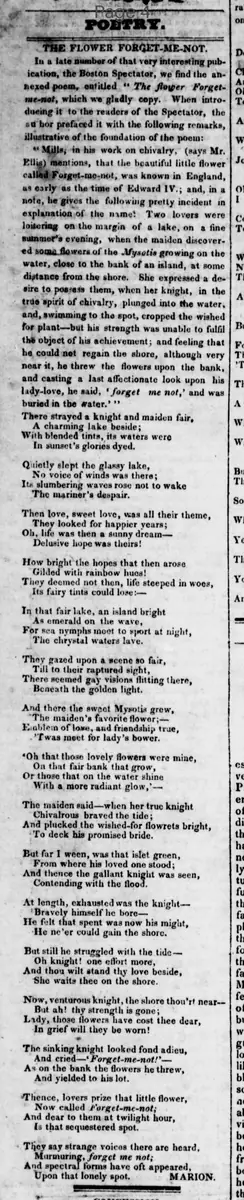
POETRY
THE FLOWER FORGET-ME-NOT.
In a late number of that very interesting publication, the Boston Spectator, we find the annexed poem, entitled "The Flower Forget-me-not," which we gladly copy. When introducing it to the readers of the Spectator, the author prefaced it with the following remarks, illustrative of the foundation of the poem:
"Mills, in his work on chivalry, (says Mr. Ellis) mentions, that the beautiful little flower called Forget-me-not, was known in England, as early as the time of Edward IV.; and, in a note, he gives the following pretty incident in explanation of the name! Two lovers were loitering on the margin of a lake, on a fine summer's evening, when the maiden discovered some flowers of the Myosotis growing on the water, close to the bank of an island, at some distance from the shore. She expressed a desire to possess them, when her knight, in the true spirit of chivalry, plunged into the water, and, swimming to the spot, cropped the wished for plant—but his strength was unable to fulfil the object of his achievement; and feeling that he could not regain the shore, although very near it, he threw the flowers upon the bank, and casting a last affectionate look upon his lady-love, he said, 'forget me not,' and was buried in the water."
There strayed a knight and maiden fair,
A charming lake beside;
With blended tints, its waters were
In sunset's glories dyed.
Quietly slept the glassy lake,
No voice of winds was there;
Its slumbering waves rose not to wake
The mariner's despair.
Then love, sweet love, was all their theme,
They looked for happier years;
Oh, life was then a sunny dream—
Delusive hope was theirs!
How bright the hopes that then arose
Gilded with rainbow hues!
They deemed not then, life steeped in woes,
Its fairy tints could lose:—
In that fair lake, an island bright
As emerald on the wave,
For sea nymphs meet to sport at night,
The chrystal waters lave.
They gazed upon a scene so fair,
Till to their raptured sight,
There seemed gay visions flitting there,
Beneath the golden light.
And there the sweet Myosotis grew,
The maiden's favorite flower;—
Emblem of love, and friendship true,
'Twas meet for lady's bower.
Oh that those lovely flowers were mine.
On that fair bank that grow,
Or those that on the water shine
With a more radiant glow,'—
The maiden said—when her true knight
Chivalrous braved the tide;
And plucked the wished-for flowrets bright,
To deck his promised bride.
But ah I ween, was that islet green,
From where his loved one stood;
And thence the gallant knight was seen,
Contending with the flood.
At length, exhausted was the knight—
Bravely himself he bore—
He felt that spent was now his might,
He ne'er could gain the shore.
But still he struggled with the tide—
Oh knight! one effort more,
And thou wilt stand thy love beside,
She waits thee on the shore.
Now, venturous knight, the shore thou'rt near—
But ah! thy strength is gone;
Lady, those flowers have cost thee dear,
In grief will they be worn!
The sinking knight looked fond adieu,
And cried—'Forget-me-not!'—
As on the bank the flowers he threw,
And yielded to his lot.
Thence, lovers prize that little flower,
Now called Forget-me-not;
And dear to them at twilight hour,
Is that sequestered spot.
They say strange voices there are heard,
Murmuring, forget me not;
And spectral forms have oft appeared,
Upon that lonely spot.
MARION.
THE FLOWER FORGET-ME-NOT.
In a late number of that very interesting publication, the Boston Spectator, we find the annexed poem, entitled "The Flower Forget-me-not," which we gladly copy. When introducing it to the readers of the Spectator, the author prefaced it with the following remarks, illustrative of the foundation of the poem:
"Mills, in his work on chivalry, (says Mr. Ellis) mentions, that the beautiful little flower called Forget-me-not, was known in England, as early as the time of Edward IV.; and, in a note, he gives the following pretty incident in explanation of the name! Two lovers were loitering on the margin of a lake, on a fine summer's evening, when the maiden discovered some flowers of the Myosotis growing on the water, close to the bank of an island, at some distance from the shore. She expressed a desire to possess them, when her knight, in the true spirit of chivalry, plunged into the water, and, swimming to the spot, cropped the wished for plant—but his strength was unable to fulfil the object of his achievement; and feeling that he could not regain the shore, although very near it, he threw the flowers upon the bank, and casting a last affectionate look upon his lady-love, he said, 'forget me not,' and was buried in the water."
There strayed a knight and maiden fair,
A charming lake beside;
With blended tints, its waters were
In sunset's glories dyed.
Quietly slept the glassy lake,
No voice of winds was there;
Its slumbering waves rose not to wake
The mariner's despair.
Then love, sweet love, was all their theme,
They looked for happier years;
Oh, life was then a sunny dream—
Delusive hope was theirs!
How bright the hopes that then arose
Gilded with rainbow hues!
They deemed not then, life steeped in woes,
Its fairy tints could lose:—
In that fair lake, an island bright
As emerald on the wave,
For sea nymphs meet to sport at night,
The chrystal waters lave.
They gazed upon a scene so fair,
Till to their raptured sight,
There seemed gay visions flitting there,
Beneath the golden light.
And there the sweet Myosotis grew,
The maiden's favorite flower;—
Emblem of love, and friendship true,
'Twas meet for lady's bower.
Oh that those lovely flowers were mine.
On that fair bank that grow,
Or those that on the water shine
With a more radiant glow,'—
The maiden said—when her true knight
Chivalrous braved the tide;
And plucked the wished-for flowrets bright,
To deck his promised bride.
But ah I ween, was that islet green,
From where his loved one stood;
And thence the gallant knight was seen,
Contending with the flood.
At length, exhausted was the knight—
Bravely himself he bore—
He felt that spent was now his might,
He ne'er could gain the shore.
But still he struggled with the tide—
Oh knight! one effort more,
And thou wilt stand thy love beside,
She waits thee on the shore.
Now, venturous knight, the shore thou'rt near—
But ah! thy strength is gone;
Lady, those flowers have cost thee dear,
In grief will they be worn!
The sinking knight looked fond adieu,
And cried—'Forget-me-not!'—
As on the bank the flowers he threw,
And yielded to his lot.
Thence, lovers prize that little flower,
Now called Forget-me-not;
And dear to them at twilight hour,
Is that sequestered spot.
They say strange voices there are heard,
Murmuring, forget me not;
And spectral forms have oft appeared,
Upon that lonely spot.
MARION.
What sub-type of article is it?
Poem
What themes does it cover?
Love Romance
Death Mortality
Nature
What keywords are associated?
Forget Me Not
Knight
Maiden
Chivalry
Lake
Drowning
Love
Legend
Myosotis
Edward Iv
What entities or persons were involved?
Marion.
Literary Details
Title
The Flower Forget Me Not.
Author
Marion.
Subject
Origin Of The Name Forget Me Not From A Chivalric Tale In Edward Iv's Time.
Key Lines
The Sinking Knight Looked Fond Adieu,
And Cried—'Forget Me Not!'—
As On The Bank The Flowers He Threw,
And Yielded To His Lot.
Thence, Lovers Prize That Little Flower,
Now Called Forget Me Not;
And Dear To Them At Twilight Hour,
Is That Sequestered Spot.
They Say Strange Voices There Are Heard,
Murmuring, Forget Me Not;
And Spectral Forms Have Oft Appeared,
Upon That Lonely Spot.