Thank you for visiting SNEWPapers!
Sign up free
Editorial
November 29, 1811
The Rhode Island American, And General Advertiser
Providence, Providence County, Rhode Island
What is this article about?
Editorial from Boston Repository criticizes US government's 1812 settlement of Chesapeake-Leopard affair as a ruse to sustain anti-British, pro-French policies under Jefferson, rejecting 1809 terms then but accepting now to delude public and provoke war.
Clipping
OCR Quality
90%
Excellent
Full Text
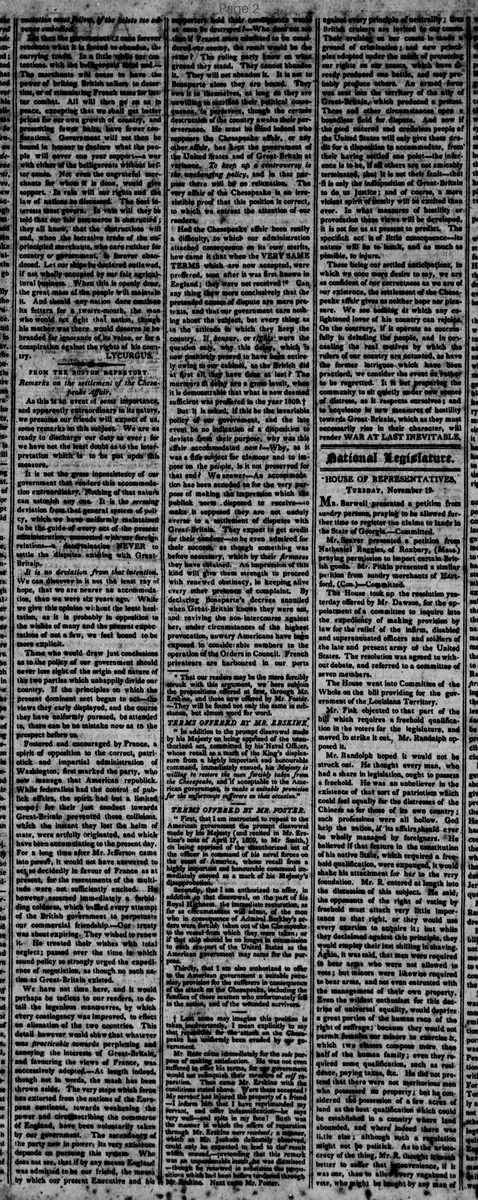
FROM THE BOSTON REPOSITORY.
Remarks on the settlement of the Chesapeake affair
As this is an event of some importance, and apparently extraordinary in its nature, we presume our friends will expect of us, some remarks on this subject. We are as ready to discharge our duty as ever; for we have not the least doubt as to the interpretation which is to be put upon this measure.
It is not the gross inconsistency of our government that renders this accommodation extraordinary. Nothing of that nature can astonish any one. It is the seeming deviation from that general system of policy, which we have uniformly maintained to be the guide of every act of the present administration, connected with our foreign relations—a determination NEVER to settle the disputes existing with Great-Britain.
It is no deviation from that intention. We can discover in it not the least ray of hope, that we are nearer an accommodation than we were six years ago. While we give this opinion without the least hesitation, as it is probably in opposition to the wishes of many and the present expectations of not a few, we feel bound to be more explicit.
Those who would draw just conclusions as to the policy of our government should never lose sight of the origin and nature of the two parties which unhappily divide our country. If the principles on which the present dominant sect began to act the views they early displayed, and the course they have uniformly pursued, be attended to, there can be no mistake now as to the prospect before us.
Fostered and encouraged by France, a spirit of opposition to the correct, patriotic and impartial administration of Washington, first marked the party, who now manage that American republic. While federalists had the control of public affairs, the spirit had but a limited scope; for their just conduct towards Great-Britain prevented those collisions, which the instant they lost the helm of state, were artfully originated, and which have been accumulating to the present day.
For a long time after Mr. Jefferson came into power, it would not have answered to act so decidedly in favour of France as at present, for the resentments of the multitude were not sufficiently excited. He however assumed immediately a forbidding coldness, which baffled every attempt of the British government to perpetuate our commercial friendship. Our treaty was about expiring, They wished to renew it. He treated their wishes with total neglect; passed over the time in which sound policy so strongly urged the expedience of negotiation, as though no such nation as Great-Britain existed.
We have not time here, and it would perhaps be tedious to our readers, to detail the ingenious manoeuvres, by which every contingency was improved, to effect an alienation of the two countries. This detail however would shew that whatever was practicable towards perplexing and annoying the interests of Great-Britain and favouring the views of France, was successively adopted. At length indeed, though not in words, the mask has been thrown aside. The very steps which force has extorted from the nations of the European continent, towards weakening the power and circumscribing the commerce of England, have been voluntarily taken by our government. The ascendancy of the party now in power its very existence depends on pursuing this system. Who does not see, that if by any means England was admitted to be our friend, the means by which our present Executive and his supporters hold their consequence would at once be destroyed? Who does not see that if France were admitted to be considered our enemy, the result would be the same? The ruling party know on what ground they stand, They cannot abandon it. They will not abandon it. It is not to Bonaparte alone they are bound. They owe it to themselves, as long as they are unwilling to sacrifice their political consequence to persevere, though the certain destruction of the country awaits their perseverance. He must be blind indeed who supposes the Chesapeake affair, or any other affair, has kept the government of the United States and of Great-Britain at variance. To keep up a controversy is the unchanging policy, and in that purpose there will be no relaxation. The very affair of the Chesapeake is an irresistible proof that this position is correct, to which we entreat the attention of our readers.
Had the Chesapeake affair been really a difficulty, to which our administration attached consequence on its own merits, how came it that when the VERY SAME TERMS which, are now accepted, were proffered, soon after it was first known in England; they were not received! Can any thing shew more conclusively that the pretended causes of dispute are mere pretexts, and that our government care nothing about the subject, but every thing as to the attitude in which they keep the country. If honour, or right were the question only, why this delay. which is now positively proved to have been entirely owing to our cabinet, as the British did at first ill they have done at last? The murmurs of delay are a gross insult when it is demonstrable that what is now deemed sufficient was proffered in the year 1809.
But it is asked, if this be the invariable policy of our government, and the late events be no indication of a disposition to deviate from their purpose. why was this affair accommodated now? Why, as it was a fine subject for clamour and to impose on the people, is it not preserved for that end? We answer—An accommodation has been acceded to for the very purpose of making the impression which the publick seem disposed to receive—to make it supposed they are not unduly averse to a settlement of disputes with Great-Britain. They expect to get credit for their candour—to be even admired for their success, as though something was before necessary, which by their firmness they have obtained. An impression of this kind will give them strength to proceed with renewed obstinacy, in keeping alive every other pretence of complaint. By declaring Bonaparte's decrees annulled when Great-Britain knows they were not, and reviving the non-intercourse against her, under circumstances of the highest provocation, unwary Americans have been exposed in considerable numbers to the operation of the Orders in Council. French privateers are harboured in our ports against every principle of neutrality; thus British cruisers are invited to our coasts. Their cruising on our coasts is made a ground of crimination; and new principles adopted under the mask of protecting our rights on our coasts, which have already produced one battle, and may probably produce others. An armed force was sent into the territory of the ally of Great-Britain, which produced a protest. These and other circumstances open a boundless field for dispute. And now if the good natured and credulous people of the United States will only give them credit for a disposition to accommodate, from their having settled one point -the inference is to be, if all others are not amicably terminated; that it is not their fault—that it is only the indisposition of Great-Britain to do us justice; and of course, a more violent spirit of enmity will be excited than ever. In what measures of hostility or provocation these views will be developed. it is not for us at present to predict The specifick act is of little consequence—its nature will be to insult, and as much as possible, to injure.
These being our settled anticipations, in which we once more desire to say, we are as confident of our correctness as we are of our existence, the settlement of the Chesapeake affair gives us neither hope nor pleasure. We see nothing of which any enlightened lover of his country can rejoice. On the contrary, if it operate as successfully in deluding the people, and in concealing the real motives by which the rulers of our country are actuated, as have the former intrigues which have been practised, we consider the event as rather to be regretted. It is but preparing the community to sit quietly under new scenes of distress, as it respects ourselves; and to acquiesce in new measures of hostility towards Great-Britain, which as they must necessarily rise in their character, will render WAR AT LAST INEVITABLE
Remarks on the settlement of the Chesapeake affair
As this is an event of some importance, and apparently extraordinary in its nature, we presume our friends will expect of us, some remarks on this subject. We are as ready to discharge our duty as ever; for we have not the least doubt as to the interpretation which is to be put upon this measure.
It is not the gross inconsistency of our government that renders this accommodation extraordinary. Nothing of that nature can astonish any one. It is the seeming deviation from that general system of policy, which we have uniformly maintained to be the guide of every act of the present administration, connected with our foreign relations—a determination NEVER to settle the disputes existing with Great-Britain.
It is no deviation from that intention. We can discover in it not the least ray of hope, that we are nearer an accommodation than we were six years ago. While we give this opinion without the least hesitation, as it is probably in opposition to the wishes of many and the present expectations of not a few, we feel bound to be more explicit.
Those who would draw just conclusions as to the policy of our government should never lose sight of the origin and nature of the two parties which unhappily divide our country. If the principles on which the present dominant sect began to act the views they early displayed, and the course they have uniformly pursued, be attended to, there can be no mistake now as to the prospect before us.
Fostered and encouraged by France, a spirit of opposition to the correct, patriotic and impartial administration of Washington, first marked the party, who now manage that American republic. While federalists had the control of public affairs, the spirit had but a limited scope; for their just conduct towards Great-Britain prevented those collisions, which the instant they lost the helm of state, were artfully originated, and which have been accumulating to the present day.
For a long time after Mr. Jefferson came into power, it would not have answered to act so decidedly in favour of France as at present, for the resentments of the multitude were not sufficiently excited. He however assumed immediately a forbidding coldness, which baffled every attempt of the British government to perpetuate our commercial friendship. Our treaty was about expiring, They wished to renew it. He treated their wishes with total neglect; passed over the time in which sound policy so strongly urged the expedience of negotiation, as though no such nation as Great-Britain existed.
We have not time here, and it would perhaps be tedious to our readers, to detail the ingenious manoeuvres, by which every contingency was improved, to effect an alienation of the two countries. This detail however would shew that whatever was practicable towards perplexing and annoying the interests of Great-Britain and favouring the views of France, was successively adopted. At length indeed, though not in words, the mask has been thrown aside. The very steps which force has extorted from the nations of the European continent, towards weakening the power and circumscribing the commerce of England, have been voluntarily taken by our government. The ascendancy of the party now in power its very existence depends on pursuing this system. Who does not see, that if by any means England was admitted to be our friend, the means by which our present Executive and his supporters hold their consequence would at once be destroyed? Who does not see that if France were admitted to be considered our enemy, the result would be the same? The ruling party know on what ground they stand, They cannot abandon it. They will not abandon it. It is not to Bonaparte alone they are bound. They owe it to themselves, as long as they are unwilling to sacrifice their political consequence to persevere, though the certain destruction of the country awaits their perseverance. He must be blind indeed who supposes the Chesapeake affair, or any other affair, has kept the government of the United States and of Great-Britain at variance. To keep up a controversy is the unchanging policy, and in that purpose there will be no relaxation. The very affair of the Chesapeake is an irresistible proof that this position is correct, to which we entreat the attention of our readers.
Had the Chesapeake affair been really a difficulty, to which our administration attached consequence on its own merits, how came it that when the VERY SAME TERMS which, are now accepted, were proffered, soon after it was first known in England; they were not received! Can any thing shew more conclusively that the pretended causes of dispute are mere pretexts, and that our government care nothing about the subject, but every thing as to the attitude in which they keep the country. If honour, or right were the question only, why this delay. which is now positively proved to have been entirely owing to our cabinet, as the British did at first ill they have done at last? The murmurs of delay are a gross insult when it is demonstrable that what is now deemed sufficient was proffered in the year 1809.
But it is asked, if this be the invariable policy of our government, and the late events be no indication of a disposition to deviate from their purpose. why was this affair accommodated now? Why, as it was a fine subject for clamour and to impose on the people, is it not preserved for that end? We answer—An accommodation has been acceded to for the very purpose of making the impression which the publick seem disposed to receive—to make it supposed they are not unduly averse to a settlement of disputes with Great-Britain. They expect to get credit for their candour—to be even admired for their success, as though something was before necessary, which by their firmness they have obtained. An impression of this kind will give them strength to proceed with renewed obstinacy, in keeping alive every other pretence of complaint. By declaring Bonaparte's decrees annulled when Great-Britain knows they were not, and reviving the non-intercourse against her, under circumstances of the highest provocation, unwary Americans have been exposed in considerable numbers to the operation of the Orders in Council. French privateers are harboured in our ports against every principle of neutrality; thus British cruisers are invited to our coasts. Their cruising on our coasts is made a ground of crimination; and new principles adopted under the mask of protecting our rights on our coasts, which have already produced one battle, and may probably produce others. An armed force was sent into the territory of the ally of Great-Britain, which produced a protest. These and other circumstances open a boundless field for dispute. And now if the good natured and credulous people of the United States will only give them credit for a disposition to accommodate, from their having settled one point -the inference is to be, if all others are not amicably terminated; that it is not their fault—that it is only the indisposition of Great-Britain to do us justice; and of course, a more violent spirit of enmity will be excited than ever. In what measures of hostility or provocation these views will be developed. it is not for us at present to predict The specifick act is of little consequence—its nature will be to insult, and as much as possible, to injure.
These being our settled anticipations, in which we once more desire to say, we are as confident of our correctness as we are of our existence, the settlement of the Chesapeake affair gives us neither hope nor pleasure. We see nothing of which any enlightened lover of his country can rejoice. On the contrary, if it operate as successfully in deluding the people, and in concealing the real motives by which the rulers of our country are actuated, as have the former intrigues which have been practised, we consider the event as rather to be regretted. It is but preparing the community to sit quietly under new scenes of distress, as it respects ourselves; and to acquiesce in new measures of hostility towards Great-Britain, which as they must necessarily rise in their character, will render WAR AT LAST INEVITABLE
What sub-type of article is it?
Foreign Affairs
Partisan Politics
War Or Peace
What keywords are associated?
Chesapeake Affair
Us Foreign Policy
Jefferson Administration
British Relations
French Influence
War Inevitability
What entities or persons were involved?
Jefferson
Washington
Bonaparte
Great Britain
France
Federalists
Editorial Details
Primary Topic
Critique Of Chesapeake Affair Settlement As Pretext For Anti British Policy
Stance / Tone
Strongly Critical Of Jefferson Administration's Foreign Policy
Key Figures
Jefferson
Washington
Bonaparte
Great Britain
France
Federalists
Key Arguments
Settlement Deviates From Policy Of Never Accommodating Britain
Administration Fostered By France Opposes Impartial Rule
Jefferson Neglected British Treaty Renewal
Chesapeake Terms Rejected In 1809 Despite Being Same As Now
Accommodation Aims To Feign Candor While Provoking Further Disputes
Predicts War Inevitable Due To Maintained Hostility