Thank you for visiting SNEWPapers!
Sign up free
Letter to Editor
May 14, 1862
Washington Telegraph
Washington, Hempstead County, Arkansas
What is this article about?
A correspondent shares a passage from Macaulay's History of England (Vol. 1, pp. 410-423) arguing that effective wartime leadership requires absolute authority under one commander, without interference from representative bodies, citing historical examples from Venice, Florence, and the Dutch.
Clipping
OCR Quality
98%
Excellent
Full Text
[For the Telegraph.]
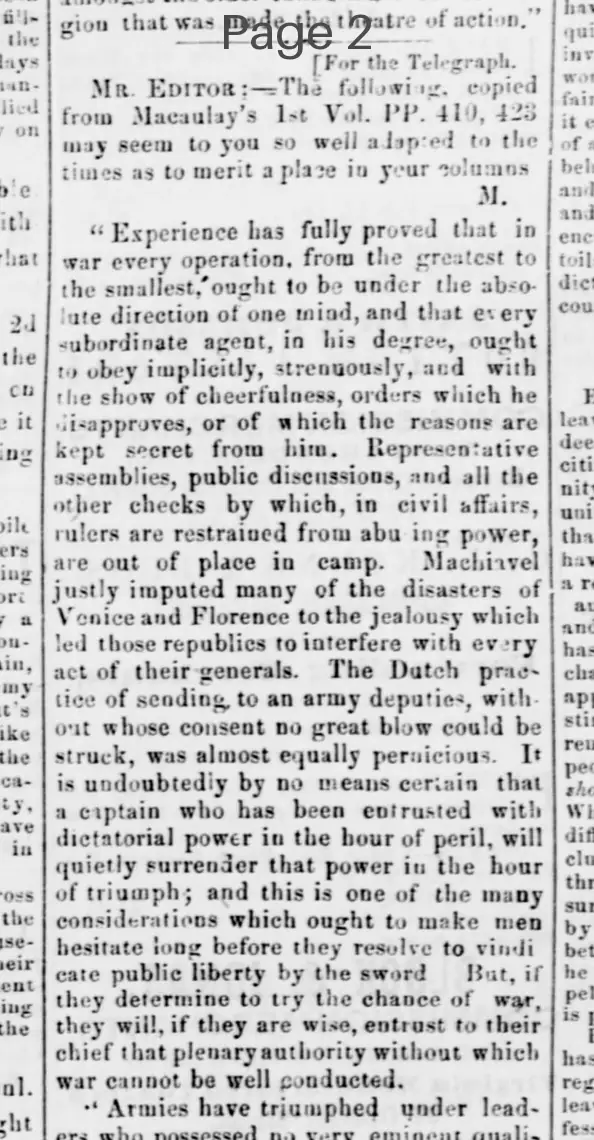
Mr. Editor:—The following, copied from Macaulay's 1st Vol. PP. 410. 423 may seem to you so well adapted to the times as to merit a place in your columns
M.
'Experience has fully proved that in war every operation, from the greatest to the smallest, ought to be under the absolute direction of one mind, and that every subordinate agent, in his degree, ought to obey implicitly, strenuously, and with the show of cheerfulness, orders which he disapproves, or of which the reasons are kept secret from him. Representative assemblies, public discussions, and all the other checks by which, in civil affairs, rulers are restrained from abusing power, are out of place in camp. Machiavel justly imputed many of the disasters of Venice and Florence to the jealousy which led those republics to interfere with every act of their generals. The Dutch practice of sending, to an army deputies, without whose consent no great blow could be struck, was almost equally pernicious. It is undoubtedly by no means certain that a captain who has been entrusted with dictatorial power in the hour of peril, will quietly surrender that power in the hour of triumph; and this is one of the many considerations which ought to make men hesitate long before they resolve to vindicate public liberty by the sword. But, if they determine to try the chance of war, they will, if they are wise, entrust to their chief that plenary authority without which war cannot be well conducted.
Armies have triumphed under leaders who possessed no very eminent qualifications; but what army commanded by a debating club ever escaped discomfiture and disgrace?'
Mr. Editor:—The following, copied from Macaulay's 1st Vol. PP. 410. 423 may seem to you so well adapted to the times as to merit a place in your columns
M.
'Experience has fully proved that in war every operation, from the greatest to the smallest, ought to be under the absolute direction of one mind, and that every subordinate agent, in his degree, ought to obey implicitly, strenuously, and with the show of cheerfulness, orders which he disapproves, or of which the reasons are kept secret from him. Representative assemblies, public discussions, and all the other checks by which, in civil affairs, rulers are restrained from abusing power, are out of place in camp. Machiavel justly imputed many of the disasters of Venice and Florence to the jealousy which led those republics to interfere with every act of their generals. The Dutch practice of sending, to an army deputies, without whose consent no great blow could be struck, was almost equally pernicious. It is undoubtedly by no means certain that a captain who has been entrusted with dictatorial power in the hour of peril, will quietly surrender that power in the hour of triumph; and this is one of the many considerations which ought to make men hesitate long before they resolve to vindicate public liberty by the sword. But, if they determine to try the chance of war, they will, if they are wise, entrust to their chief that plenary authority without which war cannot be well conducted.
Armies have triumphed under leaders who possessed no very eminent qualifications; but what army commanded by a debating club ever escaped discomfiture and disgrace?'
What sub-type of article is it?
Informative
Historical
Philosophical
What themes does it cover?
Military War
Politics
Constitutional Rights
What keywords are associated?
Military Leadership
War Authority
Republican Interference
Macaulay History
Historical Precedents
Dictatorial Power
What entities or persons were involved?
M.
Mr. Editor
Letter to Editor Details
Author
M.
Recipient
Mr. Editor
Main Argument
in times of war, operations must be directed by a single authoritative mind without interference from representative assemblies or public discussions, as such checks are incompatible with effective military command and have historically led to disasters in republics like venice, florence, and the dutch.
Notable Details
Quotes Macaulay's History Of England, Vol. 1, Pp. 410 423
References Machiavelli On Venetian And Florentine Military Failures
Cites Dutch Practice Of Army Deputies
Warns Of Risks In Granting And Surrendering Dictatorial Power