Thank you for visiting SNEWPapers!
Sign up free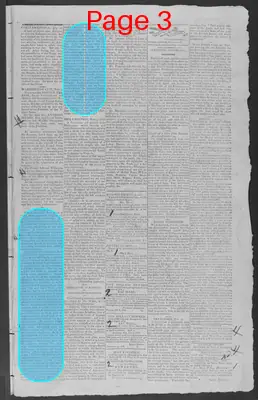
Editorial
December 1, 1808
Kentucky Gazette And General Advertiser
Lexington, Fayette County, Kentucky
What is this article about?
The editorial eulogizes Charles James Fox upon his death on November 10, highlighting his virtues, efforts for peace in Europe, and unwavering support for American independence, including his role in the peace treaty. It urges the U.S. legislature to honor him appropriately.
Clipping
OCR Quality
98%
Excellent
Full Text
November 10.
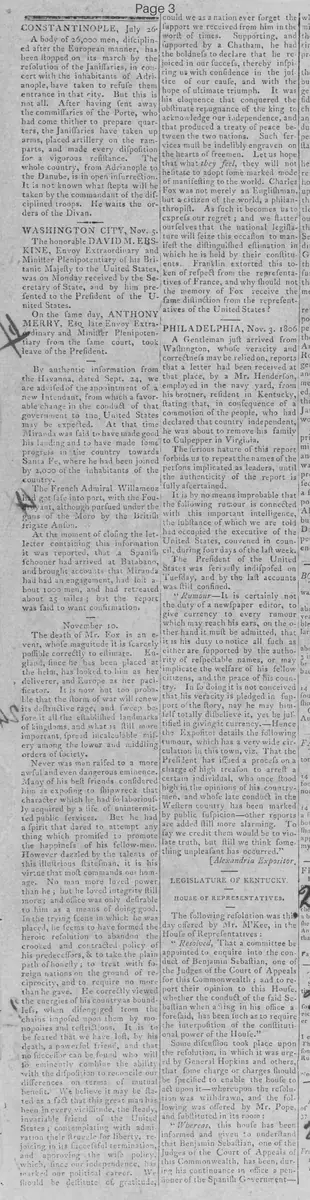
The death of Mr. Fox is an event, whose magnitude it is scarcely possible correctly to estimate. England, since he has been placed at the helm, has looked to him as her deliverer, and Europe as her pacificator. It is now but too probable that the storm of war will renew its destructive rage, and sweep before it all the established landmarks of kingdoms, and what is still more important, spread incalculable misery among the lower and middling orders of society.
Never was man raised to a more awful and even dangerous eminence. Many of his best friends considered him as exposing to shipwreck that character which he had so laboriously acquired by a life of unintermitted public services. But he had a spirit that dared to attempt anything which promised to promote the happiness of his fellow-men.
However dazzled by the talents of this illustrious statesman, it is his virtue that most commands our homage. No man more loved power than he; but he loved integrity still more; and office was only desirable to him as a means of doing good.
In the trying scene in which he was placed, he seems to have formed the heroic resolution to abandon the crooked and contracted policy of his predecessors, & to take the plain path of honesty; to treat with foreign nations on the ground of reciprocity, and to require no more than he gave. He correctly viewed the energies of his country as boundless, when disengaged from the chains imposed upon them by monopolies and restrictions. It is to be feared that we have lost, by his death, a powerful friend, and that no successor can be found who will so eminently combine the ability with the disposition to reconcile our differences on terms of mutual benefit.
We believe it may be stated as a fact that this great man has been in every vicissitude, the steady, invariable friend of the United States; contemplating with admiration their struggle for liberty, rejoicing in its successful termination, and approving the wise policy which, since our independence, has marked our political career. We should be destitute of gratitude, could we as a nation ever forget the support we received from him in the worst of times. Supporting, and supported by a Chatham, he had the boldness to declare that he rejoiced in our success, thereby inspiring us with confidence in the justice of our cause, and with the hope of ultimate triumph. It was his eloquence that conquered the obstinate repugnance of the king to acknowledge our independence, and that produced a treaty of peace between the two nations. Such services must be indelibly engraven on the hearts of freemen. Let us hope that what they feel, they will not hesitate to adopt some marked mode of manifesting to the world. Charles Fox was not merely an Englishman, but a citizen of the world, a philanthropist. As such it becomes us to express our regret; and we flatter ourselves that the national legislature will seize this occasion to manifest the distinguished estimation in which he is held by their constituents. Franklin extorted this token of respect from the representatives of France, and why should not the memory of Fox receive the same distinction from the representatives of the United States?
The death of Mr. Fox is an event, whose magnitude it is scarcely possible correctly to estimate. England, since he has been placed at the helm, has looked to him as her deliverer, and Europe as her pacificator. It is now but too probable that the storm of war will renew its destructive rage, and sweep before it all the established landmarks of kingdoms, and what is still more important, spread incalculable misery among the lower and middling orders of society.
Never was man raised to a more awful and even dangerous eminence. Many of his best friends considered him as exposing to shipwreck that character which he had so laboriously acquired by a life of unintermitted public services. But he had a spirit that dared to attempt anything which promised to promote the happiness of his fellow-men.
However dazzled by the talents of this illustrious statesman, it is his virtue that most commands our homage. No man more loved power than he; but he loved integrity still more; and office was only desirable to him as a means of doing good.
In the trying scene in which he was placed, he seems to have formed the heroic resolution to abandon the crooked and contracted policy of his predecessors, & to take the plain path of honesty; to treat with foreign nations on the ground of reciprocity, and to require no more than he gave. He correctly viewed the energies of his country as boundless, when disengaged from the chains imposed upon them by monopolies and restrictions. It is to be feared that we have lost, by his death, a powerful friend, and that no successor can be found who will so eminently combine the ability with the disposition to reconcile our differences on terms of mutual benefit.
We believe it may be stated as a fact that this great man has been in every vicissitude, the steady, invariable friend of the United States; contemplating with admiration their struggle for liberty, rejoicing in its successful termination, and approving the wise policy which, since our independence, has marked our political career. We should be destitute of gratitude, could we as a nation ever forget the support we received from him in the worst of times. Supporting, and supported by a Chatham, he had the boldness to declare that he rejoiced in our success, thereby inspiring us with confidence in the justice of our cause, and with the hope of ultimate triumph. It was his eloquence that conquered the obstinate repugnance of the king to acknowledge our independence, and that produced a treaty of peace between the two nations. Such services must be indelibly engraven on the hearts of freemen. Let us hope that what they feel, they will not hesitate to adopt some marked mode of manifesting to the world. Charles Fox was not merely an Englishman, but a citizen of the world, a philanthropist. As such it becomes us to express our regret; and we flatter ourselves that the national legislature will seize this occasion to manifest the distinguished estimation in which he is held by their constituents. Franklin extorted this token of respect from the representatives of France, and why should not the memory of Fox receive the same distinction from the representatives of the United States?
What sub-type of article is it?
Foreign Affairs
War Or Peace
What keywords are associated?
Charles Fox Death
American Independence
Us England Peace
Foreign Policy Reciprocity
National Gratitude
What entities or persons were involved?
Charles James Fox
United States
England
Chatham
King
Franklin
Editorial Details
Primary Topic
Eulogy For Charles James Fox And His Support For American Independence
Stance / Tone
Admiring Tribute And Call For National Gratitude
Key Figures
Charles James Fox
United States
England
Chatham
King
Franklin
Key Arguments
Fox's Death May Renew War In Europe
Fox Prioritized Integrity And Reciprocity In Foreign Policy
Fox Was A Steadfast Friend To The United States During Independence
Fox's Eloquence Secured Peace Treaty And King's Acknowledgment
U.S. Should Honor Fox Through Legislative Action