Thank you for visiting SNEWPapers!
Sign up free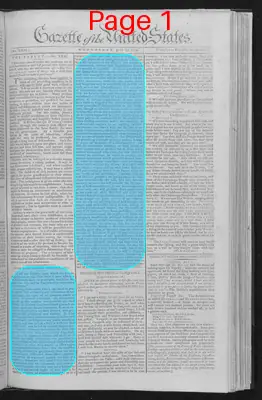
Editorial
July 29, 1789
Gazette Of The United States
New York, New York County, New York
What is this article about?
Post-revolutionary editorial advocating regulated American commerce through discriminatory trade laws against Britain to ensure reciprocity, raise revenue, and promote prosperity, critiquing free trade ideals and proposing retaliatory measures like navigation acts and export prohibitions.
Clipping
OCR Quality
95%
Excellent
Full Text
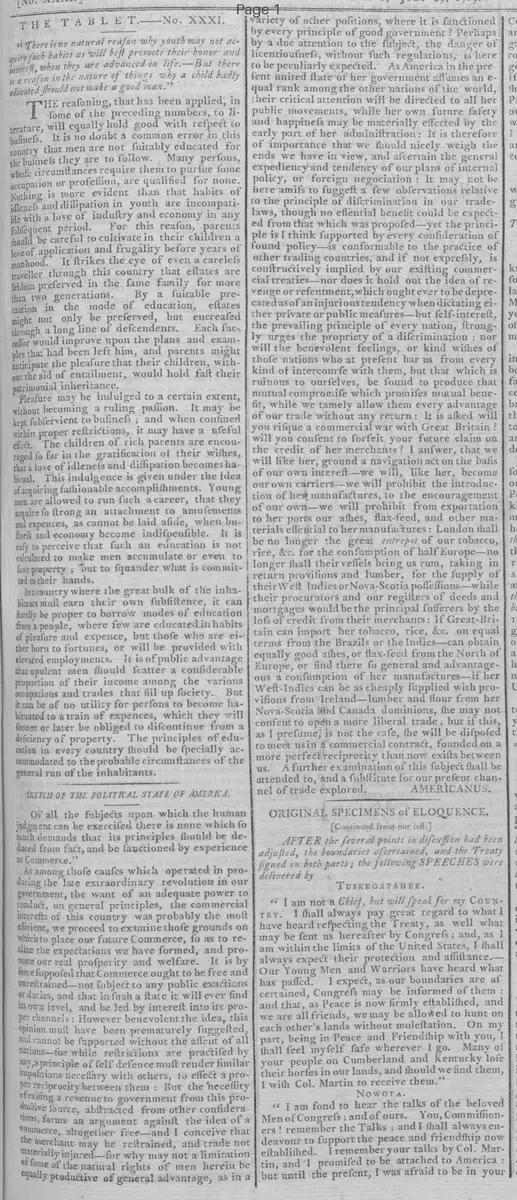
SKETCH OF THE POLITICAL STATE OF AMERICA.
Of all the subjects upon which the human judgment can be exercised there is none which so much demands that its principles should be deduced from fact, and be sanctioned by experience as Commerce.
As among those causes which operated in producing the late extraordinary revolution in our government, the want of an adequate power to conduct, on general principles, the commercial interests of this country was probably the most efficient, we proceed to examine those grounds on which to place our future Commerce, so as to realize the expectations we have formed, and promote our real prosperity and welfare. It is by some supposed that Commerce ought to be free and unrestrained—not subject to any public exactions or duties, and that in such a state it will ever find its own level, and be led by interest into its proper channels: However benevolent the idea, this opinion must have been prematurely suggested, and cannot be supported without the assent of all nations—for while restrictions are practised by any, a principle of self-defence must render similar impositions necessary with others, to effect a proper reciprocity between them: But the necessity of raising a revenue to government from this productive source, abstracted from other considerations, forms an argument against the idea of a commerce, altogether free—and I conceive that the merchant may be restrained, and trade not materially injured—for why may not a limitation of some of the natural rights of men herein be equally productive of general advantage, as in a variety of other positions, where it is sanctioned by every principle of good government? Perhaps by a due attention to the subject, the danger of licentiousness, without such regulations, is here to be peculiarly expected. As America in the present united state of her government assumes an equal rank among the other nations of the world, their critical attention will be directed to all her public movements, while her own future safety and happiness may be materially affected by the early part of her administration: It is therefore of importance that we should nicely weigh the ends we have in view, and ascertain the general expediency and tendency of our plans of internal policy, or foreign negotiation: It may not be here amiss to suggest a few observations relative to the principle of discrimination in our trade- laws, though no essential benefit could be expected from that which was proposed—yet the principle is I think supported by every consideration of sound policy—is conformable to the practice of other trading countries, and if not expressly, is constructively implied by our existing commercial treaties—nor does it hold out the idea of revenge or resentment, which ought ever to be deprecated as of an injurious tendency when dictating either private or public measures—but self-interest, the prevailing principle of every nation, strongly urges the propriety of a discrimination; nor will the benevolent feelings, or kind wishes of those nations who at present bar us from every kind of intercourse with them, but that which is ruinous to ourselves, be found to produce that mutual compromise which promises mutual benefit, while we tamely allow them every advantage of our trade without any return: It is asked will you risk a commercial war with Great Britain? will you consent to forfeit your future claim on the credit of her merchants? I answer, that we will like her, ground a navigation act on the basis of our own interest we will, like her, become our own carriers—we will prohibit the introduction of her manufactures, to the encouragement of our own—we will prohibit from exportation to her ports our ashes, flax-seed, and other materials essential to her manufactures: London shall be no longer the great entrepot of our tobacco, rice, &c. for the consumption of half Europe—no longer shall their vessels bring us rum, taking in return provisions and lumber, for the supply of their West Indies or Nova-Scotia possessions—while their procurators and our registers of deeds and mortgages would be the principal sufferers by the loss of credit from their merchants: If Great-Britain can import her tobacco, rice, &c. on equal terms from the Brazils or the Indies—can obtain equally good ashes, or flax-seed from the North of Europe, or find there so general and advantageous a consumption of her manufactures—if her West-Indies can be as cheaply supplied with provisions from Ireland—lumber and flour from her Nova-Scotia and Canada dominions, she may not consent to open a more liberal trade; but if this, as I presume, is not the case, she will be disposed to meet us in a commercial contract, founded on a more perfect reciprocity than now exists between us. A further examination of this subject shall be attended to, and a substitute for our present channel of trade explored.
AMERICANUS.
Of all the subjects upon which the human judgment can be exercised there is none which so much demands that its principles should be deduced from fact, and be sanctioned by experience as Commerce.
As among those causes which operated in producing the late extraordinary revolution in our government, the want of an adequate power to conduct, on general principles, the commercial interests of this country was probably the most efficient, we proceed to examine those grounds on which to place our future Commerce, so as to realize the expectations we have formed, and promote our real prosperity and welfare. It is by some supposed that Commerce ought to be free and unrestrained—not subject to any public exactions or duties, and that in such a state it will ever find its own level, and be led by interest into its proper channels: However benevolent the idea, this opinion must have been prematurely suggested, and cannot be supported without the assent of all nations—for while restrictions are practised by any, a principle of self-defence must render similar impositions necessary with others, to effect a proper reciprocity between them: But the necessity of raising a revenue to government from this productive source, abstracted from other considerations, forms an argument against the idea of a commerce, altogether free—and I conceive that the merchant may be restrained, and trade not materially injured—for why may not a limitation of some of the natural rights of men herein be equally productive of general advantage, as in a variety of other positions, where it is sanctioned by every principle of good government? Perhaps by a due attention to the subject, the danger of licentiousness, without such regulations, is here to be peculiarly expected. As America in the present united state of her government assumes an equal rank among the other nations of the world, their critical attention will be directed to all her public movements, while her own future safety and happiness may be materially affected by the early part of her administration: It is therefore of importance that we should nicely weigh the ends we have in view, and ascertain the general expediency and tendency of our plans of internal policy, or foreign negotiation: It may not be here amiss to suggest a few observations relative to the principle of discrimination in our trade- laws, though no essential benefit could be expected from that which was proposed—yet the principle is I think supported by every consideration of sound policy—is conformable to the practice of other trading countries, and if not expressly, is constructively implied by our existing commercial treaties—nor does it hold out the idea of revenge or resentment, which ought ever to be deprecated as of an injurious tendency when dictating either private or public measures—but self-interest, the prevailing principle of every nation, strongly urges the propriety of a discrimination; nor will the benevolent feelings, or kind wishes of those nations who at present bar us from every kind of intercourse with them, but that which is ruinous to ourselves, be found to produce that mutual compromise which promises mutual benefit, while we tamely allow them every advantage of our trade without any return: It is asked will you risk a commercial war with Great Britain? will you consent to forfeit your future claim on the credit of her merchants? I answer, that we will like her, ground a navigation act on the basis of our own interest we will, like her, become our own carriers—we will prohibit the introduction of her manufactures, to the encouragement of our own—we will prohibit from exportation to her ports our ashes, flax-seed, and other materials essential to her manufactures: London shall be no longer the great entrepot of our tobacco, rice, &c. for the consumption of half Europe—no longer shall their vessels bring us rum, taking in return provisions and lumber, for the supply of their West Indies or Nova-Scotia possessions—while their procurators and our registers of deeds and mortgages would be the principal sufferers by the loss of credit from their merchants: If Great-Britain can import her tobacco, rice, &c. on equal terms from the Brazils or the Indies—can obtain equally good ashes, or flax-seed from the North of Europe, or find there so general and advantageous a consumption of her manufactures—if her West-Indies can be as cheaply supplied with provisions from Ireland—lumber and flour from her Nova-Scotia and Canada dominions, she may not consent to open a more liberal trade; but if this, as I presume, is not the case, she will be disposed to meet us in a commercial contract, founded on a more perfect reciprocity than now exists between us. A further examination of this subject shall be attended to, and a substitute for our present channel of trade explored.
AMERICANUS.
What sub-type of article is it?
Trade Or Commerce
Economic Policy
Foreign Affairs
What keywords are associated?
American Commerce
Trade Reciprocity
British Restrictions
Navigation Acts
Economic Discrimination
Commercial Policy
What entities or persons were involved?
Great Britain
American Government
British Merchants
Editorial Details
Primary Topic
Advocacy For Discriminatory Trade Policies To Achieve Commercial Reciprocity With Britain
Stance / Tone
Supportive Of Regulated Commerce And Retaliatory Measures Against British Trade Restrictions
Key Figures
Great Britain
American Government
British Merchants
Key Arguments
Commerce Principles Must Derive From Fact And Experience
Free Trade Is Impractical Without Universal Agreement Due To Foreign Restrictions
Regulated Commerce Is Necessary For Revenue And Reciprocity
Discrimination In Trade Laws Aligns With Sound Policy And International Practice
Propose Navigation Acts, Self Carriage, And Prohibitions On British Manufactures And Key Exports To Force Reciprocity
Britain Will Negotiate Fairer Terms If Denied American Advantages