Thank you for visiting SNEWPapers!
Sign up free
Litchfield Enquirer
Litchfield, Litchfield County, Connecticut
What is this article about?
This editorial from the American Monthly Magazine praises Henry Clay's character, talents, and patriotism, noting his high regard in New England despite recent political ousting. It defends him against calumny and criticizes the Jackson administration's widespread office purges and patronage system as unconstitutional and demoralizing, predicting it will undermine the government.
Merged-components note: Continuation of the same article from American Monthly Magazine on Mr. Clay and political critique, split by parsing.
Clipping
OCR Quality
Full Text
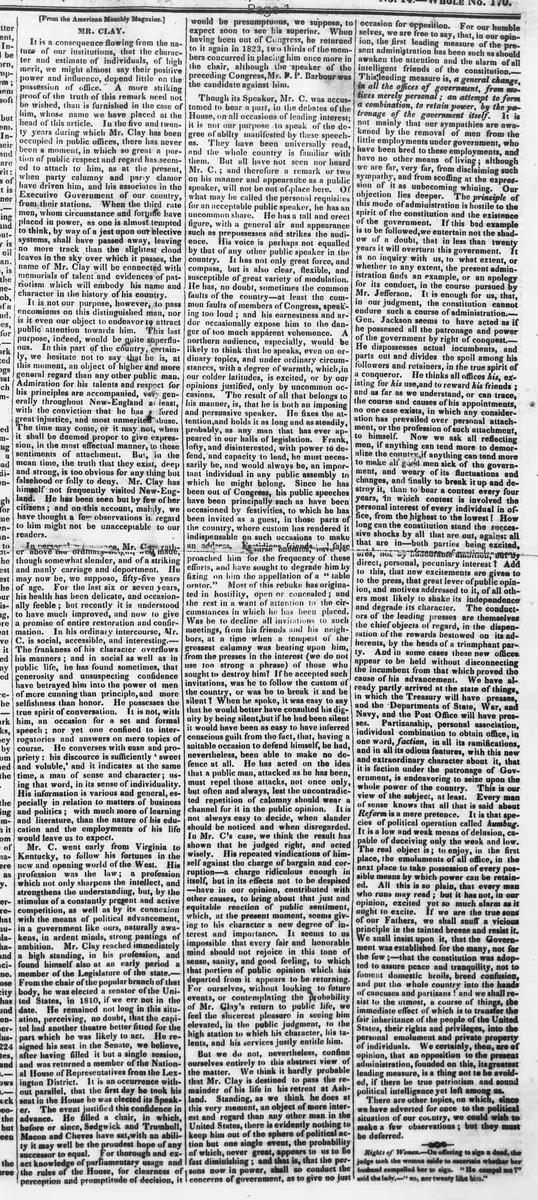
MR. CLAY.
It is a consequence flowing from the nature of our institutions, that the character and estimate of individuals, of high merit, we might almost say their positive power and influence, depend little on the possession of office. A more striking proof of the truth of this remark need not be wished, than is furnished in the case of him, whose name we have placed at the head of this article. In the five and twenty years during which Mr. Clay has been occupied in public offices, there has never been a moment, in which so great a portion of public respect and regard has seemed to attach to him, as at the present, when party calumny and party clamor have driven him, and his associates in the Executive Government of our country, from their stations. When the third rate men, whom circumstance and fortune have placed in power, as one is almost tempted to think, by way of a jest upon our elective systems, shall have passed away, leaving no more track than the slightest cloud leaves in the sky over which it passes, the name of Mr. Clay will be connected with memorials of talent and evidences of patriotism which will embody his name and character in the history of his country.
It is not our purpose, however, to pass encomiums on this distinguished man, nor is it even our object to endeavor to attract public attention towards him. This last purpose, indeed, would be quite superfluous. In this part of the country, certainly, we hesitate not to say that he is, at this moment, an object of higher and more general regard than any other public man. Admiration for his talents and respect for his principles are accompanied, very generally throughout New-England at least, with the conviction that he has suffered great injustice, and most unmerited abuse.
The time may come, or it may not, when it shall be deemed proper to give expression, in the most effectual manner, to these sentiments of attachment. But, in the mean time, the truth that they exist, deep and strong, is too obvious for any thing but falsehood or folly to deny. Mr. Clay has himself not frequently visited New-England. He has been seen but by few of her citizens; and on this account, mainly, we have thought a few observations in regard to him might not be unacceptable to our readers.
In person Mr. Clay is above the ordinary stature, though somewhat slender, and of a striking and manly carriage and deportment. He may now be, we suppose, fifty-five years of age. For the last six or seven years, his health has been delicate, and occasionally feeble; but recently it is understood to have much improved, and now to give a promise of entire restoration and confirmation. In his ordinary intercourse, Mr. C. is social, accessible, and interesting. The frankness of his character overflows his manners; and in social as well as in public life, he has found sometimes, that generosity and unsuspecting confidence have betrayed him into the power of men of more cunning than principle, and more selfishness than honor. He possesses the true spirit of conversation. It is not, with him, an occasion for a set and formal speech; nor yet one confined to interrogatories and answers on mere topics of course. He converses with ease and propriety: his discourse is sufficiently 'sweet and voluble,' and it indicates at the same time, a man of sense and character; using that word, in its sense of individuality. His information is various and general, especially in relation to matters of business and politics; with much more of learning and literature, than the nature of his education and the employments of his life would leave us to expect.
Mr. C. went early from Virginia to Kentucky, to follow his fortunes in the new and opening world of the West. His profession was the law; a profession which not only sharpens the intellect, and strengthens the understanding, but, by the stimulus of a constantly present and active competition, as well as by its connexion with the means of political advancement, in a government like ours, naturally awakens, in ardent minds, strong pantings of ambition. Mr. Clay reached immediately a high standing, in his profession, and found himself also at an early period a member of the Legislature of the state.
From the chair of the popular branch of that body, he was elected a senator of the United States, in 1810, if we err not in the date. He remained not long in this situation, perceiving, no doubt, that the capitol had another theatre better fitted for the part which he was likely to act. He resigned his seat in the Senate, we believe, after having filled it but a single session, and was returned a member of the National House of Representatives from the Lexington District. It is an occurrence without parallel, that the first day he took his seat in the House he was elected its Speaker. The event justified this confidence in advance. He filled a chair, in which, before or since, Sedgwick and Trumbull, Macon and Cheves have sat, with an ability it may well be the proudest hope of any successor to equal. For thorough and exact knowledge of parliamentary usage and the rules of the House, for clearness of perception and promptitude of decision, it would be presumptuous, we suppose, to expect soon to see his superior. When having been out of Congress, he returned to it again in 1823, two thirds of the members concurred in placing him once more in the chair, although the speaker of the preceding Congress, Mr. P. P. Barbour was the candidate against him.
Though its Speaker, Mr. C. was accustomed to bear a part, in the debates of the House, on all occasions of leading interest; it is not our purpose to speak of the degree of ability manifested by these speeches. They have been universally read, and the whole country is familiar with them. But all have not seen nor heard Mr. C.; and therefore a remark or two on his manner and appearance as a public speaker, will not be out of place here. Of what may be called the personal requisites for an acceptable public speaker, he has an uncommon share. He has a tall and erect figure, with a general air and appearance such as prepossesses and strikes the audience. His voice is perhaps not equalled by that of any other public speaker in the country. It has not only great force, and compass, but is also clear, flexible, and susceptible of great variety of modulation.
He has, no doubt, sometimes the common faults of the country—at least the common faults of members of Congress, speaking too loud; and his earnestness and ardor occasionally expose him to the danger of too much apparent vehemence. A northern audience, especially, would be likely to think that he speaks, even on ordinary topics, and under ordinary circumstances, with a degree of warmth, which, in our colder latitudes, is excited, or by our opinions justified, only by uncommon occasions. The result of all that belongs to his manner, is, that he is both an imposing and persuasive speaker. He fixes the attention, and holds it as long and as steadily, probably, as any man that has ever appeared in our halls of legislation. Frank, lofty, and disinterested, with power to defend, and capacity to lead, he must necessarily be, and would always be, an important individual in any public assembly to which he might belong.
Since he has been out of Congress, his public speeches have been principally such as have been occasioned by festivities, to which he has been invited as a guest, in those parts of the country, where custom has rendered it indispensable on such occasions to make an address. Satirists once and again, have reproached him for the frequency of these efforts, and have sought to degrade him by fixing on him the appellation of a "table orator." Most of this rebuke has originated in hostility, open or concealed; and the rest in a want of attention to the circumstances in which he has been placed. Was he to decline all invitations to such meetings, from his friends and his neighbors, at a time when a tempest of the grossest calumny was beating upon him, from the presses in the interest (we do not use too strong a phrase) of those who sought to destroy him? If he accepted such invitations, was he to follow the custom of the country, or was he to break it and be silent? When he spoke, it was easy to say that he would better have consulted his dignity by being silent, but if he had been silent it would have been as easy to have inferred conscious guilt from the fact, that, having a suitable occasion to defend himself, he had, nevertheless, been able to make no defence at all. He has acted on the idea that a public man, attacked as he has been, must repel those attacks, not once only, but often and always, lest the uncontradicted repetition of calumny should wear a channel for it in the public opinion. It is not always easy to decide, when slander should be noticed and when disregarded.
In Mr. C's case, we think the result has shown that he judged right, and acted wisely. His repeated vindications of himself against the charge of bargain and corruption—a charge ridiculous enough in itself, but in its effects not to be despised—have in our opinion, contributed with other causes, to bring about that just and equitable reaction of public sentiment, which, at the present moment, seems giving to his character a new degree of interest and importance. It seems to us impossible that every fair and honorable mind should not rejoice in this tone of sense, sanity, and good feeling, to which that portion of public opinion which has departed from it appears to be returning.
For ourselves, without looking to future events, or contemplating the probability of Mr. Clay's return to public life, we feel the sincerest pleasure in seeing him elevated, in the public judgment, to the high station to which his character, his talents, and his services justly entitle him. But we do not, nevertheless, confine ourselves entirely to this abstract view of the matter. We think it hardly probable that Mr. Clay is destined to pass the remainder of his life in his retreat at Ashland. Standing, as we think he does at this very moment, an object of more interest and regard than any other man in the United States, there is evidently nothing to keep him out of the sphere of political action but one single event, the probability of which, never great, appears to us to be fast diminishing; and that is, that the persons now in power, shall so conduct the concerns of government, as to give no just
occasion for opposition. For our humble selves, we are free to say, that, in our opinion, the first leading measure of the present administration has been such as should awaken the attention and the alarm of all intelligent friends of the constitution.
This leading measure is, a general change, in all the offices of government, from motives merely personal; an attempt to form a combination, to retain power, by the patronage of the government itself. It is not mainly that our sympathies are awakened by the removal of men from the little employments under government, who have been bred to these employments, and have no other means of living; although we are far, very far, from disclaiming such sympathy, and from scoffing at the expression of it as unbecoming whining. Our objection lies deeper. The principle of this mode of administration is hostile to the spirit of the constitution and the existence of the government. If this bad example is to be followed, we entertain not the shadow of a doubt, that in less than twenty years it will overturn this government. It is no inquiry with us, to what extent, or whether to any extent, the present administration finds an example, or an apology for its conduct, in the course pursued by Mr. Jefferson. It is enough for us, that, in our judgment, the constitution cannot endure such a course of administration.
Gen. Jackson seems to have acted as if he possessed all the patronage and power of the government by right of conquest.
He dispossesses actual incumbents, and parts out and divides the spoil among his followers and retainers, in the true spirit of a conqueror. He thinks all offices his, existing for his use, and to reward his friends; and as far as we understand, or can trace, the course and causes of his appointments, no one case exists, in which any consideration has prevailed over personal attachment, or the profession of such attachment, to himself. Now we ask all reflecting men, if anything can tend more to demoralize the country, if anything can tend more to make all good men sick of the government, and weary of its fluctuations and changes, and finally to break it up and destroy it, than to bear a contest every four years, in which contest is involved the personal interest of every individual in office, from the highest to the lowest! How long can the constitution stand the successive shocks by all that are out, against all that are in—both parties being excited, not by honorable ambition, but by direct, personal, pecuniary interest? Add to this, that new excitements are given to the press, that great lever of public opinion, and motives addressed to it, of all others most likely to shake its independence and degrade its character. The conductors of the leading presses are themselves the chief objects of regard, in the dispensation of the rewards bestowed on its adherents, by the heads of a triumphant party. And in some cases these new offices appear to be held without disconnecting the incumbent from that which proved the cause of his advancement. We have already partly arrived at the state of things, in which the Treasury will have presses, and the Departments of State, War, and Navy, and the Post Office will have presses.
Partizanship, personal association, individual combination to obtain office, in one word, faction, in all its ramifications, and in all its odious features, with this new and extraordinary character about it, that it is faction under the patronage of Government, is endeavoring to seize upon the whole power of the country. This is our view of the subject, at least. Every man of sense knows that all that is said about Reform is a mere pretence. It is that species of political operation called humbug. It is a low and weak means of delusion, capable of deceiving only the weak and low. The real object is; to enjoy, in the first place, the emoluments of all office, in the next place to take possession of every possible means by which power can be retained. All this is so plain, that every man who runs may read; but it has not, in our opinion, excited yet so much alarm as it ought to excite. If we are the true sons of our Fathers, we shall snuff a vicious principle in the tainted breeze and resist it.
We shall insist upon it, that the Government was established for the many, not for the few;—that the constitution was adopted to assure peace and tranquility, not to foment domestic broils, breed confusion, and put the whole country into the hands of caucuses and partisans! and we shall resist to the utmost, a course of things, the immediate effect of which is to transfer the fair inheritance of the people of the United States, their rights and privileges, into the personal emolument and private property of individuals. We certainly, then, are of opinion, that an opposition to the present administration, founded on this, its greatest leading measure, is a thing not to be avoided, if there be true patriotism and sound political intelligence yet left among us.
There are other topics, on which, since we have adverted for once to the political situation of our country, we could wish to make a few observations; but they must be deferred.
What sub-type of article is it?
What keywords are associated?
What entities or persons were involved?
Editorial Details
Primary Topic
Praise For Henry Clay And Critique Of Jackson's Patronage System
Stance / Tone
Supportive Of Clay, Strongly Critical Of Jackson Administration
Key Figures
Key Arguments