Thank you for visiting SNEWPapers!
Sign up free
Editorial
April 18, 1809
Alexandria Daily Gazette, Commercial & Political
Alexandria, Virginia
What is this article about?
A letter recounts Judge Oliver Ellsworth's 1797 prediction of Thomas Jefferson's potential presidency, portraying him as a visionary influenced by the French Revolution, likely leading to weak government, lack of energy, and risk of war with Britain despite no intent.
Clipping
OCR Quality
98%
Excellent
Full Text
Character of Jefferson.
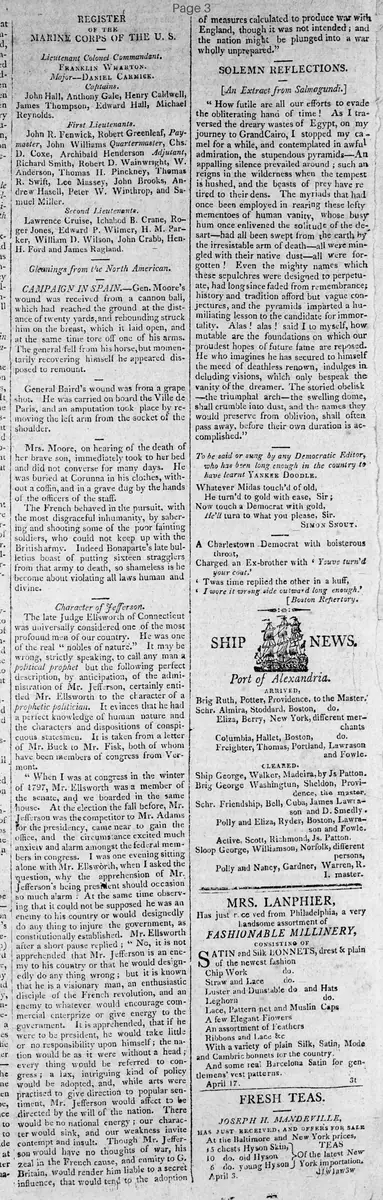
The late Judge Ellsworth of Connecticut was universally considered one of the most profound men of our country. He was one of the real "nobles of nature." It may be wrong, strictly speaking, to call any man a political prophet but the following perfect description, by anticipation, of the administration of Mr. Jefferson, certainly entitles Mr. Ellsworth to the character of a prophetic politician. It evinces that he had a perfect knowledge of human nature and the characters and dispositions of conspicuous statesmen. It is taken from a letter of Mr. Buck to Mr. Fisk, both of whom have been members of congress from Vermont.
"When I was at congress in the winter of 1797, Mr. Ellsworth was a member of the senate, and we boarded in the same house. At the election the fall before, Mr. Jefferson was the competitor to Mr. Adams for the presidency, came near to gain the office, and the circumstance excited much anxiety and alarm amongst the federal members in congress. I was one evening sitting alone with Mr. Ellsworth, when I asked the question, why the apprehension of Mr. Jefferson's being president should occasion so much alarm : At the same time observing that it could not be supposed he was an enemy to his country or would designedly do any thing to injure the government, as constitutionally established. "Mr. Ellsworth after a short pause replied ; " No, it is not apprehended that Mr. Jefferson is an enemy to his country or that he would designedly do any thing wrong; but it is known that he is a visionary man, an enthusiastic disciple of the French revolution, and an enemy to whatever would encourage commercial enterprise or give energy to the government. It is apprehended, that if he were to be president, he would take little or no responsibility upon himself; the nation would be as it were without a head; every thing would be referred to congress; a lax, intriguing kind of policy would be adopted, and, while arts were practised to give direction to popular sentiment, Mr. Jefferson would affect to be directed by the will of the nation. There would be no national energy; our character would sink, and our weakness invite contempt and insult. Though Mr. Jefferson would have no thoughts of war, his zeal in the French cause, and enmity to G. Britain, would render him liable to a secret British influence, that would tend to the adoption of measures calculated to produce war with England, though it was not intended; and the nation might be plunged into a war wholly unprepared."
The late Judge Ellsworth of Connecticut was universally considered one of the most profound men of our country. He was one of the real "nobles of nature." It may be wrong, strictly speaking, to call any man a political prophet but the following perfect description, by anticipation, of the administration of Mr. Jefferson, certainly entitles Mr. Ellsworth to the character of a prophetic politician. It evinces that he had a perfect knowledge of human nature and the characters and dispositions of conspicuous statesmen. It is taken from a letter of Mr. Buck to Mr. Fisk, both of whom have been members of congress from Vermont.
"When I was at congress in the winter of 1797, Mr. Ellsworth was a member of the senate, and we boarded in the same house. At the election the fall before, Mr. Jefferson was the competitor to Mr. Adams for the presidency, came near to gain the office, and the circumstance excited much anxiety and alarm amongst the federal members in congress. I was one evening sitting alone with Mr. Ellsworth, when I asked the question, why the apprehension of Mr. Jefferson's being president should occasion so much alarm : At the same time observing that it could not be supposed he was an enemy to his country or would designedly do any thing to injure the government, as constitutionally established. "Mr. Ellsworth after a short pause replied ; " No, it is not apprehended that Mr. Jefferson is an enemy to his country or that he would designedly do any thing wrong; but it is known that he is a visionary man, an enthusiastic disciple of the French revolution, and an enemy to whatever would encourage commercial enterprise or give energy to the government. It is apprehended, that if he were to be president, he would take little or no responsibility upon himself; the nation would be as it were without a head; every thing would be referred to congress; a lax, intriguing kind of policy would be adopted, and, while arts were practised to give direction to popular sentiment, Mr. Jefferson would affect to be directed by the will of the nation. There would be no national energy; our character would sink, and our weakness invite contempt and insult. Though Mr. Jefferson would have no thoughts of war, his zeal in the French cause, and enmity to G. Britain, would render him liable to a secret British influence, that would tend to the adoption of measures calculated to produce war with England, though it was not intended; and the nation might be plunged into a war wholly unprepared."
What sub-type of article is it?
Partisan Politics
Foreign Affairs
What keywords are associated?
Jefferson Character
Ellsworth Prediction
Federalist Alarm
French Revolution Influence
British Enmity
Presidential Weakness
What entities or persons were involved?
Thomas Jefferson
Judge Ellsworth
Mr. Buck
Mr. Fisk
John Adams
French Revolution
Great Britain
Editorial Details
Primary Topic
Judge Ellsworth's Prediction Of Jefferson's Presidency
Stance / Tone
Critical Of Jefferson, Praising Ellsworth's Foresight
Key Figures
Thomas Jefferson
Judge Ellsworth
Mr. Buck
Mr. Fisk
John Adams
French Revolution
Great Britain
Key Arguments
Jefferson Is A Visionary And Enthusiast Of The French Revolution
He Opposes Measures Encouraging Commercial Enterprise Or Government Energy
As President, He Would Avoid Responsibility, Referring Everything To Congress
A Lax, Intriguing Policy Would Be Adopted, Manipulating Popular Sentiment
Lack Of National Energy Would Weaken The Us Character And Invite Insult
His Pro French Stance And Anti British Enmity Could Lead To Unintended War With England Via British Influence