Thank you for visiting SNEWPapers!
Sign up free
Literary
February 11, 1935
The Times News
Hendersonville, Henderson County, North Carolina
What is this article about?
In Chapter XXII of 'Silken Spindles,' Gale Henderson, stranded in sleet after missing her bus, accepts a ride from Brian Westmore. They share coffee and sandwiches, discussing Brian's pension plan for mill workers. He takes her home, where Steve Meyers approaches.
Merged-components note: Merged parts of the serial story 'Silken Spindles' with accompanying illustrations based on sequential reading order and spatial proximity.
Clipping
OCR Quality
65%
Fair
Full Text
BEGIN HERE TODAY
Gale Henderson, pretty and 23, works at a silk mill.
She and her 1 year-old brother, Phil, support their invalid father.
In the mill Gale asks Steve Meyers who also works there to marry him. She promises to give him an answer in a few days.
Westmore whose father, now dead built the mill. Brian has come home after two years in Paris to enter the mill. Gale disappears before he learns her name.
Vicky Thatcher, daughter of Robert Thatcher, general manager of the mill, schemes to captivate Brian. She asks him to help her in a plan, supposedly to discourage Greg Harmon, an unwelcome suitor. The plan is really an attempt to inveigle Brian to show her attentions.
Brian agrees.
NOW GO ON WITH THE STORY
CHAPTER XXII
The coupe came to a stop and the door opened. A man's voice called. "Want a ride east? Be glad to take you—"
She couldn't stand there in the sleet and cold for four hours; that was certain. She tried to see the man in the car but his face was in darkness.
"I do want to get home," she said. "I missed the bus."
"Yes. I saw the driver pull away and leave you. That was a mean trick. Say—" All at once the man was out of the car, coming toward her. "Why, Gale Henderson!" he exclaimed. "I didn't know it was you! What in the world are you doing here?"
Gale looked up at Brian Westmore. She hoped he would think it was the cold that made her lips tremble as they did. She said, "I didn't recognize you either."
"But you mustn't stand here shivering. Here—get into the car."
He helped her into the coupe, and a moment later was beside her. "Say, I came along just when I did," he went on. "It's a rotten afternoon—you shouldn't be out in it."
Gale smiled. "Believe it or not, mister," she said, "I was waiting for a bus—and I'd have had quite a wait, too. The next one isn't due until 8:30."
He said, concerned, "You're cold aren't you? Take my coat—"
She shook her head. "Oh, no," she said, "I'm warm now. Really I am! Tell me, do you always go around rescuing maidens in distress? I believe this is the second time you've saved me from an icy death."
Brian laughed. "As a career," he said, "I can't think of anything I'd like better than rescuing maidens in distress. Would you give me a letter of recommendation or testimonial?"
"I certainly would. Any time you want it."
They drove in silence for a few moments. Then Brian asked, "Have you given up skating? I've been out once or twice and looked for you but I didn't see you."
"I've—been busy." Gale told him.
So he'd missed her. He'd looked for her.
Gale went on, without raising her eyes, "Be—"
WHO WAS FIRST IN AMERICA
By Joseph Nathan Kane
Author of "Famous First Facts"
What was the first motion picture with a plot?
When were the first national Soldiers' Homes opened?
What college was the first to offer medical instruction?
Answers in next issue.
FIRST COTTON THREAD MADE IN PAWTUCKET, R.I., IN 1793.
ACCOMES FIRST INDIAN TEACHER OF CHRISTIANITY
OAKLAND, CAL., HAD FIRST COMMERCIAL LAUNDRY, 1851.
Answers to Previous Questions
HANNAH WILKINSON WAS first to conceive the idea of twisting fine Surinam cotton yarn on spinning wheels.
Hiacoomes was ordained in 1670 and preached to the Indians in a small church at Martha's Vineyard, Mass. The Oakland laundry was started for the purpose of washing the clothes of the men who had come to California in the gold rush.
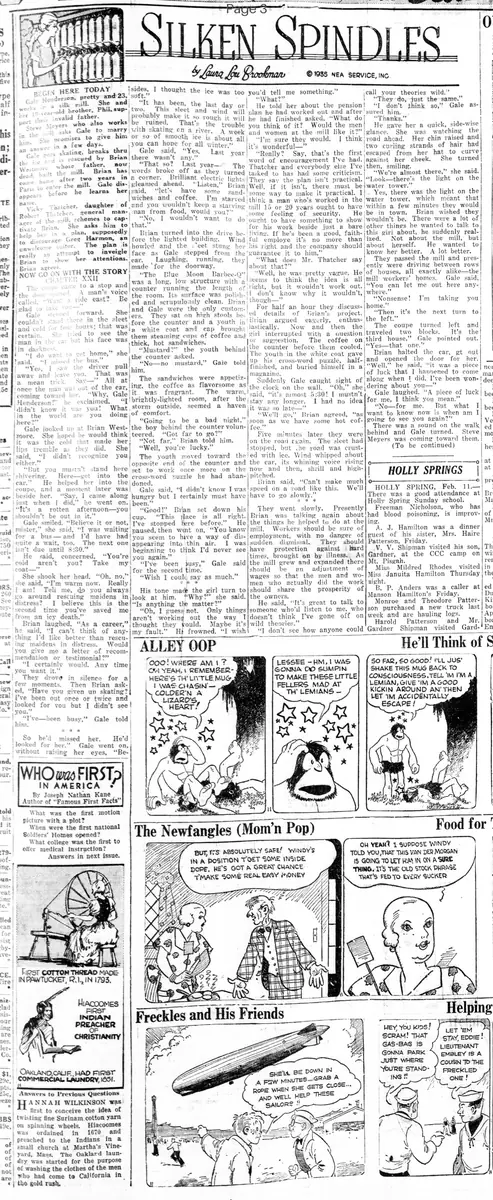
SILKEN SPINDLES
Besides, I thought the ice was too soft.
"It has been, the last day or two.
This sleet and wind will probably make it so rough it will be ruined. That's the trouble with skating on a river. A week or so of smooth ice is about all you can hope for all winter."
Gale said, "Yes.
Last year there wasn't any."
"That so?
Last year—"
The words broke off as they turned a corner.
Brilliant electric lights gleamed ahead.
"Listen,"
Brian said, "let's have some sandwiches and coffee.
I'm starved and you wouldn't keep a starving man from food, would you?"
"No. I wouldn't want to do that."
Brian turned into the drive before the lighted building. Wind howled and the sleet stung her face as Gale stepped from the car.
Laughing, running, they made for the doorway.
"The Blue Moon Barbee-Q"
was a long, low structure with a counter running the length of the room. Its surface was polished and scrupulously clean. Brian and Gale were the only customers. They sat on high stools before the counter and a youth in a white coat and cap brought them steaming cups of coffee and thick, hot sandwiches.
"Mustard?" the youth behind the counter asked.
"No—no mustard," Gale told him.
The sandwiches were appetizing, the coffee as flavorsome as it was fragrant.
The warm, brightly-lighted room, after the storm outside, seemed a haven of comfort.
"Going to be a bad night,"
the boy behind the counter volunteered. "Got far to go?"
"Not far." Brian told him.
"Well, you're lucky."
The youth moved toward the opposite end of the counter and set to work once more on the cross-word puzzle he had abandoned.
Gale said, "I didn't know I was hungry but I certainly must have been."
"Good!" Brian set down his cup.
"This place is all right.
I've stopped here before."
He paused, then went on, "You know you seem to have a way of disappearing into thin air. I was beginning to think I'd never see you again."
"I've been busy," Gale said for the second time.
"Wish I could say as much."
His tone made the girl turn to look at him. "Why?" she said.
"Is anything the matter?"
"Oh, I guess not. Only things aren't working out the way I thought they would. Maybe it's my fault." He frowned. "I wish
you'd tell me something."
"What?"
He told her about the pension plan he had worked out and after he had finished asked, "What do you think of it? Would the men and women at the mill like it?"
"I'm sure they would. I think it's wonderful"
"Really? Say, that's the first word of encouragement I've had.
Thatcher and everybody else I've talked to has had some criticism.
They say the plan isn't practical.
Well, if it isn't, there must be some way to make it practical. I think a man who's worked in the mill 15 or 20 years ought to have some feeling of security.
He ought to have something to show for his work beside just a bare living. If he's been a good, faithful employee it's no more than his right and the company should guarantee it to him."
"What does Mr. Thatcher say about that?"
"Well, he was pretty vague. He seems to think the idea is all right, but it wouldn't work out.
I don't know why it wouldn't, though"
For half an hour they discussed details of Brian's project.
Brian argued eagerly, enthusiastically. Now and then the girl interrupted with a question or suggestion. The coffee on the counter before them cooled.
The youth in the white coat gave up his cross-word puzzle, half-finished, and buried himself in a magazine.
Suddenly Gale caught sight of the clock on the wall, "Oh," she said, "it's almost 5:30! I mustn't stay any longer. I had no idea it was so late—"
"We'll go," Brian agreed, "as soon as we have some hot coffee."
Five minutes later they were on the road again. The sleet had stopped, but the road was crusted with ice. Wind whipped about the car, its whining voice rising now and then, shrill and high-pitched.
Brian said. "Can't make much speed on a road like this. We'll have to go slowly."
They went slowly. Presently Brian was talking again about the things he helped to do at the mill, Workers should be sure of employment, with no danger of sudden dismissal.
They should have protection against hard times, brought on by illness. As the mill grew and expanded there should be an adjustment of wages so that the men and women who actually did the work should share the prosperity of the owners.
He said, "It's great to talk to someone who'll listen to me, who doesn't think I've gone off on wild theories."
"I don't see how anyone could call your theories wild."
"They do, just the same."
"I don't think so," Gale assured him.
"Thanks."
He gave her a quick, side-wise glance. She was watching the road ahead. Her chin raised and two curling strands of hair had escaped from her hat to curve against her cheek. She turned then, smiling.
"We're almost there," she said.
"Look—there's the light on the water tower."
Yes, there was the light on the water tower, which meant that within a few minutes they would be in town. Brian wished they wouldn't be. There were a lot of other things he wanted to talk to this girl about, he suddenly realized. Not about the mill, but about herself. He wanted to know her better. A lot better.
They passed the mill and presently were driving between rows of houses, all exactly alike—the mill workers' homes. Gale said, "You can let me out here anywhere."
"Nonsense! I'm taking you home."
"Then it's the next turn to the left."
The coupe turned left and traveled two blocks.
"It's the third house," Gale pointed out.
"Yes—that one."
Brian halted the car, got out and opened the door for her.
"Well," he said, "it was a piece of luck that I happened to come along when I did. I've been wondering about you—"
Gale laughed. "A piece of luck for me, I think you mean."
"No—for me. But what I want to know now is when am I going to see you again?'
There was a sound on the walk behind and Gale turned. Steve Meyers was coming toward them.
(To be continued)
Gale Henderson, pretty and 23, works at a silk mill.
She and her 1 year-old brother, Phil, support their invalid father.
In the mill Gale asks Steve Meyers who also works there to marry him. She promises to give him an answer in a few days.
Westmore whose father, now dead built the mill. Brian has come home after two years in Paris to enter the mill. Gale disappears before he learns her name.
Vicky Thatcher, daughter of Robert Thatcher, general manager of the mill, schemes to captivate Brian. She asks him to help her in a plan, supposedly to discourage Greg Harmon, an unwelcome suitor. The plan is really an attempt to inveigle Brian to show her attentions.
Brian agrees.
NOW GO ON WITH THE STORY
CHAPTER XXII
The coupe came to a stop and the door opened. A man's voice called. "Want a ride east? Be glad to take you—"
She couldn't stand there in the sleet and cold for four hours; that was certain. She tried to see the man in the car but his face was in darkness.
"I do want to get home," she said. "I missed the bus."
"Yes. I saw the driver pull away and leave you. That was a mean trick. Say—" All at once the man was out of the car, coming toward her. "Why, Gale Henderson!" he exclaimed. "I didn't know it was you! What in the world are you doing here?"
Gale looked up at Brian Westmore. She hoped he would think it was the cold that made her lips tremble as they did. She said, "I didn't recognize you either."
"But you mustn't stand here shivering. Here—get into the car."
He helped her into the coupe, and a moment later was beside her. "Say, I came along just when I did," he went on. "It's a rotten afternoon—you shouldn't be out in it."
Gale smiled. "Believe it or not, mister," she said, "I was waiting for a bus—and I'd have had quite a wait, too. The next one isn't due until 8:30."
He said, concerned, "You're cold aren't you? Take my coat—"
She shook her head. "Oh, no," she said, "I'm warm now. Really I am! Tell me, do you always go around rescuing maidens in distress? I believe this is the second time you've saved me from an icy death."
Brian laughed. "As a career," he said, "I can't think of anything I'd like better than rescuing maidens in distress. Would you give me a letter of recommendation or testimonial?"
"I certainly would. Any time you want it."
They drove in silence for a few moments. Then Brian asked, "Have you given up skating? I've been out once or twice and looked for you but I didn't see you."
"I've—been busy." Gale told him.
So he'd missed her. He'd looked for her.
Gale went on, without raising her eyes, "Be—"
WHO WAS FIRST IN AMERICA
By Joseph Nathan Kane
Author of "Famous First Facts"
What was the first motion picture with a plot?
When were the first national Soldiers' Homes opened?
What college was the first to offer medical instruction?
Answers in next issue.
FIRST COTTON THREAD MADE IN PAWTUCKET, R.I., IN 1793.
ACCOMES FIRST INDIAN TEACHER OF CHRISTIANITY
OAKLAND, CAL., HAD FIRST COMMERCIAL LAUNDRY, 1851.
Answers to Previous Questions
HANNAH WILKINSON WAS first to conceive the idea of twisting fine Surinam cotton yarn on spinning wheels.
Hiacoomes was ordained in 1670 and preached to the Indians in a small church at Martha's Vineyard, Mass. The Oakland laundry was started for the purpose of washing the clothes of the men who had come to California in the gold rush.
SILKEN SPINDLES
Besides, I thought the ice was too soft.
"It has been, the last day or two.
This sleet and wind will probably make it so rough it will be ruined. That's the trouble with skating on a river. A week or so of smooth ice is about all you can hope for all winter."
Gale said, "Yes.
Last year there wasn't any."
"That so?
Last year—"
The words broke off as they turned a corner.
Brilliant electric lights gleamed ahead.
"Listen,"
Brian said, "let's have some sandwiches and coffee.
I'm starved and you wouldn't keep a starving man from food, would you?"
"No. I wouldn't want to do that."
Brian turned into the drive before the lighted building. Wind howled and the sleet stung her face as Gale stepped from the car.
Laughing, running, they made for the doorway.
"The Blue Moon Barbee-Q"
was a long, low structure with a counter running the length of the room. Its surface was polished and scrupulously clean. Brian and Gale were the only customers. They sat on high stools before the counter and a youth in a white coat and cap brought them steaming cups of coffee and thick, hot sandwiches.
"Mustard?" the youth behind the counter asked.
"No—no mustard," Gale told him.
The sandwiches were appetizing, the coffee as flavorsome as it was fragrant.
The warm, brightly-lighted room, after the storm outside, seemed a haven of comfort.
"Going to be a bad night,"
the boy behind the counter volunteered. "Got far to go?"
"Not far." Brian told him.
"Well, you're lucky."
The youth moved toward the opposite end of the counter and set to work once more on the cross-word puzzle he had abandoned.
Gale said, "I didn't know I was hungry but I certainly must have been."
"Good!" Brian set down his cup.
"This place is all right.
I've stopped here before."
He paused, then went on, "You know you seem to have a way of disappearing into thin air. I was beginning to think I'd never see you again."
"I've been busy," Gale said for the second time.
"Wish I could say as much."
His tone made the girl turn to look at him. "Why?" she said.
"Is anything the matter?"
"Oh, I guess not. Only things aren't working out the way I thought they would. Maybe it's my fault." He frowned. "I wish
you'd tell me something."
"What?"
He told her about the pension plan he had worked out and after he had finished asked, "What do you think of it? Would the men and women at the mill like it?"
"I'm sure they would. I think it's wonderful"
"Really? Say, that's the first word of encouragement I've had.
Thatcher and everybody else I've talked to has had some criticism.
They say the plan isn't practical.
Well, if it isn't, there must be some way to make it practical. I think a man who's worked in the mill 15 or 20 years ought to have some feeling of security.
He ought to have something to show for his work beside just a bare living. If he's been a good, faithful employee it's no more than his right and the company should guarantee it to him."
"What does Mr. Thatcher say about that?"
"Well, he was pretty vague. He seems to think the idea is all right, but it wouldn't work out.
I don't know why it wouldn't, though"
For half an hour they discussed details of Brian's project.
Brian argued eagerly, enthusiastically. Now and then the girl interrupted with a question or suggestion. The coffee on the counter before them cooled.
The youth in the white coat gave up his cross-word puzzle, half-finished, and buried himself in a magazine.
Suddenly Gale caught sight of the clock on the wall, "Oh," she said, "it's almost 5:30! I mustn't stay any longer. I had no idea it was so late—"
"We'll go," Brian agreed, "as soon as we have some hot coffee."
Five minutes later they were on the road again. The sleet had stopped, but the road was crusted with ice. Wind whipped about the car, its whining voice rising now and then, shrill and high-pitched.
Brian said. "Can't make much speed on a road like this. We'll have to go slowly."
They went slowly. Presently Brian was talking again about the things he helped to do at the mill, Workers should be sure of employment, with no danger of sudden dismissal.
They should have protection against hard times, brought on by illness. As the mill grew and expanded there should be an adjustment of wages so that the men and women who actually did the work should share the prosperity of the owners.
He said, "It's great to talk to someone who'll listen to me, who doesn't think I've gone off on wild theories."
"I don't see how anyone could call your theories wild."
"They do, just the same."
"I don't think so," Gale assured him.
"Thanks."
He gave her a quick, side-wise glance. She was watching the road ahead. Her chin raised and two curling strands of hair had escaped from her hat to curve against her cheek. She turned then, smiling.
"We're almost there," she said.
"Look—there's the light on the water tower."
Yes, there was the light on the water tower, which meant that within a few minutes they would be in town. Brian wished they wouldn't be. There were a lot of other things he wanted to talk to this girl about, he suddenly realized. Not about the mill, but about herself. He wanted to know her better. A lot better.
They passed the mill and presently were driving between rows of houses, all exactly alike—the mill workers' homes. Gale said, "You can let me out here anywhere."
"Nonsense! I'm taking you home."
"Then it's the next turn to the left."
The coupe turned left and traveled two blocks.
"It's the third house," Gale pointed out.
"Yes—that one."
Brian halted the car, got out and opened the door for her.
"Well," he said, "it was a piece of luck that I happened to come along when I did. I've been wondering about you—"
Gale laughed. "A piece of luck for me, I think you mean."
"No—for me. But what I want to know now is when am I going to see you again?'
There was a sound on the walk behind and Gale turned. Steve Meyers was coming toward them.
(To be continued)
What sub-type of article is it?
Prose Fiction
What themes does it cover?
Love Romance
Commerce Trade
Political
What keywords are associated?
Silk Mill
Romance
Pension Plan
Workers Rights
Serial Story
Winter Sleet
Blue Moon Barbecue
Literary Details
Title
Chapter Xxii
Form / Style
Serialized Romance Chapter
Key Lines
"As A Career," He Said, "I Can't Think Of Anything I'd Like Better Than Rescuing Maidens In Distress."
"I'm Sure They Would. I Think It's Wonderful"
"It's Great To Talk To Someone Who'll Listen To Me, Who Doesn't Think I've Gone Off On Wild Theories."