Thank you for visiting SNEWPapers!
Sign up free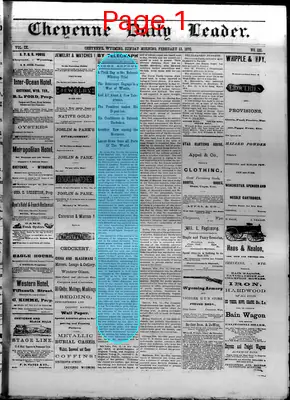
The Cheyenne Daily Leader
Cheyenne, Laramie County, Wyoming
What is this article about?
St. Louis court in Babcock whiskey trial debates admissibility of incriminating telegrams between Babcock, McDonald, and Joyce; President's deposition expresses unshaken confidence in Babcock; defense and prosecution argue intensely, court adjourns to Monday.
Clipping

OCR Quality
Full Text
REPORTED EXPRESSLY FOR THE MORNING LEADER
NIGHT REPORT
A Field Day in the Babcock
Whiskey Trial.
The Attorneys Engage in a
War of Words,
And All About A Few Tele-
grams.
The
President makes
His
Deposicion.
His Confidence in Babcock
Unshaken.
Another
Row among the
Mormons.
Latest News from all Parts
Of The World.
St. Louis, Feb. 12.-On the opening of the Babcock trial, this morning, the cross-examination of ex-commissioner Douglass was completed, and the district attorney presented an affidavit of Lindsley Murdock, an ex-collector, made in 1873, containing charges against Joyce and McDonald, which had been sent to the President, and by him referred to Douglass. Nearly the entire morning was taken up by the investigation of the famous telegrams which passed between Washington and St. Louis, and one was admitted as evidence, it being in Babcock's handwriting. It was addressed to McDonald, and reads as follows: "I have succeeded; they will not go; I will write you," and is signed "Sylph." Before this was read the defense announced that a long argument would be made against the admission of these telegrams, and as this particular one would probably be included in those objected to, the defense wished to raise that point. Deputy commissioner Rogers was re-called, and testified to certain interviews with Babcock on the matter of Douglass' order transferring McDonald to Philadelphia, in which Babcock said the order would injure Douglass politically. The opposition of the defense to the admission of the telegrams was carried to the utmost extremity. They would admit nothing unless it was proved to have been placed in the hands of the person to whom it was addressed, and the only one which could be so clearly proven was the one signed "Sylph," given above. The defense also objected to the relevancy of these dispatches, announcing that they would argue the point at length. The next dispatch traced out was to Babcock, from Joyce, but it was not read. It was traced to G. S. Joyce, door-keeper at the Executive mansion, but as he is now dead, it cannot be proven that Babcock received it. Other dispatches were traced in like manner, but their delivery to Babcock could not be proven clearly. Judge Dillon decided that although there was no positive proof of the delivery of these dispatches to Babcock, it must be presumed that as the custom of door-keepers and others who received them was to deliver them, they must be given to the jury. It was then decided to group the several telegrams together and argue on the admission of the whole at the same time. At the opening of the afternoon session the argument was commenced by Storrs, for the defense. He was followed by Col. Dyer, for the prosecution, whose address was brief and to the point. Col. Broadhead then spoke for the prosecution. Judge Porter commenced his speech for the defense, but before its conclusion the court adjourned until Monday, when the argument will be continued.
What sub-type of article is it?
What keywords are associated?
What entities or persons were involved?
Where did it happen?
Domestic News Details
Primary Location
St. Louis
Event Date
Feb. 12
Key Persons
Outcome
arguments over telegram admissibility ongoing; one telegram admitted as evidence; court adjourned until monday
Event Details
Cross-examination of ex-commissioner Douglass completed; affidavit of Lindsley Murdock presented; investigation of telegrams between Washington and St. Louis; one telegram in Babcock's handwriting admitted; defense objected to relevancy and delivery proof; Judge Dillon ruled telegrams presumptively delivered; arguments by Storrs, Dyer, Broadhead, and Porter for defense and prosecution