Thank you for visiting SNEWPapers!
Sign up free
The Columbian Fountain
Washington, District Of Columbia
What is this article about?
James Little's 1846 reminiscence of comedic mishaps at the American Theatre in Washington, D.C., during spring 1839, including a curtain failure, an absent costumed actor, and a green-room brawl that frightens off a prospective star vocalist amid poor attendance.
Merged-components note: These two components form a single continuous story titled 'A Reminiscence of the Stage' by James Little, with sequential reading orders and text that flows directly from one to the other.
Clipping
OCR Quality
Full Text
For the Columbian Fountain.
A REMINISCENCE OF THE STAGE.
BY JAMES LITTLE.
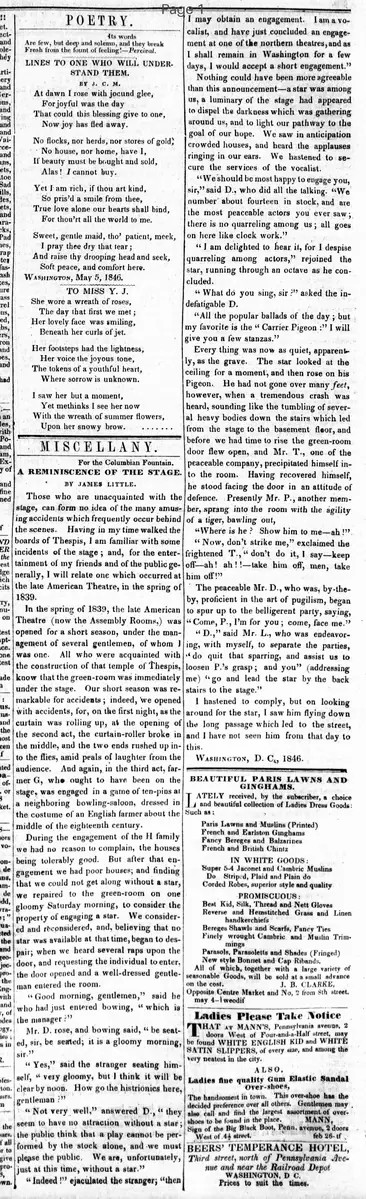
Those who are unacquainted with the stage, can form no idea of the many amusing accidents which frequently occur behind the scenes.
Having in my time walked the boards of Thespis, I am familiar with some incidents of the stage; and, for the entertainment of my friends and of the public generally, I will relate one which occurred at the late American Theatre, in the spring of 1839.
In the spring of 1839, the late American Theatre (now the Assembly Rooms,) was opened for a short season, under the management of several gentlemen, of whom I was one. All who were acquainted with the construction of that temple of Thespis know that the green-room was immediately under the stage. Our short season was remarkable for accidents; indeed, we opened with accidents, for, on the first night, as the curtain was rolling up, at the opening of the second act, the curtain-roller broke in the middle, and the two ends rushed up into the flies, amid peals of laughter from the audience. And again, in the third act, farmer G, who ought to have been on the stage, was engaged in a game of ten-pins at a neighboring bowling-saloon, dressed in the costume of an English farmer about the middle of the eighteenth century.
During the engagement of the H family we had no reason to complain, the houses being tolerably good. But after that engagement we had poor houses; and finding that we could not get along without a star, we repaired to the green-room on one gloomy Saturday morning, to consider the propriety of engaging a star. We considered and reconsidered, and, believing that no star was available at that time, began to despair; when we heard several raps upon the door, and requesting the individual to enter, the door opened and a well-dressed gentleman entered the room.
"Good morning, gentlemen," said he who had just entered bowing, " which is the manager ?"
Mr. D. rose, and bowing said, " be seated, sir, be seated; it is a gloomy morning, sir."
" Yes," said the stranger seating himself, " very gloomy, but I think it will be clear by noon. How go the histrionics here, gentleman?"
"Not very well," answered D., " they seem to have no attraction without a star; the public think that a play cannot be performed by the stock alone, and we must please the public. We are, unfortunately, just at this time, without a star."
"Indeed!" ejaculated the stranger; "then I may obtain an engagement. I am a vocalist, and have just concluded an engagement at one of the northern theatres, and as I shall remain in Washington for a few days, I would accept a short engagement."
Nothing could have been more agreeable than this announcement-a star was among us, a luminary of the stage had appeared to dispel the darkness which was gathering around us, and to light our pathway to the goal of our hope. We saw in anticipation crowded houses, and heard the applauses ringing in our ears. We hastened to secure the services of the vocalist
"We should be most happy to engage you, sir," said D., who did all the talking. "We number about fourteen in stock, and are the most peaceable actors you ever saw; there is no quarreling among us; all goes on here like clock work."
" I am delighted to hear it, for I despise quarreling among actors," rejoined the star, running through an octave as he concluded.
" What do you sing, sir ?" asked the indefatigable D.
"All the popular ballads of the day ; but my favorite is the " Carrier Pigeon :" I will give you a few stanzas."
Every thing was now as quiet, apparently, as the grave. The star looked at the ceiling for a moment, and then rose on his Pigeon. He had not gone over many feet, however, when a tremendous crash was heard, sounding like the tumbling of several heavy bodies down the stairs which led from the stage to the basement floor, and before we had time to rise the green-room door flew open, and Mr. T., one of the peaceable company, precipitated himself into the room. Having recovered himself he stood facing the door in an attitude of defence. Presently Mr. P., another member, sprang into the room with the agility of a tiger, bawling out,
"Where is he ? Show him to me-ah!"
" Now, don't strike me," exclaimed the frightened T., " don't do it, I say-keep off-ah! ah!!-take him off, men, take him off!"
The peaceable Mr. D., who was, by-the-by, proficient in the art of pugilism, began to spur up to the belligerent party, saying,
" Come, P., I'm for you; come, face me."
"D.," said Mr. L., who was endeavoring, with myself, to separate the parties,
"do quit that sparring, and assist us to loosen P.'s grasp; and you" (addressing me) "go and lead the star by the back stairs to the stage."
I hastened to comply, but on looking around for the star, I saw him flying down the long passage which led to the street and I have not seen him from that day to this.
WASHINGTON, D. C., 1846.
What sub-type of article is it?
What themes does it cover?
What keywords are associated?
What entities or persons were involved?
Where did it happen?
Story Details
Key Persons
Location
American Theatre, Washington, D.C.
Event Date
Spring Of 1839
Story Details
James Little recounts accidents during a short 1839 theater season at the American Theatre, including a broken curtain, an absent actor playing ten-pins, and a chaotic green-room fight that scares away a potential star vocalist.