Thank you for visiting SNEWPapers!
Sign up free
Domestic News
June 4, 1861
The Western Democrat
Charlotte, Mecklenburg County, North Carolina
What is this article about?
A correspondent traveling from Montgomery to Pensacola reports excellent prospects for corn and wheat crops in Alabama, with vast fields devoted to these staples, making the state the Confederacy's granary, some yielding up to 75 bushels per acre.
Clipping
OCR Quality
98%
Excellent
Full Text
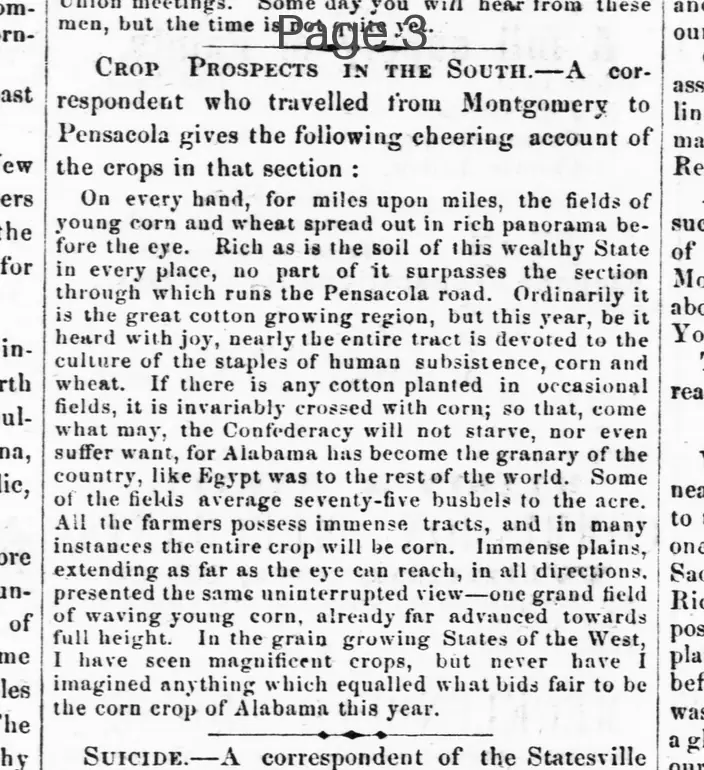
Crop Prospects in the South.—A correspondent who travelled from Montgomery to Pensacola gives the following cheering account of the crops in that section:
On every hand, for miles upon miles, the fields of young corn and wheat spread out in rich panorama before the eye. Rich as is the soil of this wealthy State in every place, no part of it surpasses the section through which runs the Pensacola road. Ordinarily it is the great cotton growing region, but this year, be it heard with joy, nearly the entire tract is devoted to the culture of the staples of human subsistence, corn and wheat. If there is any cotton planted in occasional fields, it is invariably crossed with corn; so that, come what may, the Confederacy will not starve, nor even suffer want, for Alabama has become the granary of the country, like Egypt was to the rest of the world. Some of the fields average seventy-five bushels to the acre. All the farmers possess immense tracts, and in many instances the entire crop will be corn. Immense plains, extending as far as the eye can reach, in all directions, presented the same uninterrupted view—one grand field of waving young corn, already far advanced towards full height. In the grain growing States of the West, I have seen magnificent crops, but never have I imagined anything which equalled what bids fair to be the corn crop of Alabama this year.
On every hand, for miles upon miles, the fields of young corn and wheat spread out in rich panorama before the eye. Rich as is the soil of this wealthy State in every place, no part of it surpasses the section through which runs the Pensacola road. Ordinarily it is the great cotton growing region, but this year, be it heard with joy, nearly the entire tract is devoted to the culture of the staples of human subsistence, corn and wheat. If there is any cotton planted in occasional fields, it is invariably crossed with corn; so that, come what may, the Confederacy will not starve, nor even suffer want, for Alabama has become the granary of the country, like Egypt was to the rest of the world. Some of the fields average seventy-five bushels to the acre. All the farmers possess immense tracts, and in many instances the entire crop will be corn. Immense plains, extending as far as the eye can reach, in all directions, presented the same uninterrupted view—one grand field of waving young corn, already far advanced towards full height. In the grain growing States of the West, I have seen magnificent crops, but never have I imagined anything which equalled what bids fair to be the corn crop of Alabama this year.
What sub-type of article is it?
Agriculture
Economic
What keywords are associated?
Alabama Crops
Corn Wheat
Pensacola Road
Confederacy Granary
Where did it happen?
Alabama
Domestic News Details
Primary Location
Alabama
Outcome
excellent crop prospects with fields averaging up to 75 bushels of corn per acre; alabama positioned as the confederacy's granary.
Event Details
A correspondent traveling from Montgomery to Pensacola describes vast fields of young corn and wheat along the Pensacola road, replacing usual cotton cultivation, ensuring food security for the Confederacy.