Thank you for visiting SNEWPapers!
Sign up free
Literary
October 17, 1812
Alexandria Gazette, Commercial And Political
Alexandria, Virginia
What is this article about?
This essay reflects on human passions and the regulating role of religion, contrasting the austere ministry of John the Baptist with the approachable ministry of Jesus Christ. It emphasizes the Gospel's message of peace, repentance, hope, and pardon, portraying it as life's greatest blessing that fosters harmony and joy.
Merged-components note: Continuation of the same literary essay across columns on the page.
Clipping
OCR Quality
95%
Excellent
Full Text
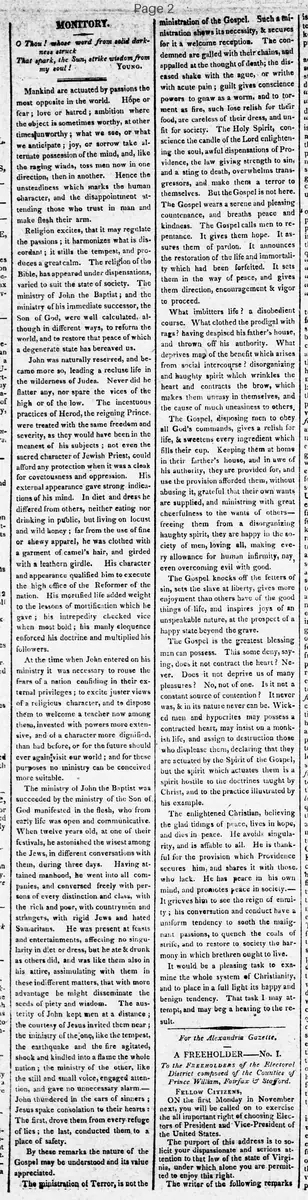
MONITORY.
O Thou! whose word from solid darkness struck
That spark, the Sun, strike wisdom from my soul!
YOUNG.
Mankind are actuated by passions the
most opposite in the world. Hope or
fear; love or hatred; ambition where
the object is sometimes worthy, at other
times unworthy; what we see, or what
we anticipate; joy, or sorrow take alternate possession of the mind, and, like
the raging winds, toss men now in one
direction, then in another. Hence the
unsteadiness which marks the human
character, and the disappointment attending those who trust in man and
make flesh their arm.
Religion excites, that it may regulate
the passions; it harmonizes what is discordant; it stills the tempest, and produces a great calm. The religion of the
Bible, has appeared under dispensations,
varied to suit the state of society. The
ministry of John the Baptist; and the
ministry of his immediate successor, the
Son of God, were well calculated, although in different ways, to reform the
world, and to restore that peace of which
a degenerate state has bereaved us.
John was naturally reserved, and became more so, leading a recluse life in
the wilderness of Judea. Never did he
flatter any, nor spare the vices of the
high or of the low. The incestuous
practices of Herod, the reigning Prince,
were treated with the same freedom and
severity, as they would have been in the
meanest of his subjects; not even the
sacred character of Jewish Priest, could
afford any protection when it was a cloak
for covetousness and oppression.
His
external appearance gave strong indications of his mind. In diet and dress he
differed from others, neither eating nor
drinking in public, but living on locusts
and wild honey; far from the use of fine
or showy apparel, he was clothed with
a garment of camel's hair, and girded
with a leathern girdle. His character
and appearance qualified him to execute
the high office of the Reformer of the
nation. His mortified life added weight
to the lessons of mortification which he
gave; his intrepidity checked vice
when most bold; his manly eloquence
enforced his doctrine and multiplied his
followers.
At the time when John entered on his
ministry it was necessary to rouse the
fears of a nation confiding in their external privileges; to excite juster views
of a religious character, and to dispose
them to welcome a teacher now among
them, invested with powers more extensive, and of a character more dignified,
than had before, or for the future should
ever again visit our world; and for these
purposes no ministry can be conceived
more suitable.
The ministry of John the Baptist was
succeeded by the ministry of the Son of.
God manifested in the flesh, who from
early life was open and communicative.
When twelve years old, at one of their
festivals, he astonished the wisest among
the Jews, in different conversations with
the in, during three days. Having attained manhood, he went into all companies, and conversed freely with persons of every distinction and class, with
the rich and poor, with countrymen and
strangers, with rigid Jews and hated
Samaritans. He was present at feasts
and entertainments, affecting no singularity in diet or dress, but he ate & drunk
as others did, and was like them also in
his attire, assimilating with them in
these indifferent matters, that with more
advantage he might disseminate the
seeds of piety and wisdom. The austerity of John kept men at a distance;
the courtesy of Jesus invited them near.
The ministry of the one, like the tempest,
the earthquake and the fire agitated,
shook and kindled into a flame the whole
nation; the ministry of the other, like
the still and small voice, engaged attention, and gave no unnecessary alarm.
John thundered in the ears of sinners;
Jesus spake consolation to their hearts:
The first, drove them from every refuge
of lies: the last, conducted them to a
place of safety.
By these remarks the nature of the
Gospel may be understood and its value
appreciated.
The ministration of Terror, is not the
ministration of the Gospel. Such a ministration shews its necessity, & secures
for it a welcome reception. The condemned are galled with their chains, and
appalled at the thought of death; the diseased shake with the ague, or writhe
with acute pain; guilt gives conscience
powers to gnaw as a worm, and to torment as fire, such lose relish for their
food, are careless of their dress, and unfit for society. The Holy Spirit, conscience the candle of the Lord enlightening the soul, awful dispensations of Providence, the law giving strength to sin,
and a sting to death, overwhelms transgressors, and make them a terror to
themselves. But the Gospel is not here.
The Gospel wears a serene and pleasing
countenance, and breaths peace and
kindness. The Gospel calls men to repentance. It gives them hope. It assures them of pardon. It announces
the restoration of the life and immortality which had been forfeited. It sets
them in the way of peace, and gives
them direction, encouragement & vigor
to proceed.
What imbitters life? a disobedient course. What clothed the prodigal with
rags? having despised his father's house,
and thrown off his authority. What
deprives man of the benefit which arises
from social intercourse? disorganizing
and haughty spirit which wrinkles the
heart and contracts the brow, which
makes them uneasy in themselves, and
the cause of much uneasiness to others.
The Gospel, disposing men to obey
all God's commands, gives a relish for
life, & sweetens every ingredient which
fills their cup. Keeping them at home
in their father's house, and in awe of
his authority, they are provided for, and
use the provision afforded them, without
abusing it, grateful that their own wants
are supplied, and ministering with great
cheerfulness to the wants of others--
freeing them from a disorganizing
haughty spirit, they are happy in the society of men, loving all, making every allowance for human infirmity, nay
even overcoming evil with good.
The Gospel knocks off the fetters of
sin, sets the slave at liberty, gives more
enjoyment than others have of the good
things of life, and inspires joys of an
unspeakable nature, at the prospect of a
happy state beyond the grave.
The Gospel is the greatest blessing
man can possess. This some deny, saying, does it not contract the heart? Never. Does it not deprive us of many
pleasures? No, not of one. Is it not a
constant source of contention? It never
was, & in its nature never can be. Wicked men and hypocrites may possess a
contracted heart, may insist on a monkish life, and assign to destruction those
who displease them, declaring that they
are actuated by the Spirit of the Gospel,
but the spirit which actuates them is a
spirit hostile to the doctrines taught by
Christ, and to the practice illustrated by
his example.
The enlightened Christian, believing
the glad tidings of peace, lives in hope,
and dies in peace. He avoids singularity, and is affable to all. He is thankful for the provision which Providence
secures him, and shares it with those
who lack. He has peace in his own
mind, and promotes peace in society.--
It grieves him to see the reign of enmity; his conversation and conduct have a
uniform tendency to sooth the malignant passions, to quench the coals of
strife, and to restore to society the harmony in which brethren ought to live.
It would be a pleasing task to examine the whole system of Christianity,
and to place in a full light its happy and
benign tendency. That task I may attempt, and may beg a hearing to the result.
O Thou! whose word from solid darkness struck
That spark, the Sun, strike wisdom from my soul!
YOUNG.
Mankind are actuated by passions the
most opposite in the world. Hope or
fear; love or hatred; ambition where
the object is sometimes worthy, at other
times unworthy; what we see, or what
we anticipate; joy, or sorrow take alternate possession of the mind, and, like
the raging winds, toss men now in one
direction, then in another. Hence the
unsteadiness which marks the human
character, and the disappointment attending those who trust in man and
make flesh their arm.
Religion excites, that it may regulate
the passions; it harmonizes what is discordant; it stills the tempest, and produces a great calm. The religion of the
Bible, has appeared under dispensations,
varied to suit the state of society. The
ministry of John the Baptist; and the
ministry of his immediate successor, the
Son of God, were well calculated, although in different ways, to reform the
world, and to restore that peace of which
a degenerate state has bereaved us.
John was naturally reserved, and became more so, leading a recluse life in
the wilderness of Judea. Never did he
flatter any, nor spare the vices of the
high or of the low. The incestuous
practices of Herod, the reigning Prince,
were treated with the same freedom and
severity, as they would have been in the
meanest of his subjects; not even the
sacred character of Jewish Priest, could
afford any protection when it was a cloak
for covetousness and oppression.
His
external appearance gave strong indications of his mind. In diet and dress he
differed from others, neither eating nor
drinking in public, but living on locusts
and wild honey; far from the use of fine
or showy apparel, he was clothed with
a garment of camel's hair, and girded
with a leathern girdle. His character
and appearance qualified him to execute
the high office of the Reformer of the
nation. His mortified life added weight
to the lessons of mortification which he
gave; his intrepidity checked vice
when most bold; his manly eloquence
enforced his doctrine and multiplied his
followers.
At the time when John entered on his
ministry it was necessary to rouse the
fears of a nation confiding in their external privileges; to excite juster views
of a religious character, and to dispose
them to welcome a teacher now among
them, invested with powers more extensive, and of a character more dignified,
than had before, or for the future should
ever again visit our world; and for these
purposes no ministry can be conceived
more suitable.
The ministry of John the Baptist was
succeeded by the ministry of the Son of.
God manifested in the flesh, who from
early life was open and communicative.
When twelve years old, at one of their
festivals, he astonished the wisest among
the Jews, in different conversations with
the in, during three days. Having attained manhood, he went into all companies, and conversed freely with persons of every distinction and class, with
the rich and poor, with countrymen and
strangers, with rigid Jews and hated
Samaritans. He was present at feasts
and entertainments, affecting no singularity in diet or dress, but he ate & drunk
as others did, and was like them also in
his attire, assimilating with them in
these indifferent matters, that with more
advantage he might disseminate the
seeds of piety and wisdom. The austerity of John kept men at a distance;
the courtesy of Jesus invited them near.
The ministry of the one, like the tempest,
the earthquake and the fire agitated,
shook and kindled into a flame the whole
nation; the ministry of the other, like
the still and small voice, engaged attention, and gave no unnecessary alarm.
John thundered in the ears of sinners;
Jesus spake consolation to their hearts:
The first, drove them from every refuge
of lies: the last, conducted them to a
place of safety.
By these remarks the nature of the
Gospel may be understood and its value
appreciated.
The ministration of Terror, is not the
ministration of the Gospel. Such a ministration shews its necessity, & secures
for it a welcome reception. The condemned are galled with their chains, and
appalled at the thought of death; the diseased shake with the ague, or writhe
with acute pain; guilt gives conscience
powers to gnaw as a worm, and to torment as fire, such lose relish for their
food, are careless of their dress, and unfit for society. The Holy Spirit, conscience the candle of the Lord enlightening the soul, awful dispensations of Providence, the law giving strength to sin,
and a sting to death, overwhelms transgressors, and make them a terror to
themselves. But the Gospel is not here.
The Gospel wears a serene and pleasing
countenance, and breaths peace and
kindness. The Gospel calls men to repentance. It gives them hope. It assures them of pardon. It announces
the restoration of the life and immortality which had been forfeited. It sets
them in the way of peace, and gives
them direction, encouragement & vigor
to proceed.
What imbitters life? a disobedient course. What clothed the prodigal with
rags? having despised his father's house,
and thrown off his authority. What
deprives man of the benefit which arises
from social intercourse? disorganizing
and haughty spirit which wrinkles the
heart and contracts the brow, which
makes them uneasy in themselves, and
the cause of much uneasiness to others.
The Gospel, disposing men to obey
all God's commands, gives a relish for
life, & sweetens every ingredient which
fills their cup. Keeping them at home
in their father's house, and in awe of
his authority, they are provided for, and
use the provision afforded them, without
abusing it, grateful that their own wants
are supplied, and ministering with great
cheerfulness to the wants of others--
freeing them from a disorganizing
haughty spirit, they are happy in the society of men, loving all, making every allowance for human infirmity, nay
even overcoming evil with good.
The Gospel knocks off the fetters of
sin, sets the slave at liberty, gives more
enjoyment than others have of the good
things of life, and inspires joys of an
unspeakable nature, at the prospect of a
happy state beyond the grave.
The Gospel is the greatest blessing
man can possess. This some deny, saying, does it not contract the heart? Never. Does it not deprive us of many
pleasures? No, not of one. Is it not a
constant source of contention? It never
was, & in its nature never can be. Wicked men and hypocrites may possess a
contracted heart, may insist on a monkish life, and assign to destruction those
who displease them, declaring that they
are actuated by the Spirit of the Gospel,
but the spirit which actuates them is a
spirit hostile to the doctrines taught by
Christ, and to the practice illustrated by
his example.
The enlightened Christian, believing
the glad tidings of peace, lives in hope,
and dies in peace. He avoids singularity, and is affable to all. He is thankful for the provision which Providence
secures him, and shares it with those
who lack. He has peace in his own
mind, and promotes peace in society.--
It grieves him to see the reign of enmity; his conversation and conduct have a
uniform tendency to sooth the malignant passions, to quench the coals of
strife, and to restore to society the harmony in which brethren ought to live.
It would be a pleasing task to examine the whole system of Christianity,
and to place in a full light its happy and
benign tendency. That task I may attempt, and may beg a hearing to the result.
What sub-type of article is it?
Essay
Soliloquy
What themes does it cover?
Religious
Moral Virtue
What keywords are associated?
Gospel
John Baptist
Jesus Christ
Religion
Peace
Repentance
Ministry
Christianity
Literary Details
Title
Monitory.
Subject
On The Ministries Of John The Baptist And Jesus, And The Nature Of The Gospel
Key Lines
O Thou! Whose Word From Solid Darkness Struck That Spark, The Sun, Strike Wisdom From My Soul!
The Ministry Of The One, Like The Tempest, The Earthquake And The Fire Agitated, Shook And Kindled Into A Flame The Whole Nation; The Ministry Of The Other, Like The Still And Small Voice, Engaged Attention, And Gave No Unnecessary Alarm.
The Gospel Wears A Serene And Pleasing Countenance, And Breaths Peace And Kindness.
The Gospel Is The Greatest Blessing Man Can Possess.