Thank you for visiting SNEWPapers!
Sign up free
National Gazette
Philadelphia, Philadelphia County, Pennsylvania
What is this article about?
Alexander Hamilton's report to the House on Treasury loans under 1790 acts, explaining use of foreign and domestic funds for public debt purchases, sinking fund management, and contingencies like St. Domingo aid, justifying financial strategies for 1790-1792.
Clipping
OCR Quality
Full Text
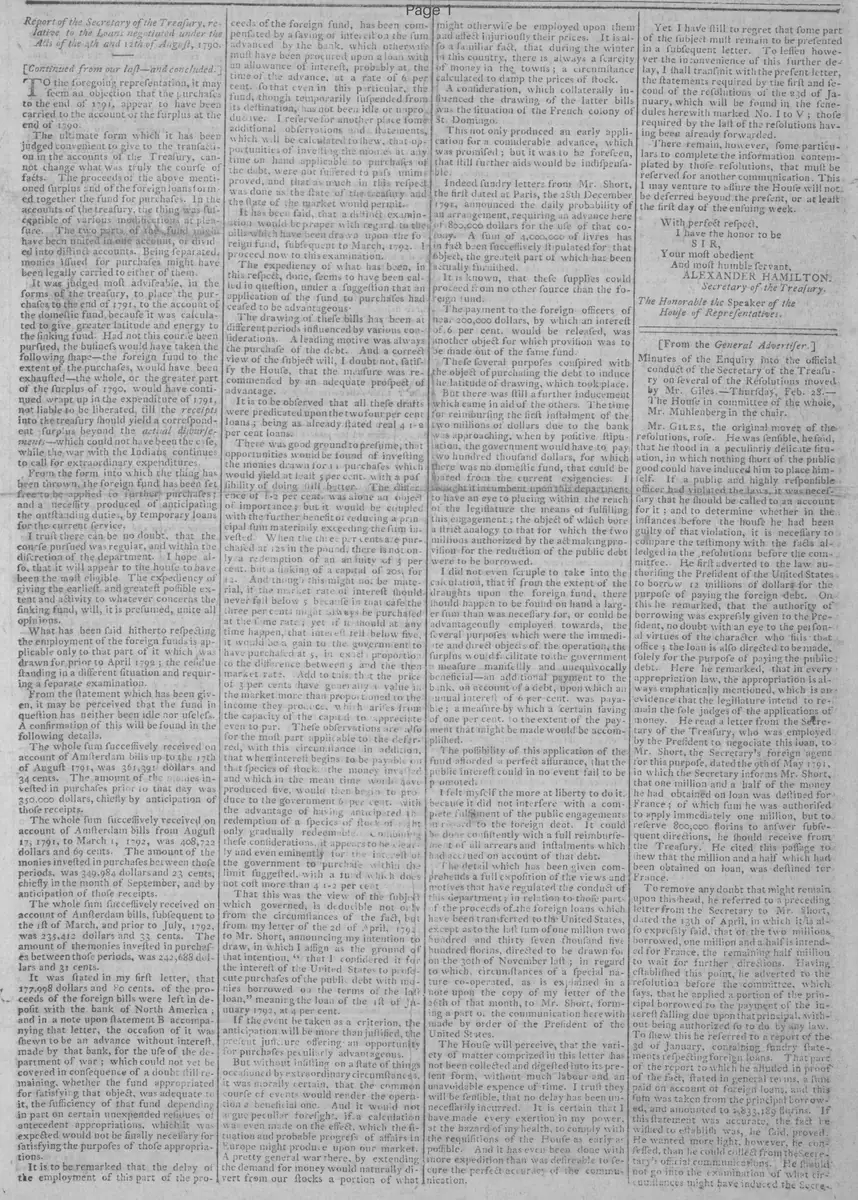
Continued from our last—and concluded.
On the foregoing representation, it may seem an objection that the purchases to the end of 1791, appear to have been carried to the account of the surplus at the end of 1790.
The ultimate form which it has been judged convenient to give to the transaction in the accounts of the Treasury, cannot change what was truly the course of facts. The proceeds of the above mentioned surplus and of the foreign loans formed together the fund for purchases. In the accounts of the treasury, the thing was susceptible of various modifications at pleasure. The two parts of the fund might have been united in one account, or divided into distinct accounts. Being separated, monies issued for purchases might have been legally carried to either of them.
It was judged most advisable, in the forms of the treasury, to place the purchases to the end of 1791, to the account of the domestic fund, because it was calculated to give greater latitude and energy to the sinking fund. Had not this course been pursued, the business would have taken the following shape—the foreign fund to the extent of the purchases, would have been exhausted—the whole, or the greater part of the surplus of 1790, would have continued wrapt up in the expenditure of 1791, not liable to be liberated, till the receipts into the treasury should yield a corresponding surplus beyond the actual disbursements—which could not have been the case, while the war with the Indians continues to call for extraordinary expenditures.
From the form into which the thing has been thrown, the foreign fund has been set free to be applied to further purchases; and a necessity produced of anticipating the outstanding duties, by temporary loans for the current service.
I trust there can be no doubt, that the course pursued was regular, and within the discretion of the department. I hope also, that it will appear to the house to have been the most eligible. The expediency of giving the earliest and greatest possible extent and activity to whatever concerns the sinking fund, will, it is presumed, unite all opinions.
What has been said hitherto respecting the employment of the foreign funds is applicable only to that part of it which was drawn for prior to April 1792; the residue standing in a different situation and requiring a separate examination.
From the statement which has been given, it may be perceived that the fund in question has neither been idle nor useless. A confirmation of this will be found in the following details.
The whole sum successively received on account of Amsterdam bills up to the 17th of August 1791, was 361,391 dollars and 34 cents. The amount of the monies invested in purchases prior to that day was 350,000 dollars, chiefly by anticipation of those receipts.
The whole sum successively received on account of Amsterdam bills from August 17, 1791, to March 1, 1792, was 408,722 dollars and 69 cents. The amount of the monies invested in purchases between those periods, was 349,984 dollars and 23 cents, chiefly in the month of September, and by anticipation of those receipts.
The whole sum successively received on account of Amsterdam bills, subsequent to the 1st of March, and prior to July, 1792, was 235,412 dollars and 33 cents. The amount of the monies invested in purchases between those periods, was 242,688 dollars and 31 cents.
It was stated in my first letter, that 177,998 dollars and 80 cents, of the proceeds of the foreign bills were left in deposit with the bank of North America; and in a note upon statement B accompanying that letter, the occasion of it was shown to be an advance without interest, made by that bank, for the use of the department of war; which could not yet be covered in consequence of a doubt still remaining, whether the fund appropriated for satisfying that object, was adequate to it, the sufficiency of that fund depending in part on certain unexpended residues of antecedent appropriations, which it was expected would not be finally necessary for satisfying the purposes of those appropriations.
It is to be remarked that the delay of the employment of this part of the proceeds of the foreign fund, has been compensated by a saving of interest on the sum advanced by the bank, which otherwise must have been procured upon a loan with an allowance of interest, probably at the time of the advance, at a rate of 6 per cent. So that even in this particular, the fund, though temporarily suspended from its destination, has not been idle or unproductive. I reserve for another place some additional observations and statements, which will be calculated to show, that opportunities of investing the monies at any time on hand applicable to purchases of the debt, were not suffered to pass unimproved, and that as much in this respect was done as the state of the treasury and the state of the market would permit.
It has been said, that a distinct examination would be proper with regard to the bills which have been drawn upon the foreign fund, subsequent to March, 1792. I proceed now to this examination.
The expediency of what has been, in this respect, done, seems to have been called in question, under a suggestion that an application of the fund to purchases had ceased to be advantageous.
The drawing of these bills has been at different periods influenced by various considerations. A leading motive was always the purchase of the debt. And a correct view of the subject will, I doubt not, satisfy the House, that the measure was recommended by an adequate prospect of advantage.
It is to be observed that all these drafts were predicated upon the two four per cent loans; being as already stated real 4 1-2 per cent loans.
There was good ground to presume, that opportunities would be found of investing the monies drawn for in purchases which would yield at least 5 per cent. with a possibility of doing still better. The difference of 1-2 per cent. was alone an object of importance; but it would be coupled with the further benefit of reducing a principal sum materially exceeding the sum invested. When the three per cents are purchased at 12s in the pound, there is not only a redemption of an annuity of 3 per cent. but a sinking of a capital of 20s. for 12. And though this might not be material, if the market rate of interest should never fall below 5 because in that case the three per cents might always be purchased at the same rate; yet if it should at any time happen, that interest fell below five, it would be a gain to the government to have purchased at 5, in exact proportion to the difference between 5 and the then market rate. Add to this, that the price of 3 per cents have generally a value in the market more than proportioned to the income they produce, which arises from the capacity of the capital to appreciate even to par. These observations are also for the most part applicable to the deferred, with this circumstance in addition, that when interest begins to be payable on that species of stock, the money invested and which in the mean time would have produced five, would then begin to produce to the government 6 per cent. with the advantage of having anticipated in redemption of a species of stock only gradually redeemable.
Upon these considerations, it appears to be clearly and even eminently for the interest of the government to purchase within the limit suggested, with a fund which does not cost more than 4 1-2 per cent.
That this was the view of the subject which governed, is deducible not only from the circumstances of the fact, but from my letter of the 2d of April, 1792 to Mr. Short, announcing my intention to draw, in which I assign as the ground of that intention, "that I considered it for the interest of the United States to prosecute purchases of the public debt with monies borrowed on the terms of the last loan," meaning the loan of the 1st of January 1792, at 4 per cent.
If the event be taken as a criterion, the anticipation will be more than justified, the present juncture offering an opportunity for purchases peculiarly advantageous. But without insisting on a state of things occasioned by extraordinary circumstances, it was morally certain, that the common course of events would render the operation a beneficial one. And it would not argue peculiar foresight, if a calculation was even made on the effect, which the situation and probable progress of affairs in Europe might produce upon our market.
A pretty general war there, by extending the demand for money would naturally divert from our stocks a portion of what might otherwise be employed upon them and affect injuriously their prices. It is also a familiar fact, that during the winter in this country, there is always a scarcity of money in the towns; a circumstance calculated to damp the prices of stock.
A consideration, which collaterally influenced the drawing of the latter bills was the situation of the French colony of St. Domingo.
This not only produced an early application for a considerable advance, which was promised; but it was to be foreseen, that still further aids would be indispensable.
Indeed sundry letters from Mr. Short, the first dated at Paris, the 25th December 1791, announced the daily probability of an arrangement, requiring an advance here of 800,000 dollars for the use of that colony. A sum of 4,000,000 of livres has in fact been successively stipulated for that object, the greatest part of which has been actually furnished.
It is known, that these supplies could proceed from no other source than the foreign fund.
The payment to the foreign officers of near 200,000 dollars, by which an interest of 6 per cent. would be released, was another object for which provision was to be made out of the same fund.
These several purposes conspired with the object of purchasing the debt to induce the latitude of drawing, which took place.
But there was still a further inducement which came in aid of the others. The time for reimbursing the first instalment of the two millions of dollars due to the bank was approaching, when by positive stipulation, the government would have to pay two hundred thousand dollars, for which there was no domestic fund, that could be spared from the current exigencies. I thought it incumbent upon this department to have an eye to placing within the reach of the legislature the means of fulfilling this engagement; the object of which bore a strict analogy to that for which the two millions authorized by the act making provision for the reduction of the public debt were to be borrowed.
I did not even scruple to take into the calculation, that if from the extent of the draughts upon the foreign fund, there should happen to be found on hand a larger sum than was necessary for, or could be advantageously employed towards, the several purposes which were the immediate and direct objects of the operation, the surplus would facilitate to the government a measure manifestly and unequivocally beneficial—an additional payment to the bank, on account of a debt, upon which an annual interest of 6 per cent. was payable; a measure by which a certain saving of one per cent. to the extent of the payment that might be made would be accomplished.
The possibility of this application of the fund afforded a perfect assurance, that the public interest could in no event fail to be promoted.
I felt myself the more at liberty to do it, because it did not interfere with a complete fulfilment of the public engagements in regard to the foreign debt. It could be done consistently with a full reimbursement of all arrears and instalments which had accrued on account of that debt.
The detail which has been given comprehends a full exposition of the views and motives that have regulated the conduct of this department; in relation to those parts of the proceeds of the foreign loans which have been transferred to the United States, except as to the last sum of one million two hundred and thirty seven thousand five hundred florins, directed to be drawn so on the 30th of November last; in regard to which, circumstances of a special nature co-operated, as is explained in a note upon the copy of my letter of the 26th of that month, to Mr. Short, forming a part of the communication herewith made by order of the President of the United States.
The House will perceive, that the variety of matter comprised in this letter has not been collected and digested into its present form, without much labour and an unavoidable expense of time. I trust they will be sensible, that no delay has been unnecessarily incurred. It is certain that I have made every exertion in my power, at the hazard of my health, to comply with the requisitions of the House as early as possible. And it has even been done with more expedition than was desirable to secure the perfect accuracy of the communication.
Yet I have still to regret that some part of the subject must remain to be presented in a subsequent letter. To lessen however the inconvenience of this further delay, I shall transmit with the present letter, the statements required by the first and second of the resolutions of the 23d of January, which will be found in the schedules herewith marked No. I to V; those required by the last of the resolutions having been already forwarded.
There remain, however, some particulars to complete the information contemplated by those resolutions, that must be reserved for another communication. This I may venture to assure the House will not be deferred beyond the present, or at least the first day of the ensuing week.
With perfect respect,
SIR,
Your most obedient
And most humble servant,
ALEXANDER HAMILTON.
Secretary of the Treasury.
The Honorable the Speaker of the
House of Representatives.
What sub-type of article is it?
What keywords are associated?
What entities or persons were involved?
Domestic News Details
Event Date
1790 1792
Key Persons
Outcome
funds used for debt purchases totaling over $900,000, aids to st. domingo colony of 4,000,000 livres, payments to foreign officers near $200,000, and bank reimbursements, saving interest and enhancing sinking fund activity.
Event Details
Hamilton defends Treasury's management of foreign and domestic loan proceeds for public debt purchases, sinking fund operations, and contingencies including Indian war expenditures, European market influences, St. Domingo aid, and bank advances, detailing receipts and investments from 1791-1792.