Thank you for visiting SNEWPapers!
Sign up free
The Liberator
Boston, Suffolk County, Massachusetts
What is this article about?
This article from The Liberator vindicates female anti-slavery associations, detailing how two English ladies influenced Rev. Ramsay's exposé on West Indian slavery, leading to Moravian confirmation and ultimately William Wilberforce's advocacy in Parliament. It argues women's role in education, petitions, and moral opposition to slavery.
Clipping
OCR Quality
Full Text
[From an English Tract.]
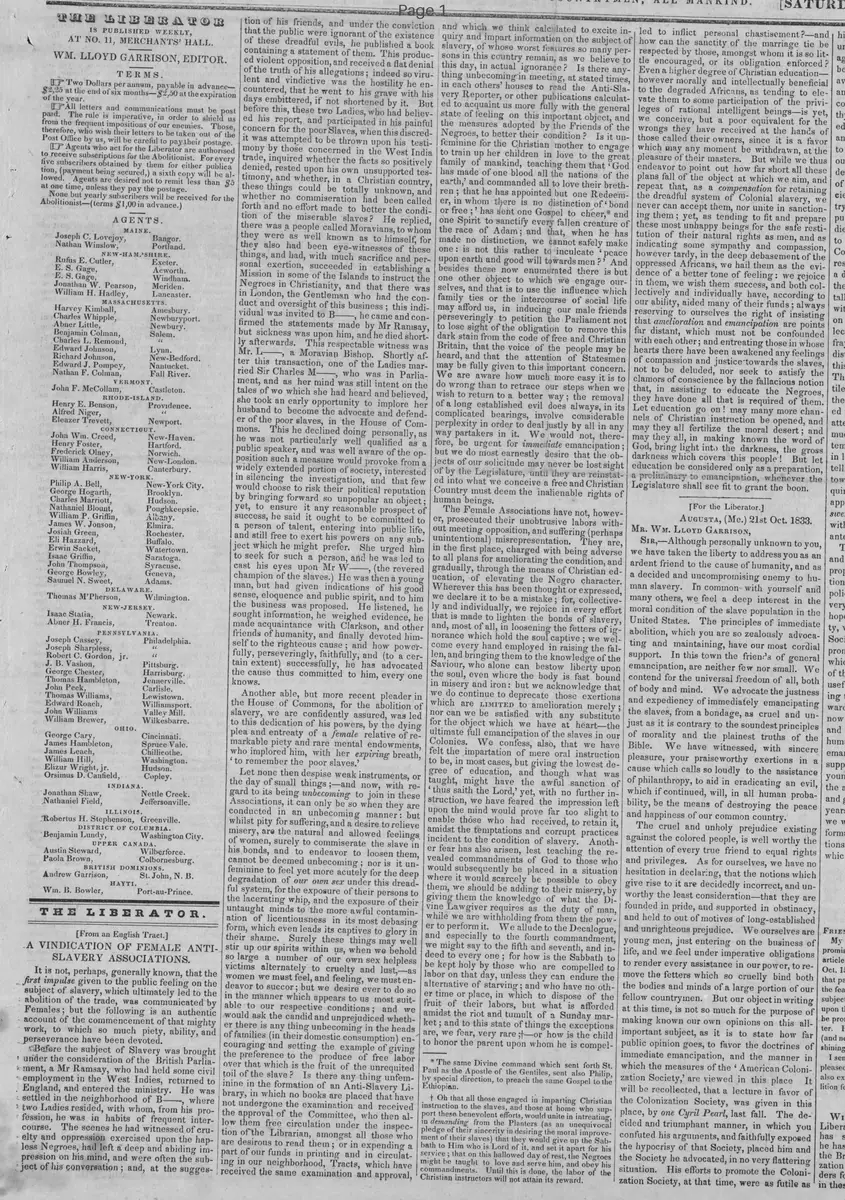
A VINDICATION OF FEMALE ANTI-SLAVERY ASSOCIATIONS.
It is not, perhaps, generally known, that the first impulse given to the public feeling on the subject of slavery, which ultimately led to the abolition of the trade, was communicated by Females; but the following is an authentic account of the commencement of that mighty work, to which so much piety, ability, and perseverance have been devoted.
Before the subject of Slavery was brought under the consideration of the British Parliament, a Mr. Ramsay, who had held some civil employment in the West Indies, returned to England, and entered the ministry. He was settled in the neighborhood of B—, where two Ladies resided, with whom, from his profession, he was in habits of frequent intercourse. The scenes he had witnessed of cruelty and oppression exercised upon the hapless Negroes, had left a deep and abiding impression on his mind, and were often the subject of his conversation; and, at the suggestion of his friends, and under the conviction that the public were ignorant of the existence of these dreadful evils, he published a book containing a statement of them. This produced violent opposition, and received a flat denial of the truth of his allegations; indeed so virulent and vindictive was the hostility he encountered, that he went to his grave with his days embittered, if not shortened by it. But before this, these two Ladies, who had believed his report, and participated in his painful concern for the poor Slaves, when this discredit was attempted to be thrown upon his testimony by those concerned in the West India trade, inquired whether the facts so positively denied, rested upon his own unsupported testimony, and whether, in a Christian country, these things could be totally unknown, and whether no commiseration had been called forth and no effort made to better the condition of the miserable slaves? He replied, there was a people called Moravians, to whom they were as well known as to himself, for they also had been eye-witnesses of these things, and had, with much sacrifice and personal exertion, succeeded in establishing a Mission in some of the Islands to instruct the Negroes in Christianity, and that there was in London, the Gentleman who had the conduct and oversight of this business; this individual was invited to B—, he came and confirmed the statements made by Mr. Ramsay, but sickness was upon him, and he died shortly afterwards. This respectable witness was Mr. L—, a Moravian Bishop. Shortly after this transaction, one of the Ladies married Sir Charles M—, who was in Parliament, and as her mind was still intent on the tales of wo which she had heard and believed, she took an early opportunity to implore her husband to become the advocate and defender of the poor slaves, in the House of Commons. This he declined doing personally, as he was not particularly well qualified as a public speaker, and was well aware of the opposition such a measure would provoke from a widely extended portion of society, interested in silencing the investigation, and that few would choose to risk their political reputation by bringing forward so unpopular an object; yet, to ensure it any reasonable prospect of success, he said it ought to be committed to a person of talent, entering into public life, and still free to exert his powers on any subject which he might prefer. She urged him to seek for such a person, and he was led to cast his eyes upon Mr. W—, (the revered champion of the slaves.) He was then a young man, but had given indications of his good sense, eloquence and public spirit, and to him the business was proposed. He listened, he sought information, he weighed evidence, he made acquaintance with Clarkson, and other friends of humanity, and finally devoted himself to the righteous cause; and how powerfully, perseveringly, faithfully, and (to a certain extent) successfully, he has advocated the cause thus committed to him, every one knows.
Another able, but more recent pleader in the House of Commons, for the abolition of slavery, we are confidently assured, was led to this dedication of his powers, by the dying plea and entreaty of a female relative of remarkable piety and rare mental endowments, who implored him, with her expiring breath, 'to remember the poor slaves.'
Let none then despise weak instruments, or the day of small things; and now, with regard to its being unbecoming to join in these Associations, it can only be so when they are conducted in an unbecoming manner: but whilst pity for suffering, and a desire to relieve misery, are the natural and allowed feelings of women, surely to commiserate the slave in his bonds, and to endeavor to loosen them, cannot be deemed unbecoming; nor is it unfeminine to feel yet more acutely for the deep degradation of our own sex under this dreadful system, for the exposure of their persons to the lacerating whip, and the exposure of their untaught minds to the more awful contamination of licentiousness in its most debasing form, which even leads its captives to glory in their shame. Surely these things may well stir up our spirits within us, when we behold so large a number of our own sex helpless victims alternately to cruelty and lust,—as women we must feel, and feeling, we must endeavor to succor; but we desire ever to do so in the manner which appears to us most suitable to our respective conditions; and we would ask the candid and unprejudiced whether there is any thing unbecoming in the heads of families (in their domestic consumption) encouraging and setting the example of giving the preference to the produce of free labor over that which is the fruit of the unrequited toil of the slave? Is there any thing unfeminine in the formation of an Anti-Slavery Library, in which no books are placed that have not undergone the examination and received the approval of the Committee, who then allow them free circulation under the inspection of the Librarian, amongst all those who are desirous to read them; or in expending a part of our funds in printing and in circulating in our neighborhood, Tracts, which have received the same examination and approval, and which we think calculated to excite inquiry and impart information on the subject of slavery, of whose worst features so many persons in this country remain, as we believe to this day, in actual ignorance? Is there any thing unbecoming in meeting, at stated times, in each others' houses to read the Anti-Slavery Reporter, or other publications calculated to acquaint us more fully with the general state of feeling on this important object, and the measures adopted by the Friends of the Negroes, to better their condition? Is it unfeminine for the Christian mother to engage to train up her children in love to the great family of mankind, teaching them that 'God has made of one blood all the nations of the earth,' and commanded all to love their brethren; that he has appointed but one Redeemer, in whom there is no distinction of 'bond or free:' has sent one Gospel to cheer, and one Spirit to sanctify every fallen creature of the race of Adam; and that, when he has made no distinction, we cannot safely make one: is not this rather to inculcate peace upon earth and good will towards men? And besides these now enumerated there is but one other object to which we engage ourselves, and that is to use the influence which family ties or the intercourse of social life may afford us, in inducing our male friends perseveringly to petition the Parliament not to lose sight of the obligation to remove this dark stain from the code of free and Christian Britain, that the voice of the people may be heard, and that the attention of Statesmen may be fully given to this important concern.
We are aware how much more easy it is to do wrong than to retrace our steps when we wish to return to a better way; the removal of a long established evil does always, in its complicated bearings, involve considerable perplexity in order to deal justly by all in any way partakers in it. We would not, therefore, be urgent for immediate emancipation; but we do most earnestly desire that the objects of our solicitude may never be lost sight of by the Legislature, until they are reinstated into what we conceive a free and Christian Country must deem the inalienable rights of human beings.
The Female Associations have not, however, prosecuted their unobtrusive labors without meeting opposition, and suffering (perhaps unintentional) misrepresentation. They are, in the first place, charged with being adverse to all plans for ameliorating the condition, and gradually, through the means of Christian education, of elevating the Negro character. Wherever this has been thought or expressed, we declare it to be a mistake; for, collectively and individually, we rejoice in every effort that is made to lighten the bonds of slavery, and, most of all, in loosening the fetters of ignorance which hold the soul captive; we welcome every hand employed in raising the fallen, and bringing them to the knowledge of the Saviour, who alone can bestow liberty upon the soul, even where the body is fast bound in misery and iron: but we acknowledge that we do continue to deprecate those exertions which are LIMITED to amelioration merely; nor can we be satisfied with any substitute for the object which we have at heart—the ultimate full emancipation of the slaves in our Colonies. We confess, also, that we have felt the impartation of mere oral instruction to be, in most cases, but giving the lowest degree of education, and though what was taught, might have the awful sanction of 'thus saith the Lord,' yet, with no further instruction, we have feared the impression left upon the mind would prove far too slight to enable those who had received, to retain it, amidst the temptations and corrupt practices incident to the condition of slavery. Another fear has also arisen, lest teaching the revealed commandments of God to those who would subsequently be placed in a situation where it would scarcely be possible to obey them, we should be adding to their misery, by giving them the knowledge of what the Divine Lawgiver requires as the duty of man, while we are withholding from them the power to perform it. We allude to the Decalogue, and especially to the fourth commandment, we might say to the fifth and seventh, and indeed to every one; for how is the Sabbath to be kept holy by those who are compelled to labor on that day, unless they can endure the alternative of starving; and who have no other time or place, in which to dispose of the fruit of their labors, but what is afforded amidst the riot and tumult of a Sunday market; and to this state of things the exceptions are, we fear, very rare;—or how is the child to honor the parent upon whom he is compelled to depend for the means of subsistence, when that parent is degraded by the lash of the merciless driver, and treated as a beast of burden, instead of a rational and immortal being? Or how can the sanctity of the marriage tie be respected by those, amongst whom it is so little encouraged, or its obligation enforced? Even a higher degree of Christian education—however morally and intellectually beneficial to the degraded Africans, as tending to elevate them to some participation of the privileges of rational intelligent beings—is yet, we conceive, but a poor equivalent for the wrongs they have received at the hands of those called their owners, since it is a favor which may any moment be withdrawn, at the pleasure of their masters. But while we thus endeavor to point out how far short all these plans fall of the object at which we aim, and repeat that, as a compensation for retaining the dreadful system of Colonial slavery, we never can accept them, nor unite in sanctioning them; yet, as tending to fit and prepare these most unhappy beings for the safe restitution of their natural rights as men, and as indicating some sympathy and compassion, however tardy, in the deep debasement of the oppressed Africans, we hail them as the evidence of a better tone of feeling: we rejoice in them, we wish them success, and both collectively and individually have, according to our ability, aided many of their funds; always reserving to ourselves the right of insisting that amelioration and emancipation are points far distant, which must not be confounded with each other; and entreating those in whose hearts there have been awakened any feelings of compassion and justice towards the slaves, not to be deluded, nor seek to satisfy the clamors of conscience by the fallacious notion that, in assisting to educate the Negroes, they have done all that is required of them. Let education go on! may many more channels of Christian instruction be opened, and may they all fertilize the moral desert; and may they all, in making known the word of God, bring light into the darkness, the gross darkness which covers this people! But let education be considered only as a preparation, a preliminary to emancipation, whenever the Legislature shall see fit to grant the boon.
* The same Divine command which sent forth St. Paul as the Apostle of the Gentiles, sent also Philip, by special direction, to preach the same Gospel to the Ethiopian.
Oh that all those engaged in imparting Christian instruction to the slaves, and those at home who support these benevolent efforts, would unite in intreating in demanding from the Planters (as an unequivocal pledge of their sincerity in desiring the moral improvement of their slaves) that they would give up the Sabbath to Him who is Lord of it, and set it apart for his service; that on this hallowed day of rest, the Negroes might be taught to love and serve him, and obey his commandments. Until this is done, the labor of the Christian instructors will not attain its reward.
What sub-type of article is it?
What themes does it cover?
What keywords are associated?
What entities or persons were involved?
Where did it happen?
Story Details
Key Persons
Location
England, West Indies, B—, London
Event Date
Before The Subject Of Slavery Was Brought Under The Consideration Of The British Parliament
Story Details
Two ladies in B— befriend Rev. Ramsay, who exposes West Indian slavery horrors; they verify via Moravian Bishop Mr. L—; one lady marries MP Sir Charles M—, who recruits young Mr. W— (Wilberforce) to advocate abolition in Parliament after consulting Clarkson. Another MP influenced by dying female relative. Article defends female anti-slavery roles in education, libraries, petitions, emphasizing emancipation over mere amelioration.