Thank you for visiting SNEWPapers!
Sign up free
The Daily Advertiser
New York, New York County, New York
What is this article about?
Parisian report from August 18, 1787, discusses the banished parliament's protest against the lamp-tax and stamp-tax edicts, debates on parliamentary powers, and extensive court reforms including suppression of troops, stables, and household reductions to cut expenses.
Clipping
OCR Quality
Full Text
August 18, 1787.
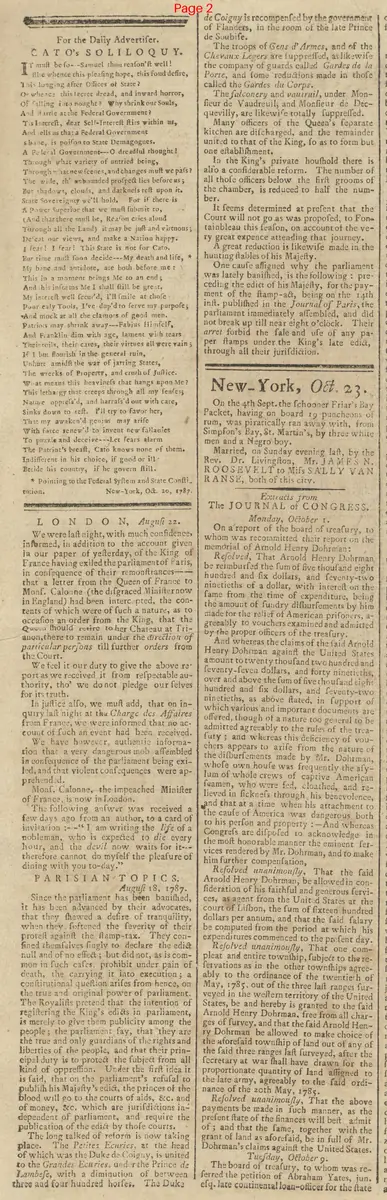
Since the parliament has been banished,
It has been advanced by their advocates,
That they shewed a desire of tranquility,
When they softened the severity of their
Protest against the lamp-tax. They confined
themselves singly to declare the edict
Null and of no effect; but did not, as is common
in such cases, prohibit under pain of
Death, the carrying it into execution; a
Constitutional question arises from hence, On
The true and original power of parliament.
The Royalists pretend that the intention of
Registering the King's edicts in parliament,
Is merely to give them publicity among the
People; the parliament say, that they are
The true and only guardians of the rights and
Liberties of the people, and that their principal
duty is to protect the subject from all
Kind of oppression. Under the first idea it
Is said, that on the parliament's refusal to
Publish his Majesty's edict, the princes of the
Blood will go to the courts of aids, &c. and
Of money, &c. which are jurisdictions independent
of parliament, and require the
Publication of the edict by those courts.
The long talked of reform is now taking
Place. The Petites Ecuries, at the head
Of which was the Duke de Coigny, is united
To the Grandes Ecuries, under the Prince de
Lambesc, with a diminution of between
Three and four hundred horses. The Duke
de Coigny is recompensed by the government
Of Flanders, in the room of the late Prince
de Soubise.
The troops of Gens d' Armes, and of the
Chevaux Legers are suppressed, as likewise
The company of guards called Gardes de la
Porte, and some reductions made in those
Called the Gardes du Corps.
The falconry and vaulting, under Monsieur
de Vaudreuil, and Monsieur de Dec-Quevilly,
are likewise totally suppressed.
Many officers of the Queen's separate
Kitchen are discharged, and the remainder
United to that of the King, so as to form but
One establishment.
In the King's private household there is
Also a considerable reform. The number of
All those officers below the first grooms of
The chamber, is reduced to half the number.
It seems determined at present that the
Court will not go as was proposed, to Fontainebleau
this season, on account of the very
great expense attending that journey.
A great reduction is likewise made in the
Hunting stables of his Majesty.
One cause assigned why the parliament
Was lately banished, is the following: preceding
the edict of his Majesty, for the payment
of the stamp-tax, being on the 14th
Int. published in the Journal of Paris, the
Parliament immediately assembled, and did
Not break up till near eight o'clock. Their
Arret forbid the sale and use of any paper
Stamps under the King's late edict,
Through all their jurisdiction.
What sub-type of article is it?
What keywords are associated?
What entities or persons were involved?
Where did it happen?
Foreign News Details
Primary Location
Paris
Event Date
August 18, 1787
Key Persons
Outcome
parliament banished for protesting edicts; court reforms suppress troops, stables, falconry, and reduce household staff and expenses; court cancels fontainebleau trip.
Event Details
Advocates claim banished parliament sought tranquility by mildly protesting lamp-tax edict without death penalty enforcement ban, sparking constitutional debate on parliamentary powers versus royal publicity needs. Princes of the Blood may seek edict publication in other courts. Reforms unite stables under Prince de Lambesc, reducing horses; suppress Gens d'Armes, Chevaux Legers, Gardes de la Porte; reduce Gardes du Corps; suppress falconry and vaulting; merge Queen's kitchen with King's; halve lower household officers; reduce hunting stables; cancel Fontainebleau journey due to cost. Parliament assembled after stamp-tax edict publication on August 14, issuing arret forbidding stamp use.