Thank you for visiting SNEWPapers!
Sign up free
Daily Globe
Saint Paul, Ramsey County, Minnesota
What is this article about?
Speculation surrounds the upcoming congress of nations to pacify Europe, focusing on the Eastern question. Tensions arise from demands by Austria, smaller states like Greece, Bosnia, and others, and conflicts between powers like Britain, Russia, France, Italy over reorganizing Roumelia and Turkish states. Russia opposes Austrian protectorate plans. Smaller principalities pose risks to peace if not addressed.
Clipping
OCR Quality
Full Text
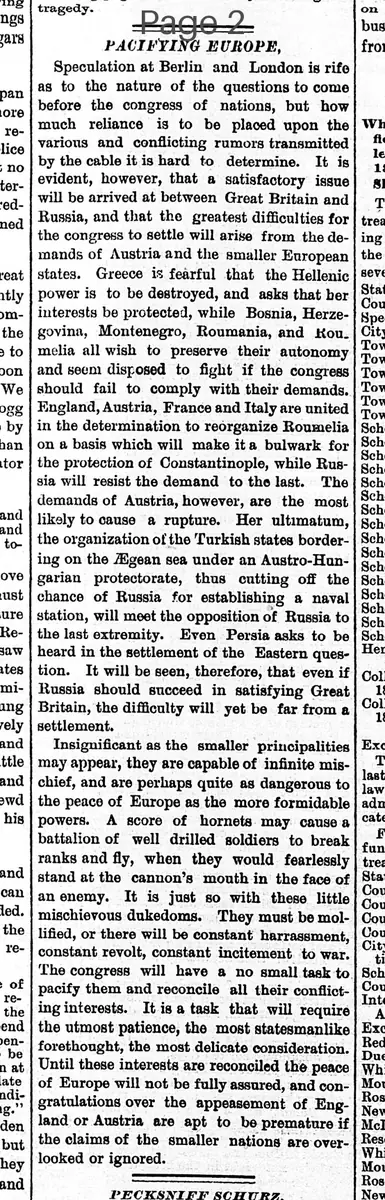
Speculation at Berlin and London is rife as to the nature of the questions to come before the congress of nations, but how much reliance is to be placed upon the various and conflicting rumors transmitted by the cable it is hard to determine. It is evident, however, that a satisfactory issue will be arrived at between Great Britain and Russia, and that the greatest difficulties for the congress to settle will arise from the demands of Austria and the smaller European states. Greece is fearful that the Hellenic power is to be destroyed, and asks that her interests be protected, while Bosnia, Herzegovina, Montenegro, Roumania, and Koumelia all wish to preserve their autonomy and seem disposed to fight if the congress should fail to comply with their demands.
England, Austria, France and Italy are united in the determination to reorganize Roumelia on a basis which will make it a bulwark for the protection of Constantinople, while Russia will resist the demand to the last. The demands of Austria, however, are the most likely to cause a rupture. Her ultimatum, the organization of the Turkish states bordering on the Ægean sea under an Austro-Hungarian protectorate, thus cutting off the chance of Russia for establishing a naval station, will meet the opposition of Russia to the last extremity. Even Persia asks to be heard in the settlement of the Eastern question. It will be seen, therefore, that even if Russia should succeed in satisfying Great Britain, the difficulty will yet be far from a settlement.
Insignificant as the smaller principalities may appear, they are capable of infinite mischief, and are perhaps quite as dangerous to the peace of Europe as the more formidable powers. A score of hornets may cause a battalion of well drilled soldiers to break ranks and fly, when they would fearlessly stand at the cannon's mouth in the face of an enemy. It is just so with these little mischievous dukedoms. They must be mollified, or there will be constant harassment, constant revolt, constant incitement to war.
The congress will have a no small task to pacify them and reconcile all their conflicting interests. It is a task that will require the utmost patience, the most statesmanlike forethought, the most delicate consideration. Until these interests are reconciled the peace of Europe will not be fully assured, and congratulations over the appeasement of England or Austria are apt to be premature if the claims of the smaller nations are overlooked or ignored.
What sub-type of article is it?
What keywords are associated?
Where did it happen?
Foreign News Details
Primary Location
Europe
Event Details
Speculation at Berlin and London on questions for the congress of nations. Satisfactory issue expected between Great Britain and Russia, but difficulties from Austria and smaller states like Greece, Bosnia, Herzegovina, Montenegro, Roumania, and Koumelia seeking autonomy protection. England, Austria, France, Italy aim to reorganize Roumelia as bulwark for Constantinople; Russia resists. Austria demands Austro-Hungarian protectorate over Turkish states on Ægean sea to block Russian naval station. Persia seeks voice in Eastern question. Smaller principalities risk mischief if not mollified. Congress faces task of reconciling interests for European peace.