Thank you for visiting SNEWPapers!
Sign up free
Editorial
August 4, 1927
The Laurens Advertiser
Laurens, Laurens County, South Carolina
What is this article about?
Clarence Poe advises young boys against starting to drink alcohol, arguing it doesn't pay in terms of health, longevity, success, and lawfulness. He cites life insurance statistics showing drinkers have higher death rates and shorter lifespans, and warns of moral and legal risks.
Clipping
OCR Quality
98%
Excellent
Full Text
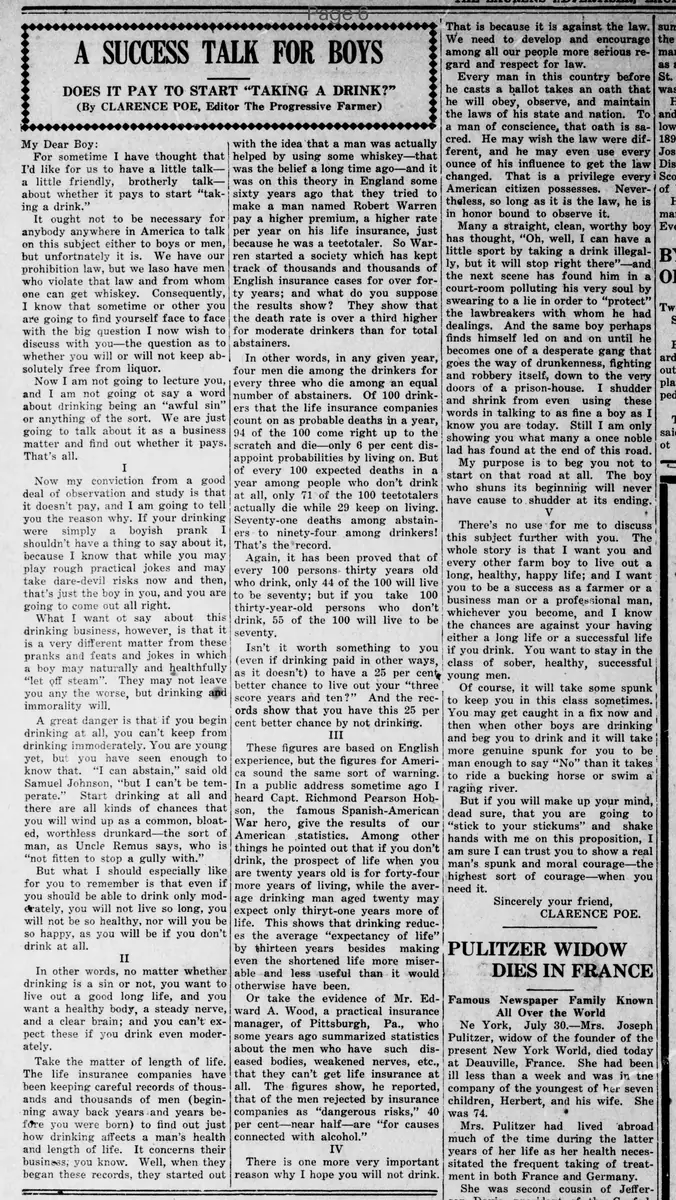
A SUCCESS TALK FOR BOYS
DOES IT PAY TO START “TAKING A DRINK?”
(By CLARENCE POE, Editor The Progressive Farmer)
My Dear Boy:
For sometime I have thought that I'd like for us to have a little talk—a little friendly, brotherly talk—about whether it pays to start "taking a drink."
It ought not to be necessary for anybody anywhere in America to talk on this subject either to boys or men, but unfortunately it is. We have our prohibition law, but we also have men who violate that law and from whom one can get whiskey. Consequently, I know that sometime or other you are going to find yourself face to face with the big question I now wish to discuss with you—the question as to whether you will or will not keep absolutely free from liquor.
Now I am not going to lecture you, and I am not going to say a word about drinking being an "awful sin" or anything of the sort. We are just going to talk about it as a business matter and find out whether it pays. That's all.
I
Now my conviction from a good deal of observation and study is that it doesn't pay, and I am going to tell you the reason why. If your drinking were simply a boyish prank I shouldn't have a thing to say about it, because I know that while you may play rough practical jokes and may take dare-devil risks now and then, that's just the boy in you, and you are going to come out all right.
What I want to say about this drinking business, however, is that it is a very different matter from these pranks and feats and jokes in which a boy may naturally and healthfully "let off steam." They may not leave you any the worse, but drinking and immorality will.
A great danger is that if you begin drinking at all, you can't keep from drinking immoderately. You are young yet, but you have seen enough to know that. "I can abstain," said old Samuel Johnson, "but I can't be temperate." Start drinking at all and there are all kinds of chances that you will wind up as a common, bloated, worthless drunkard—the sort of man, as Uncle Remus says, who is "not fitten to stop a gully with."
But what I should especially like for you to remember is that even if you should be able to drink only moderately, you will not live so long, you will not be so healthy, nor will you be so happy, as you will be if you don't drink at all.
II
In other words, no matter whether drinking is a sin or not, you want to live out a good long life, and you want a healthy body, a steady nerve, and a clear brain; and you can't expect these if you drink even moderately.
Take the matter of length of life. The life insurance companies have been keeping careful records of thousands and thousands of men (beginning away back years and years before you were born) to find out just how drinking affects a man's health and length of life. It concerns their business; you know. Well, when they began these records, they started out with the idea that a man was actually helped by using some whiskey—that was the belief a long time ago—and it was on this theory in England some sixty years ago that they tried to make a man named Robert Warren pay a higher premium, a higher rate per year on his life insurance, just because he was a teetotaler. So Warren started a society which has kept track of thousands and thousands of English insurance cases for over forty years; and what do you suppose the results show? They show that the death rate is over a third higher for moderate drinkers than for total abstainers.
In other words, in any given year, four men die among the drinkers for every three who die among an equal number of abstainers. Of 100 drinkers that the life insurance companies count on as probable deaths in a year, 94 of the 100 come right up to the scratch and die—only 6 per cent disappoint probabilities by living on. But of every 100 expected deaths in a year among people who don't drink at all, only 71 of the 100 teetotalers actually die while 29 keep on living. Seventy-one deaths among abstainers to ninety-four among drinkers! That's the record.
Again, it has been proved that of every 100 persons thirty years old who drink, only 44 of the 100 will live to be seventy; but if you take 100 thirty-year-old persons who don't drink, 55 of the 100 will live to be seventy.
Isn't it worth something to you (even if drinking paid in other ways, as it doesn't) to have a 25 per cent better chance to live out your "three score years and ten?" And the records show that you have this 25 per cent better chance by not drinking.
III
These figures are based on English experience, but the figures for America sound the same sort of warning. In a public address sometime ago I heard Capt. Richmond Pearson Hobson, the famous Spanish-American War hero, give the results of our American statistics. Among other things he pointed out that if you don't drink, the prospect of life when you are twenty years old is for forty-four more years of living, while the average drinking man aged twenty may expect only thirty-one years more of life. This shows that drinking reduces the average "expectancy of life" by thirteen years besides making even the shortened life more miserable and less useful than it would otherwise have been.
Or take the evidence of Mr. Edward A. Wood, a practical insurance manager, of Pittsburgh, Pa., who some years ago summarized statistics about the men who have such diseased bodies, weakened nerves, etc., that they can't get life insurance at all. The figures show, he reported, that of the men rejected by insurance companies as "dangerous risks," 40 per cent—near half—are "for causes connected with alcohol."
IV
There is one more very important reason why I hope you will not drink. That is because it is against the law. We need to develop and encourage among all our people more serious regard and respect for law. Every man in this country before he casts a ballot takes an oath that he will obey, observe, and maintain the laws of his state and nation. To a man of conscience, that oath is sacred. He may wish the law were different, and he may even use every ounce of his influence to get the law changed. That is a privilege every American citizen possesses. Nevertheless, so long as it is the law, he is in honor bound to observe it.
Many a straight, clean, worthy boy has thought, "Oh, well, I can have a little sport by taking a drink illegally, but it will stop right there"—and the next scene has found him in a court-room polluting his very soul by swearing to a lie in order to "protect" the lawbreakers with whom he had dealings. And the same boy perhaps finds himself led on and on until he becomes one of a desperate gang that goes the way of drunkenness, fighting and robbery itself, down to the very doors of a prison-house. I shudder and shrink from even using these words in talking to as fine a boy as I know you are today. Still I am only showing you what many a once noble lad has found at the end of this road.
My purpose is to beg you not to start on that road at all. The boy who shuns its beginning will never have cause to shudder at its ending.
V
There's no use for me to discuss this subject further with you. The whole story is that I want you and every other farm boy to live out a long, healthy, happy life; and I want you to be a success as a farmer or a business man or a professional man, whichever you become, and I know the chances are against your having either a long life or a successful life if you drink. You want to stay in the class of sober, healthy, successful young men.
Of course, it will take some spunk to keep you in this class sometimes. You may get caught in a fix now and then when other boys are drinking and beg you to drink and it will take more genuine spunk for you to be man enough to say "No" than it takes to ride a bucking horse or swim a raging river.
But if you will make up your mind, dead sure, that you are going to "stick to your stickums" and shake hands with me on this proposition, I am sure I can trust you to show a real man's spunk and moral courage—the highest sort of courage—when you need it.
Sincerely your friend,
CLARENCE POE.
DOES IT PAY TO START “TAKING A DRINK?”
(By CLARENCE POE, Editor The Progressive Farmer)
My Dear Boy:
For sometime I have thought that I'd like for us to have a little talk—a little friendly, brotherly talk—about whether it pays to start "taking a drink."
It ought not to be necessary for anybody anywhere in America to talk on this subject either to boys or men, but unfortunately it is. We have our prohibition law, but we also have men who violate that law and from whom one can get whiskey. Consequently, I know that sometime or other you are going to find yourself face to face with the big question I now wish to discuss with you—the question as to whether you will or will not keep absolutely free from liquor.
Now I am not going to lecture you, and I am not going to say a word about drinking being an "awful sin" or anything of the sort. We are just going to talk about it as a business matter and find out whether it pays. That's all.
I
Now my conviction from a good deal of observation and study is that it doesn't pay, and I am going to tell you the reason why. If your drinking were simply a boyish prank I shouldn't have a thing to say about it, because I know that while you may play rough practical jokes and may take dare-devil risks now and then, that's just the boy in you, and you are going to come out all right.
What I want to say about this drinking business, however, is that it is a very different matter from these pranks and feats and jokes in which a boy may naturally and healthfully "let off steam." They may not leave you any the worse, but drinking and immorality will.
A great danger is that if you begin drinking at all, you can't keep from drinking immoderately. You are young yet, but you have seen enough to know that. "I can abstain," said old Samuel Johnson, "but I can't be temperate." Start drinking at all and there are all kinds of chances that you will wind up as a common, bloated, worthless drunkard—the sort of man, as Uncle Remus says, who is "not fitten to stop a gully with."
But what I should especially like for you to remember is that even if you should be able to drink only moderately, you will not live so long, you will not be so healthy, nor will you be so happy, as you will be if you don't drink at all.
II
In other words, no matter whether drinking is a sin or not, you want to live out a good long life, and you want a healthy body, a steady nerve, and a clear brain; and you can't expect these if you drink even moderately.
Take the matter of length of life. The life insurance companies have been keeping careful records of thousands and thousands of men (beginning away back years and years before you were born) to find out just how drinking affects a man's health and length of life. It concerns their business; you know. Well, when they began these records, they started out with the idea that a man was actually helped by using some whiskey—that was the belief a long time ago—and it was on this theory in England some sixty years ago that they tried to make a man named Robert Warren pay a higher premium, a higher rate per year on his life insurance, just because he was a teetotaler. So Warren started a society which has kept track of thousands and thousands of English insurance cases for over forty years; and what do you suppose the results show? They show that the death rate is over a third higher for moderate drinkers than for total abstainers.
In other words, in any given year, four men die among the drinkers for every three who die among an equal number of abstainers. Of 100 drinkers that the life insurance companies count on as probable deaths in a year, 94 of the 100 come right up to the scratch and die—only 6 per cent disappoint probabilities by living on. But of every 100 expected deaths in a year among people who don't drink at all, only 71 of the 100 teetotalers actually die while 29 keep on living. Seventy-one deaths among abstainers to ninety-four among drinkers! That's the record.
Again, it has been proved that of every 100 persons thirty years old who drink, only 44 of the 100 will live to be seventy; but if you take 100 thirty-year-old persons who don't drink, 55 of the 100 will live to be seventy.
Isn't it worth something to you (even if drinking paid in other ways, as it doesn't) to have a 25 per cent better chance to live out your "three score years and ten?" And the records show that you have this 25 per cent better chance by not drinking.
III
These figures are based on English experience, but the figures for America sound the same sort of warning. In a public address sometime ago I heard Capt. Richmond Pearson Hobson, the famous Spanish-American War hero, give the results of our American statistics. Among other things he pointed out that if you don't drink, the prospect of life when you are twenty years old is for forty-four more years of living, while the average drinking man aged twenty may expect only thirty-one years more of life. This shows that drinking reduces the average "expectancy of life" by thirteen years besides making even the shortened life more miserable and less useful than it would otherwise have been.
Or take the evidence of Mr. Edward A. Wood, a practical insurance manager, of Pittsburgh, Pa., who some years ago summarized statistics about the men who have such diseased bodies, weakened nerves, etc., that they can't get life insurance at all. The figures show, he reported, that of the men rejected by insurance companies as "dangerous risks," 40 per cent—near half—are "for causes connected with alcohol."
IV
There is one more very important reason why I hope you will not drink. That is because it is against the law. We need to develop and encourage among all our people more serious regard and respect for law. Every man in this country before he casts a ballot takes an oath that he will obey, observe, and maintain the laws of his state and nation. To a man of conscience, that oath is sacred. He may wish the law were different, and he may even use every ounce of his influence to get the law changed. That is a privilege every American citizen possesses. Nevertheless, so long as it is the law, he is in honor bound to observe it.
Many a straight, clean, worthy boy has thought, "Oh, well, I can have a little sport by taking a drink illegally, but it will stop right there"—and the next scene has found him in a court-room polluting his very soul by swearing to a lie in order to "protect" the lawbreakers with whom he had dealings. And the same boy perhaps finds himself led on and on until he becomes one of a desperate gang that goes the way of drunkenness, fighting and robbery itself, down to the very doors of a prison-house. I shudder and shrink from even using these words in talking to as fine a boy as I know you are today. Still I am only showing you what many a once noble lad has found at the end of this road.
My purpose is to beg you not to start on that road at all. The boy who shuns its beginning will never have cause to shudder at its ending.
V
There's no use for me to discuss this subject further with you. The whole story is that I want you and every other farm boy to live out a long, healthy, happy life; and I want you to be a success as a farmer or a business man or a professional man, whichever you become, and I know the chances are against your having either a long life or a successful life if you drink. You want to stay in the class of sober, healthy, successful young men.
Of course, it will take some spunk to keep you in this class sometimes. You may get caught in a fix now and then when other boys are drinking and beg you to drink and it will take more genuine spunk for you to be man enough to say "No" than it takes to ride a bucking horse or swim a raging river.
But if you will make up your mind, dead sure, that you are going to "stick to your stickums" and shake hands with me on this proposition, I am sure I can trust you to show a real man's spunk and moral courage—the highest sort of courage—when you need it.
Sincerely your friend,
CLARENCE POE.
What sub-type of article is it?
Temperance
Moral Or Religious
What keywords are associated?
Temperance
Alcohol Abstinence
Boys Advice
Life Insurance Statistics
Prohibition Law
Health Risks
Moral Courage
What entities or persons were involved?
Clarence Poe
Samuel Johnson
Robert Warren
Capt. Richmond Pearson Hobson
Mr. Edward A. Wood
Life Insurance Companies
Editorial Details
Primary Topic
Advice To Boys Against Starting To Drink Alcohol
Stance / Tone
Strongly Promotes Total Abstinence From Alcohol
Key Figures
Clarence Poe
Samuel Johnson
Robert Warren
Capt. Richmond Pearson Hobson
Mr. Edward A. Wood
Life Insurance Companies
Key Arguments
Drinking Leads To Immoderate Habits And Potential Alcoholism.
Even Moderate Drinking Shortens Life And Reduces Health And Happiness.
Life Insurance Records Show Higher Death Rates For Drinkers (94 Vs 71 Per 100 Expected).
Drinkers Have 25% Lower Chance Of Reaching 70 From Age 30.
American Statistics Indicate 13 Years Shorter Expectancy For Drinkers From Age 20.
40% Of Insurance Rejections Due To Alcohol Related Causes.
Drinking Violates Prohibition Law And Erodes Respect For Law.
Abstinence Ensures Longer, Healthier, More Successful Life.