Thank you for visiting SNEWPapers!
Sign up free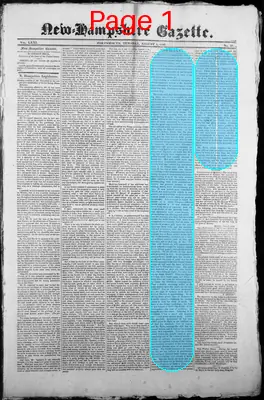
The New Hampshire Gazette
Portsmouth, Rockingham County, New Hampshire
What is this article about?
In Washington, citizens held meetings upon news of Jefferson and Adams' deaths on July 4, 1826. Secretary Rush delivered an eloquent eulogy at City Hall on July 9, praising their lives and the providential coincidence of their deaths on Independence Day, advocating resolutions for funeral honors.
Clipping
OCR Quality
Full Text
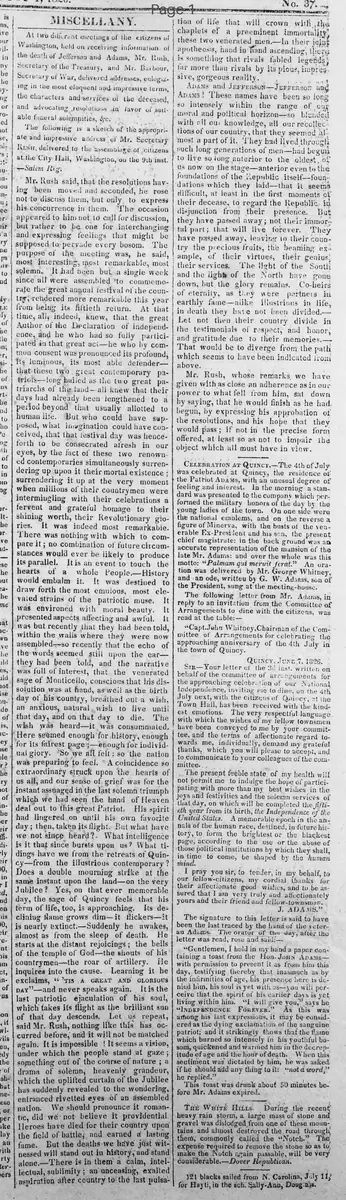
At two different meetings of the citizens of Washington, held on receiving information of the death of Jefferson and Adams, Mr. Rush, Secretary of the Treasury, and Mr. Barbour, Secretary of War, delivered addresses, eulogizing in the most eloquent and impressive terms, the characters and services of the deceased. and advocating resolutions in' favor of suitable funeral solemnities, &c.
The following is a sketch of the appropriate and impressive address of Mr. Secretary Rush, delivered to the assemblage of citizens at the City Hall, Washington, on the 9th inst. -Salem Reg.
Mr. Rush said, that the resolutions having been moved and seconded, he rose not to discuss them, but only, to express his concurrence in them. The occasion appeared to him not to call for discussion, but rather to be one for interchanging and expressing feelings that might be supposed to pervade every bosom. The purpose of the meeting was, he said. most interesting, most remarkable, most solemn. It had been but a single week since all were assembled 'to commemorate the great annual festival of the country, rendered more remarkable this year from being its fiftieth return. At that time, all, indeed, knew, that the great Author of the Declaration of Independence, and he who had so fully participated in that great act-he who by common consent was pronounced its profound. its luminous, its most able defender-- that these two great contemporary patriots--long hailed as the two great patriarchs of the land- all knew that their days had already been lengthened to a period beyond that usually allotted to human life. But who could have supposed, what imagination could have conceived, that that festival day was henceforth to be consecrated afresh in our eyes, by the fact of these two renowned contemporaries simultaneously surrendering up upon it their mortal existence; surrendering it up at the very moment when millions of their countrymen were intermingling with their celebrations a fervent and grateful homage to their shining worth, their Revolutionary glories. It was indeed most remarkable. There was nothing with which to compare it; no combination of future circumstances would ever be likely to produce its parallel. Itis an event to touch the hearts of a whole People.-History would embalm it. It was destined to draw forth the most emulous, most elevated strains of the patriotic muse. It was environed with moral beauty. It presented aspects affecting and awful. It was but recently that they had been told, within the walls where they were now assembled--so recently that the echo of the words seemed still upon the ear-- they had been told, and the narrative was full of interest, that the venerated sage of Monticello, conscious that his dissolution was at hand, as well as the birth day of his country, breathed out a wish, an anxious, natural wish to live until that day, and on that day to die. The wish 'was heard-it was consummated. Here seemed enough for history, enough for its fairest page;—enough for individual glory. So we all felt : so the nation was preparing to feel. A coincidence so extraordinary struck upon the hearts of us all, and our sense of grief was for the instant assuaged in the last solemn triumph which we had seen the hand of Heaven deal out to this great Patriot. His spirit had lingered on until his own favorite day; then, taken its flight. Put what have we not since heard?. What intelligence is it that since bursts upon us? What tidings have we from the retreats of Quincy--from the illustrious contemporary? Does a double mourning strike at the same instant upon the land-on the very Jubilee? Yes, on that ever memorable day, the sage of Quincy feels that his term of life, too, is approaching. Its declining flame grows dim-it flickers-it is nearly extinct.-Suddenly he awakes, almost as from the sleep of death. He starts at the distant rejoicings: the bells of the temple of God--the shouts of his countrymen--the roar of artillery. He inquires into the cause. Learning it he exclaims, " TIS A GREAT AND GLORIOUS Day"_-and never speaks again. Itis the last patriotic ejaculation of his soul, which takes its flight as the brilliant sun of that day descends. Let us repeat, said Mr. Rush, nothing like this has occurred before, and it will not be matched again. It is impossible ! It seems a vision. under which the people stand at gaze; something out of the course of nature ; a drama of solemn, heavenly grandeur. which the uplifted curtain of the Jubilee has suddenly revealed to the wondering. entranced rivetted eyes of an assembled nation. We should pronounce it romantic, did we not believe it providential Heroes have died for their country upon the field of battle; and earned a lasting fame. But the deaths we have just witnessed will stand out in history, and stand alone.-There is in them a calm, intellectual, sublimity; an unceasing, exalted aspiration after country to the last pulsation of life that will crown with the chaplets of a preeminent immortality these two venerated men.-In their joint apotheosis, hand in hand ascending, there is something that rivals fabled legends far more than rivals by its pious, impressive, gorgeous reality.
Adams and Jefferson-Jefferson and Adams ! These names have been so long so intensely within the range of our moral and political horizon-so blended with all our knowledge, all our recollections of our country, that they seemed almost a part of it. They had lived through such long generations of men-had begun to live so long anterior to the oldest, of us now on the stage-anterior even to the foundations of the Republic itself--foundations which they laid-that it seems difficult, at least in the first moments of their decease, to regard the Republic. in disjunction from their presence. But they have passed away; not their immortal part; that will live forever. They have passed away, leaving to their country the precious fruits, the beaming example, of their virtues, their genius. their services. The light of the South and the light of the North have gone down, but the glory remains. Co-heirs of eternity, as they were partners in earthly fame--alike illustrious in life. in death they have not been divided.-- Let not then their country divide in the testimonials of respect, and honor, and gratitude due to their memories.- That would be to diverge from the path which seems to have been indicated from above.
Mr. Rush, whose remarks we have given with as close an adherence as in our power to what fell from him, sat down by saying, that he would finish as he had. begun, by expressing his approbation of the resolutions, and his hope that they would pass; if not in the precise form offered, at least so as not to impair the object which all must have in view.
What sub-type of article is it?
What keywords are associated?
What entities or persons were involved?
Where did it happen?
Domestic News Details
Primary Location
Washington
Event Date
On The 9th Inst.
Key Persons
Outcome
deaths of jefferson and adams on the 50th anniversary of independence day; resolutions advocated for suitable funeral solemnities.
Event Details
Citizens of Washington held meetings upon news of Jefferson and Adams' deaths. Secretary Rush delivered an address at City Hall eulogizing their lives, services, and the providential coincidence of their deaths on July 4, expressing concurrence with resolutions for funeral honors.