Thank you for visiting SNEWPapers!
Sign up free
The Evening Telegraph
Philadelphia, Philadelphia County, Pennsylvania
What is this article about?
Spain plans to send 20,000 troops to Cuba in September; Cortes to convene October 1 for king election; Carlist agents arrested in Madrid. US Secretary Fish tells Spanish Minister Roberts of strict neutrality in Cuban revolt, sympathy for Cuba, and potential action against Spanish gunboats built in US for possible use against Peru amid dormant war.
Clipping
OCR Quality
Full Text
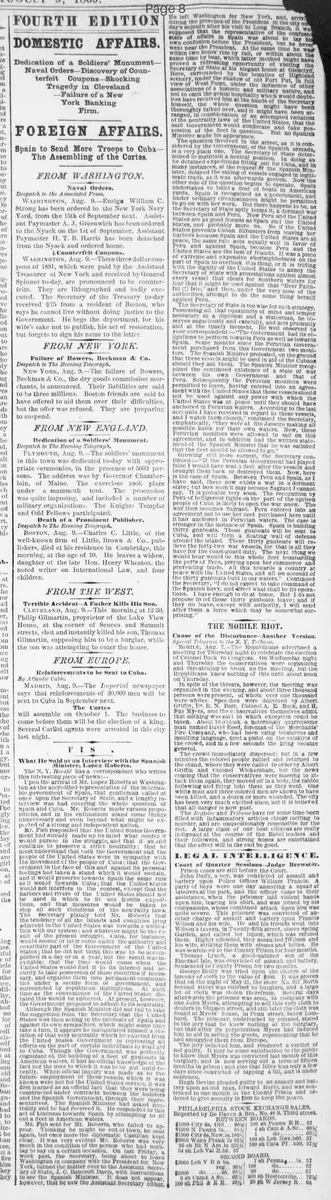
DOMESTIC AFFAIRS.
Dedication of a Soldiers' Monument—Naval Orders—Discovery of Counterfeit Coupons—Shocking Tragedy in Cleveland—Failure of a New York Banking Firm.
FOREIGN AFFAIRS.
Spain to Send More Troops to Cuba—The Assembling of the Cortes.
FROM WASHINGTON.
Naval Orders.
Despatch to the Associated Press.
WASHINGTON, Aug. 9.—Ensign William C. Strong has been ordered to the New York Navy Yard, from the 15th of September next. Assistant Paymaster A. J. Greenwich has been ordered to the Nyack on the 1st of September. Assistant Paymaster H. T. B. Harris has been detached from the Nyack and ordered home.
Counterfeit Coupons.
WASHINGTON, Aug. 9.—Three three dollar coupons of 1881, which were paid by the Assistant Treasurer at New York and received by General Spinner to-day, are pronounced to be counterfeits. They are lithographed and badly executed. The Secretary of the Treasury to-day received $75 from a resident of Boston, who says he cannot live without doing justice to the Government. He begs the department, for his wife's sake not to publish his act of restoration, but forgets to sign his name to the letter.
FROM NEW YORK
Failure of Bowers, Beckman & Co.
Despatch to The Evening Telegraph.
NEW YORK, Aug. 9.—The failure of Bowers, Beckman & Co., the dry goods commission merchants, is announced. Their liabilities are said to be three millions. Boston friends are said to have offered to aid them over their difficulties, but the offer was refused. They are preparing to suspend.
FROM NEW ENGLAND
Dedication of a Soldiers' Monument.
Despatch to The Evening Telegraph.
PLYMOUTH, Aug. 9.—The soldiers' monument in this town was dedicated to-day with appropriate ceremonies, in the presence of 5000 persons. The address was by Governor Chamberlain, of Maine. The exercises took place under a mammoth tent. The procession was quite imposing, and included a number of military organizations. The Knights Templar and Odd Fellows participated.
Death of a Prominent Publisher.
Despatch to The Evening Telegraph
BOSTON, Aug. 9.—Charles C. Little, of the well-known firm of Little, Brown & Co., publishers, died at his residence in Cambridge, this morning, at the age of 70. He leaves a widow, daughter of the late Hon. Henry Wheaton, the noted writer on International Law, and four children.
FROM THE WEST
Terrible Accident—A Father Kills His Son.
CLEVELAND, Aug. 9.—This morning at 12:30, Philip Gilmartin, proprietor of the Lake View House, at the corner of Seneca and Summit streets, shot and instantly killed his son, Thomas Gilmartin, supposing him to be a burglar, while the son was attempting to enter the house.
FROM EUROPE.
Reinforcements to be Sent to Cuba.
By Atlantic Cable.
MADRID, Aug. 9.—The Imperial newspaper says that reinforcements of 20,000 men will be sent to Cuba in September next.
The Cortes will assemble on October 1. The business to come before them will be the election of a king.
Several Carlist agents were arrested in this city last night.
MR. FISH
What He Said at an Interview with the Spanish Minister, Lopez Roberts.
The N. Y. Herald has a correspondent who writes this interesting piece of news:-
Upon the arrival of Mr. Lopez Roberts at Washington as the accredited representative of the indomitable government of Spain, that gentleman called at once upon the Secretary of State, and a lengthy interview was had covering the whole question of Spain and Cuba. Mr. Roberts made various propositions, and in his enthusiasm asked some things unnecessary and even beyond what might be expected of a strong and independent nation.
Mr. Fish responded that the United States Government had already made up its mind what course it would pursue in the struggle, and that it should continue to preserve a strict neutrality; that he must understand that both the Government and the people of the United States were in sympathy with the movement of the people of Cuba; that the Government in the face of this and against its personal feelings had taken a stand which it would sustain, and it would preserve towards Spain the same rule as it would towards Cuba; that the United States would not interfere in the contest, except that the harbors and rivers of the United States should not be used in which to fit out hostile expeditions, and that measures would be taken to stop all such violations of the neutrality laws.
The Secretary plainly told Mr. Roberts that the tendency of all the islands and countries lying adjacent to the United States was towards a unification with our system; and whatever might be the result of the present struggle, Cuba, for instance, would sooner or later come under the authority and constitute part of the Government of the United States; that he did not think this was to be accomplished in a day or in a year but the result was inevitable; that the time would come when the United States would find security to take possession of these countries if necessary, and organize them into permanent communities under a secure form of government, and surrounded by republican institutions. At such time the convenience dictated this would be enforced. At present, however, the Government proposed to adhere to its neutrality Although the Spanish Minister did not fail to take the suggestion from the Secretary that the United States was then acting in the interests of Spain and against its own sympathies, which might some time take turn appears he inaugurated himself violation of that very neutrality which he exacted from the United States Government in repressing all efforts on the part of certain individuals to send aid Cuba cognizant of the building of a fleet of gunboats in American waters, it had no official knowledge of the fact nor the uses to which it was to be put until recently future employment of these vessels which it was known were not for the United States service it was first learned as an official fact that they were being constructed under contracts between and the Spanish Government, through their representatives The Spanish Minister had asked neutrality and he had received act of kindness towards Spain by attempting to fit out a fleet in American waters.
Mr. Fish sent for Mr. Roberts, who failed to appear. Thinking he might be out of town, he sent again, but once more the diplomatic Castilian kept clear. It was very evident Mr. Roberts was very much the condition of the person ing to say on a certain occasion. On last Friday, a week past the Washington in company with the President for New York, turned the matter over to the Assistant Secretary of State, J. C. Bancroft Davis, with instructions see the Spanish however, that he saw the Assistant Secretary either.
He left Washington for New York, and, arriving during the presence of the President in the city on day sojourn supposed that the representative of the confused state own confusion before the President, but he never went near the President within two hours' ride by rail, or within about the same time by boat, which latter method might have proved Secretary Here surrounded of State at his elegant home at Glenclyff scenery, under the shadow of old Fort Put, in full associations view of West Point under the influence of other not to omit the genial hospitality which would doubtless himself have received him at the hands of the Secretary thoroughly talked over, and it might have been arranged in consideration of the neutrality laws of the United States, that the said Government would confiscate session of the fleet in question. But no Spanish Minister made his appearance.
The question involved in the arrest, as it is considered very by plain the Government one of the Spanish mined to maintain a neutral position. In doing so he detained expeditions fitting out for Cuba many instances at the request of the Spanish Min- ister delayed the sailing of vessels engaged in legiti- mate trade, as it was afterwards proven. Now the other side of the question begins to operate. Spain undertakes to build a fleet of boats in American yards. Spain is recognized as a government, and under ordinary circumstances might be permitted to go on with her work. But there happens to be, as the Secretary of State aptly terms it, a dormant war between Spain and Peru. Now Peru and the United States are as good friends as Spain and the United States, and probably more so. So if the United States prevents Cuban filibusters from leaving her harbors because Spain and the United States are at peace, the same rule acts equally well in favor of Peru and against Spain, because Peru and the United States are the best of friends. It was a piece of extreme and expensive shortsightedness on the part of Spain to overlook this thing, or it is trifling with the dignity of the United States to annoy the Secretary of State with protestations against almost every vessel that clears for Southern waters for fear that it might be used against that "Ever Faith- Ful (?) Isle," and then, under the very nose of the authorities, attempt to do the same thing herself against Peru.
The Secretary of State is too wise for such strategy. Possessing all that equanimity of mind and temper necessary in a diplomat and a statesman, he observes sagaciously and carefully, and acts prudently and at the timely moment. He well observed to your correspondent:—"The Government had its ob- ligations to perform towards Peru as well as towards Spain. Some months since the Peruvian Govern- ment purchased from this Government two moni- tors. The Spanish Minister protested, on the ground that these vessels might be used in aid of the Cubans should they ask them. The Spanish Minister recog- nized the continued existence of a state of war between his own Government and that of Peru. Subsequently the Peruvian monitors were permitted to leave, having entered into an agree- ment with the United States that those vessels should not be used against any power with which the United States was at peace until they should have anchored in Peruvian waters. According to the last accounts I have received in regard to these vessels, and I watch them closely," continued the Secretary. emphatically, "they were at Rio Janeiro making all possible haste for their own waters. Now, these Peruvian monitors were allowed to sail on this agrcement, and in addition had the written state- ment of the Spanish Minister that he was satisfied that the fleet should be allowed to go.
Growing still more earnest, the Secretary con- tinued:-"If the Peruvian Government had played false I would have sent a fleet after the vessels and brought them back or destroyed them. Now, here is the case of Spain. Between Peru and Spain, as I have said, there now exists a war in a dormant state; but how soon it may become flagrant I cannot say. 'It is probable very soon. The recognition by Peru of belligerent rights on the part of the uprisen people of Cuba is likely to open the war anew. The war then becomes flagrant.' Peru entered into an agreement not to use her fleet purchased here until it had anchored in Peruvian waters. The case is stronger in the instance of Spain. Spain is building thirty gunboats. Those gunboats will be sent to Cuba, and will form a floating wall of defense around the island. These thirty gunboats will re- lieve the forty-two war vessels, for that is all they have for the coast-guard duty. The next thing we would hear would be this whole fleet bombarding the ports of Peru, preying upon her commerce and preventing trade. All this towards a country at peace with the United States, and all on account of the thirty gunboats built in our waters." Continued the Secretary, "I do not expect to take command of the Spanish navy, and direct what shall be its opera- tions. I have enough to do at home. But I do not propose to let those thirty gunboats leave; and if they do leave, except with authority, I will send after them a force which may be somewhat sur- prising."
What sub-type of article is it?
What keywords are associated?
What entities or persons were involved?
Where did it happen?
Foreign News Details
Primary Location
Spain
Event Date
Aug. 9
Key Persons
Outcome
reinforcements of 20,000 men to be sent to cuba in september; cortes to assemble on october 1 for election of a king; several carlist agents arrested in madrid; us to maintain strict neutrality in cuban struggle, prevent use of us harbors for hostile expeditions; potential seizure of spanish gunboats built in us waters due to dormant war with peru.
Event Details
The Imperial newspaper in Madrid reports that Spain will send 20,000 reinforcements to Cuba in September. The Cortes will assemble on October 1 to elect a king. Several Carlist agents were arrested in Madrid last night. In a diplomatic interview, Spanish Minister Lopez Roberts met with US Secretary of State Mr. Fish, who affirmed US neutrality in the Spanish-Cuban conflict, sympathy for Cuban movement, and inevitability of Cuba joining the US. US will enforce neutrality laws against filibusters and notes Spain's building of 30 gunboats in US yards, potentially for use against Peru, with which Spain is in a dormant war. US obligations to Peru may lead to preventing the gunboats from leaving or seizing them if they do.