Thank you for visiting SNEWPapers!
Sign up free
Editorial
January 6, 1944
The Prison Mirror
Stillwater, Washington County, Minnesota
What is this article about?
This editorial critiques the psychological harms of long-term imprisonment, detailing how it fosters bitterness evolving into lethargy, loss of initiative, and fear of reintegration into society, urging investigation and improvement of prison conditions.
Merged-components note: Continuation of the editorial 'The Danger in Imprisonment' from page 1 to page 3; corrected label from 'story' to 'editorial' for the continuation component.
Clippings
1 of 2
OCR Quality
95%
Excellent
Full Text
The
Danger in
Imprisonment
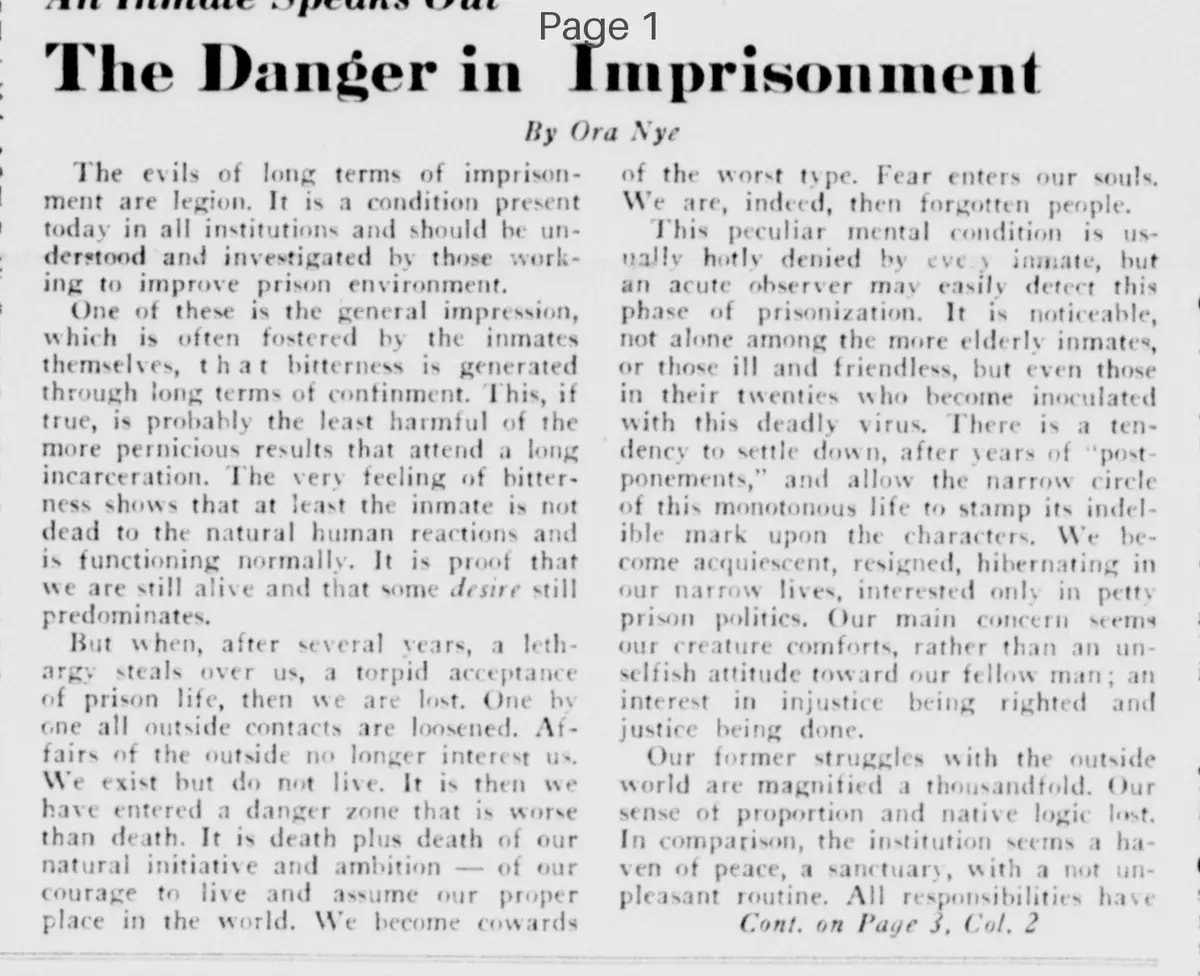
The evils of long terms of imprisonment are legion. It is a condition present today in all institutions and should be understood and investigated by those working to improve prison environment.
One of these is the general impression, which is often fostered by the inmates themselves, that bitterness is generated through long terms of confinement. This, if true, is probably the least harmful of the more pernicious results that attend a long incarceration. The very feeling of bitterness shows that at least the inmate is not dead to the natural human reactions and is functioning normally. It is proof that we are still alive and that some desire still predominates.
But when, after several years, a lethargy steals over us, a torpid acceptance of prison life, then we are lost. One by one all outside contacts are loosened. Affairs of the outside no longer interest us We exist but do not live. It is then we have entered a danger zone that is worse than death. It is death plus death of our natural initiative and ambition - of our courage to live and assume our proper place in the world. We become cowards
of the worst type. Fear enters our souls We are, indeed, then forgotten people.
This peculiar mental condition is usually hotly denied by every inmate, but an acute observer may easily detect this phase of prisonization. It is noticeable, not alone among the more elderly inmates, or those ill and friendless, but even those in their twenties who become inoculated with this deadly virus. There is a tendency to settle down, after years of "postponements," and allow the narrow circle of this monotonous life to stamp its indelible mark upon the characters. We become acquiescent, resigned, hibernating in our narrow lives. interested only in petty prison politics. Our main concern seems our creature comforts, rather than an unselfish attitude toward our fellow man; an interest in injustice being righted and justice being done.
Our former struggles with the outside world are magnified a thousandfold. Our sense of proportion and native logic lost. In comparison, the institution seems a haven of peace, a sanctuary, with a not unpleasant routine. All responsibilities have
Cont. on Page 3, Col. 2
The Danger of Imprisonment
Continued from Page One
been taken away and there is no need for vital decisions to be made. No sacrifices are expected.
We gather with years behind us, a small circle of chosen friends; have access to a fine library, are offered opportunities for educational work and social activities if we are interested. We have livable rooms and sufficient food. Everything is provided, with little or no effort. Our work assignment is often of our own choosing. Our general health is under the hospital regime.
The well-arranged and routine existence requires little initiative and no planning on our part. We need take "no thought of tomorrow." All protest that we are anxiously waiting for the day of our release, but it is obvious if that becomes a reality, many will return again and again to finally settle down in the routine for which there need be no responsibility - a safe harbor from all the strife and storms of life.
Right there is the seed, the virus of the fearfully insidious disease, which attacks the large majority of inmates who spend long years in penal institutions. It is a disease so contagious that it works through the blood of every "long termer" until many no longer dream of a future of usefulness in the outside world. Even those with shorter terms become infected for it colors the very life of the usual institution.
The small group remaining immune to the influence are continually open to attack. They are considered extremely reactionary, even by some of the officials. They cause friction and refuse to settle quietly in their particular niche. They try to preserve their individuality and refuse to suffocate their spirits in the lethargy of the usual prison rust. They disturb the complaisance of the long-timer: entombed in a grave of their own choosing. How jar them awake? -Clarion
Danger in
Imprisonment
The evils of long terms of imprisonment are legion. It is a condition present today in all institutions and should be understood and investigated by those working to improve prison environment.
One of these is the general impression, which is often fostered by the inmates themselves, that bitterness is generated through long terms of confinement. This, if true, is probably the least harmful of the more pernicious results that attend a long incarceration. The very feeling of bitterness shows that at least the inmate is not dead to the natural human reactions and is functioning normally. It is proof that we are still alive and that some desire still predominates.
But when, after several years, a lethargy steals over us, a torpid acceptance of prison life, then we are lost. One by one all outside contacts are loosened. Affairs of the outside no longer interest us We exist but do not live. It is then we have entered a danger zone that is worse than death. It is death plus death of our natural initiative and ambition - of our courage to live and assume our proper place in the world. We become cowards
of the worst type. Fear enters our souls We are, indeed, then forgotten people.
This peculiar mental condition is usually hotly denied by every inmate, but an acute observer may easily detect this phase of prisonization. It is noticeable, not alone among the more elderly inmates, or those ill and friendless, but even those in their twenties who become inoculated with this deadly virus. There is a tendency to settle down, after years of "postponements," and allow the narrow circle of this monotonous life to stamp its indelible mark upon the characters. We become acquiescent, resigned, hibernating in our narrow lives. interested only in petty prison politics. Our main concern seems our creature comforts, rather than an unselfish attitude toward our fellow man; an interest in injustice being righted and justice being done.
Our former struggles with the outside world are magnified a thousandfold. Our sense of proportion and native logic lost. In comparison, the institution seems a haven of peace, a sanctuary, with a not unpleasant routine. All responsibilities have
Cont. on Page 3, Col. 2
The Danger of Imprisonment
Continued from Page One
been taken away and there is no need for vital decisions to be made. No sacrifices are expected.
We gather with years behind us, a small circle of chosen friends; have access to a fine library, are offered opportunities for educational work and social activities if we are interested. We have livable rooms and sufficient food. Everything is provided, with little or no effort. Our work assignment is often of our own choosing. Our general health is under the hospital regime.
The well-arranged and routine existence requires little initiative and no planning on our part. We need take "no thought of tomorrow." All protest that we are anxiously waiting for the day of our release, but it is obvious if that becomes a reality, many will return again and again to finally settle down in the routine for which there need be no responsibility - a safe harbor from all the strife and storms of life.
Right there is the seed, the virus of the fearfully insidious disease, which attacks the large majority of inmates who spend long years in penal institutions. It is a disease so contagious that it works through the blood of every "long termer" until many no longer dream of a future of usefulness in the outside world. Even those with shorter terms become infected for it colors the very life of the usual institution.
The small group remaining immune to the influence are continually open to attack. They are considered extremely reactionary, even by some of the officials. They cause friction and refuse to settle quietly in their particular niche. They try to preserve their individuality and refuse to suffocate their spirits in the lethargy of the usual prison rust. They disturb the complaisance of the long-timer: entombed in a grave of their own choosing. How jar them awake? -Clarion
What sub-type of article is it?
Crime Or Punishment
Social Reform
What keywords are associated?
Long Term Imprisonment
Prison Lethargy
Psychological Effects
Penal Reform
Inmate Bitterness
Reintegration Fear
What entities or persons were involved?
Inmates
Penal Institutions
Prison Officials
Editorial Details
Primary Topic
Psychological Dangers Of Long Term Imprisonment
Stance / Tone
Critical Warning Against Prison Lethargy
Key Figures
Inmates
Penal Institutions
Prison Officials
Key Arguments
Long Imprisonment Generates Bitterness, But Worse Is The Ensuing Lethargy And Torpid Acceptance.
Inmates Lose Outside Contacts, Initiative, Ambition, And Courage To Reintegrate.
Prison Life Becomes A Perceived Sanctuary, Leading To Fear Of Release And Repeated Returns.
The Condition Affects Even Younger Inmates And Is Contagious Within Institutions.
Immune Inmates Who Resist Are Seen As Reactionary And Cause Friction.