Thank you for visiting SNEWPapers!
Sign up free
Editorial
February 6, 1772
The Massachusetts Spy
Boston, Suffolk County, Massachusetts
What is this article about?
Continuation of an editorial on Roman checks on power: laws barring re-election without ten-year intervals, accountability for officials, property qualifications, expulsion of King Tarquin, limits on dictatorial power, and its eventual disuse until usurped by Sulla and Caesar.
Merged-components note: This is the continuation of the editorial piece from page 1 to page 2, as the text flows directly.
Clippings
1 of 2
OCR Quality
88%
Good
Full Text
The remainder of the piece begun in our last.
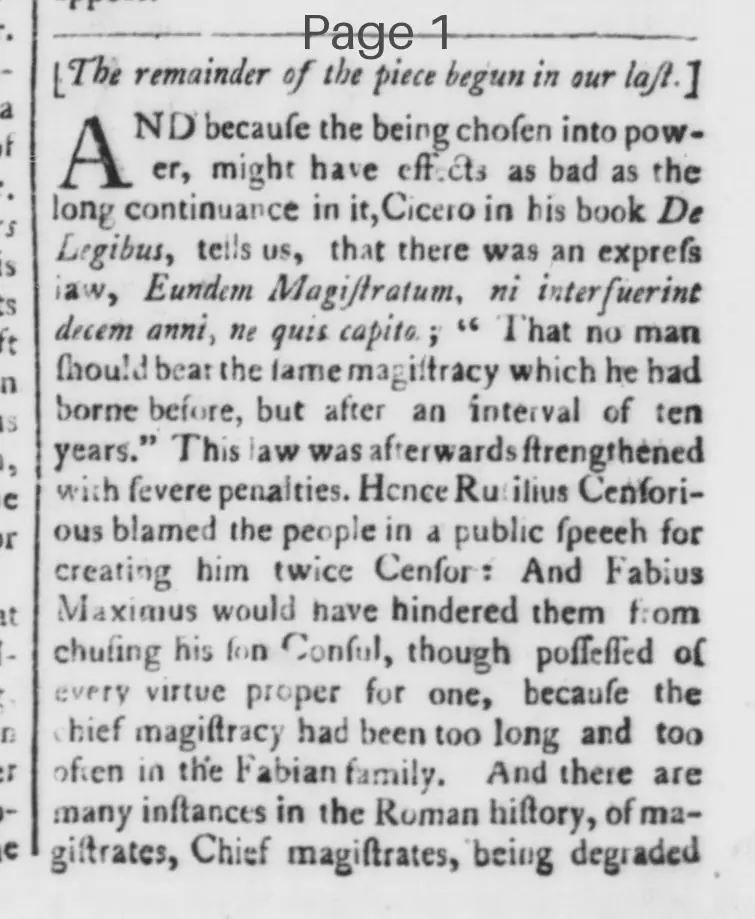
And because the being chosen into power, might have effects as bad as the long continuance in it, Cicero in his book De Legibus, tells us, that there was an express law, Eundem Magistratum, ni interfuerint decem anni, ne quis capito; That no man should bear the same magistracy which he had borne before, but after an interval of ten years. This law was afterwards strengthened with severe penalties. Hence Ruilius Censorinus blamed the people in a public speech for creating him twice Censor: And Fabius Maximus would have hindered them from choosing his son Consul, though possessed of every virtue proper for one, because the chief magistracy had been too long and too often in the Fabian family. And there are many instances in the Roman history, of magistrates, Chief magistrates, being degraded for their pride, avarice, and male administration; and those who were thus degraded, were by law disabled, like our late directors, from ever enjoying again any post or power. Nor were the Romans less careful to oblige their magistrates as soon as they came out of their offices and governments, to make up their accounts, and to give a strict account of their good behaviour; and for an ill one they were often condemned, and lost their estates confiscated. Besides all which, to be a Senator, or a magistrate, a certain qualification in point of fortune was required; and those who had run through their fortunes were degraded from the dignity of Senators. - A reasonable precaution, that they who were intrusted with the interest of their country, should have some interest of their own in it.
In this manner did the Roman people check power, and those who had it; and when any power was grown quite ungovernable, they abolished it. Thus they expelled Tarquin, and the Kingly government, having first suffered much by it; and they prospered as eminently without it. That Government too had been extremely limited: The first Roman Kings were little more than Generals for life: They had no negative vote in the Senate, and could neither make war nor peace; and even in the execution of justice, an appeal lay from them to the people. as is manifest in the case of the surviving Horatius, who slew his sister. Servius Tullius made laws, says Tacitus, which even the Kings were to obey. By confining the power of the crown within proper bounds, he gained power without bounds in the affections of the people. But the insolent Tarquin broke through all bounds, and acted so openly against law, and the people of Rome, that they had no remedy left but to expel him and his race, which they did with glorious success.
The dictatorial power was afterwards given occasionally, and found of great use; but still it was limited to so many months; and there are instances where even the dictator could not do what he pleased, but was overruled by the judgment of the people. Besides when the Romans came to have great and distant territories, and great armies, they thought the dictatorial power too great and too dangerous to be trusted with any subject. and laid it quite aside; nor was it ever afterwards used, till it was violently usurped, first by Sylla, afterwards by Caesar, and then Rome lost its liberty.
And because the being chosen into power, might have effects as bad as the long continuance in it, Cicero in his book De Legibus, tells us, that there was an express law, Eundem Magistratum, ni interfuerint decem anni, ne quis capito; That no man should bear the same magistracy which he had borne before, but after an interval of ten years. This law was afterwards strengthened with severe penalties. Hence Ruilius Censorinus blamed the people in a public speech for creating him twice Censor: And Fabius Maximus would have hindered them from choosing his son Consul, though possessed of every virtue proper for one, because the chief magistracy had been too long and too often in the Fabian family. And there are many instances in the Roman history, of magistrates, Chief magistrates, being degraded for their pride, avarice, and male administration; and those who were thus degraded, were by law disabled, like our late directors, from ever enjoying again any post or power. Nor were the Romans less careful to oblige their magistrates as soon as they came out of their offices and governments, to make up their accounts, and to give a strict account of their good behaviour; and for an ill one they were often condemned, and lost their estates confiscated. Besides all which, to be a Senator, or a magistrate, a certain qualification in point of fortune was required; and those who had run through their fortunes were degraded from the dignity of Senators. - A reasonable precaution, that they who were intrusted with the interest of their country, should have some interest of their own in it.
In this manner did the Roman people check power, and those who had it; and when any power was grown quite ungovernable, they abolished it. Thus they expelled Tarquin, and the Kingly government, having first suffered much by it; and they prospered as eminently without it. That Government too had been extremely limited: The first Roman Kings were little more than Generals for life: They had no negative vote in the Senate, and could neither make war nor peace; and even in the execution of justice, an appeal lay from them to the people. as is manifest in the case of the surviving Horatius, who slew his sister. Servius Tullius made laws, says Tacitus, which even the Kings were to obey. By confining the power of the crown within proper bounds, he gained power without bounds in the affections of the people. But the insolent Tarquin broke through all bounds, and acted so openly against law, and the people of Rome, that they had no remedy left but to expel him and his race, which they did with glorious success.
The dictatorial power was afterwards given occasionally, and found of great use; but still it was limited to so many months; and there are instances where even the dictator could not do what he pleased, but was overruled by the judgment of the people. Besides when the Romans came to have great and distant territories, and great armies, they thought the dictatorial power too great and too dangerous to be trusted with any subject. and laid it quite aside; nor was it ever afterwards used, till it was violently usurped, first by Sylla, afterwards by Caesar, and then Rome lost its liberty.
What sub-type of article is it?
Constitutional
What keywords are associated?
Roman Magistracies
Checks On Power
Re Election Limits
Official Accountability
Tarquin Expulsion
Dictatorial Power
Republican Safeguards
What entities or persons were involved?
Cicero
Ruilius Censorinus
Fabius Maximus
Tarquin
Servius Tullius
Horatius
Sylla
Caesar
Roman Senate
Roman People
Editorial Details
Primary Topic
Roman Checks On Power And Limits On Magistracies
Stance / Tone
Admiring Of Roman Republican Safeguards Against Abuse Of Power
Key Figures
Cicero
Ruilius Censorinus
Fabius Maximus
Tarquin
Servius Tullius
Horatius
Sylla
Caesar
Roman Senate
Roman People
Key Arguments
Law Prohibited Holding Same Magistracy Without 10 Year Interval, Later With Penalties
Magistrates Required To Account For Behavior And Finances Post Office, With Punishments For Misconduct
Property Qualification Required For Senators And Magistrates
Expulsion Of King Tarquin For Overreaching Power
Early Kings Had Limited Powers, With Appeals To The People
Dictatorial Power Limited In Duration And Overruled By People When Needed
Dictatorship Abolished As Territories Grew, Until Usurped By Sulla And Caesar Leading To Loss Of Liberty