Thank you for visiting SNEWPapers!
Sign up free
Editorial
November 7, 1789
Gazette Of The United States
New York, New York County, New York
What is this article about?
In 'The Observer No. III,' the author argues that the post-Revolutionary War public debt can be a national benefit if managed wisely, creating transferable property to support commerce and agriculture without burdensome taxes, benefiting creditors, farmers, and the economy.
Merged-components note: Continuation of 'THE OBSERVER.-No. III.' across pages, merged into single coherent editorial on public debt management.
Clippings
1 of 2
OCR Quality
95%
Excellent
Full Text
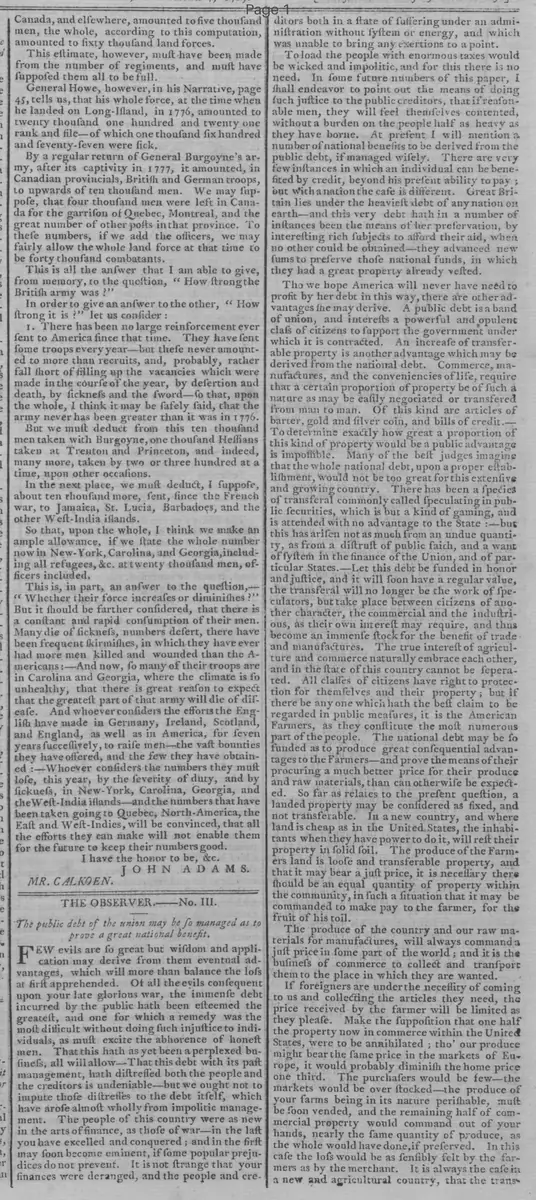
THE OBSERVER.-No. III.
The public debt of the union may be so managed as to prove a great national benefit.
Few evils are so great but wisdom and application may derive from them eventual advantages, which will more than balance the loss at first apprehended. Of all the evils consequent upon your late glorious war, the immense debt incurred by the public hath been esteemed the greatest, and one for which a remedy was the most difficult without doing such injustice to individuals, as must excite the abhorrence of honest men. That this hath as yet been a perplexed business, all will allow— That this debt with its past management, hath distressed both the people and the creditors is undeniable—but we ought not to impute those distresses to the debt itself, which have arose almost wholly from impolitic management. The people of this country were as new in the arts of finance, as those of war—in the last you have excelled and conquered; and in the first may soon become eminent, if some popular prejudices do not prevent. It is not strange that your finances were deranged, and the people and creditors both in a state of suffering under an administration without system or energy, and which was unable to bring any exertions to a point.
To load the people with enormous taxes would be wicked and impolitic, and for this there is no need. In some future numbers of this paper, I shall endeavor to point out the means of doing such justice to the public creditors, that if reasonable men, they will feel themselves contented, without a burden on the people half as heavy as they have borne. At present I will mention a number of national benefits to be derived from the public debt, if managed wisely. There are very few instances in which an individual can be benefited by credit, beyond his present ability to pay; but with a nation the case is different. Great Britain lies under the heaviest debt of any nation on earth—and this very debt hath in a number of instances been the means of her preservation, by interesting rich subjects to afford their aid, when no other could be obtained—they advanced new sums to preserve those national funds, in which they had a great property already vested.
Though we hope America will never have need to profit by her debt in this way, there are other advantages she may derive. A public debt is a band of union, and interests a powerful and opulent class of citizens to support the government under which it is contracted. An increase of transferable property is another advantage which may be derived from the national debt. Commerce, manufactures, and the conveniencies of life, require that a certain proportion of property be of such a nature as may be easily negotiated or transferred from man to man. Of this kind are articles of barter, gold and silver coin, and bills of credit.—
To determine exactly how great a proportion of this kind of property would be a public advantage is impossible. Many of the best judges imagine that the whole national debt, upon a proper establishment, would not be too great for this extensive and growing country. There has been a species of transferal commonly called speculating in public securities, which is but a kind of gaming, and is attended with no advantage to the State:—but this has arisen not as much from an undue quantity, as from a distrust of public faith, and a want of system in the finance of the Union, and of particular States.—Let this debt be funded in honor and justice, and it will soon have a regular value, the transferal will no longer be the work of speculators, but take place between citizens of another character, the commercial and the industrious, as their own interest may require, and thus become an immense stock for the benefit of trade and manufactures. The true interest of agriculture and commerce naturally embrace each other, and in the state of this country cannot be separated. All classes of citizens have right to protection for themselves and their property; but if there be any one which hath the best claim to be regarded in public measures, it is the American Farmers, as they constitute the most numerous part of the people. The national debt may be so funded as to produce great consequential advantages to the Farmers—and prove the means of their procuring a much better price for their produce and raw materials, than can otherwise be expected. So far as relates to the present question, a landed property may be considered as fixed, and not transferable. In a new country, and where land is cheap as in the United States, the inhabitants when they have power to do it, will rest their property in solid soil. The produce of the Farmers land is loose and transferable property, and that it may bear a just price, it is necessary there should be an equal quantity of property within the community, in such a situation that it may be commanded to make pay to the farmer, for the fruit of his toil.
The produce of the country and our raw materials for manufactures, will always command a just price in some part of the world; and it is the business of commerce to collect and transport them to the place in which they are wanted. If foreigners are under the necessity of coming to us and collecting the articles they need, the price received by the farmer will be limited as they please. Make the supposition that one half the property now in commerce within the United States, were to be annihilated; though our produce might bear the same price in the markets of Europe, it would probably diminish the home price one third. The purchasers would be few—the markets would be over stocked—the produce of your farms being in its nature perishable, must be soon vended, and the remaining half of commercial property would command out of your hands, nearly the same quantity of produce, as the whole would have done, if preserved. In this case the loss would be as sensibly felt by the farmers as by the merchant. It is always the case in a new and agricultural country, that the trans-
Transferable property is in too small quantity for the advantage of those who hold and till the ground.
At present the principal of the national debt cannot be paid, but with a little honesty and policy it may be placed in a situation safe for the creditors and beneficial to all classes of citizens.
For the benefit of the agricultural interest, I would not wish the debt to be annihilated, if it were consistent with justice. Let it be honestly funded, it must remain in its nature transferable, and will be an immense bank for all kinds of business. The situation of the United States is such, your agriculture so extensive and increasing, and the quantity of your produce so great, that unless by some policy of this kind you fix a certain quantity of property in its nature negotiable, the market will be overstocked, and the loss will in the end be borne by the farmer.
Suppose the surplus produce of a farmer beyond his own consumption, to equal one hundred bushels of wheat. If there be a just proportion of negotiable property, each bushel will be worth five shillings; but if this proportion be a little lessened, each bushel will command only four shillings, and the whole loss to the farmer will be five pounds; which is a sum four times so great as he needs to pay in taxes, to place the whole American debt on honorable funds. To execute this business, honesty, and great abilities are requisite—the new treasury department promises you both, and I make no doubt but the debt we have lamented, will soon be a great national advantage.
The public debt of the union may be so managed as to prove a great national benefit.
Few evils are so great but wisdom and application may derive from them eventual advantages, which will more than balance the loss at first apprehended. Of all the evils consequent upon your late glorious war, the immense debt incurred by the public hath been esteemed the greatest, and one for which a remedy was the most difficult without doing such injustice to individuals, as must excite the abhorrence of honest men. That this hath as yet been a perplexed business, all will allow— That this debt with its past management, hath distressed both the people and the creditors is undeniable—but we ought not to impute those distresses to the debt itself, which have arose almost wholly from impolitic management. The people of this country were as new in the arts of finance, as those of war—in the last you have excelled and conquered; and in the first may soon become eminent, if some popular prejudices do not prevent. It is not strange that your finances were deranged, and the people and creditors both in a state of suffering under an administration without system or energy, and which was unable to bring any exertions to a point.
To load the people with enormous taxes would be wicked and impolitic, and for this there is no need. In some future numbers of this paper, I shall endeavor to point out the means of doing such justice to the public creditors, that if reasonable men, they will feel themselves contented, without a burden on the people half as heavy as they have borne. At present I will mention a number of national benefits to be derived from the public debt, if managed wisely. There are very few instances in which an individual can be benefited by credit, beyond his present ability to pay; but with a nation the case is different. Great Britain lies under the heaviest debt of any nation on earth—and this very debt hath in a number of instances been the means of her preservation, by interesting rich subjects to afford their aid, when no other could be obtained—they advanced new sums to preserve those national funds, in which they had a great property already vested.
Though we hope America will never have need to profit by her debt in this way, there are other advantages she may derive. A public debt is a band of union, and interests a powerful and opulent class of citizens to support the government under which it is contracted. An increase of transferable property is another advantage which may be derived from the national debt. Commerce, manufactures, and the conveniencies of life, require that a certain proportion of property be of such a nature as may be easily negotiated or transferred from man to man. Of this kind are articles of barter, gold and silver coin, and bills of credit.—
To determine exactly how great a proportion of this kind of property would be a public advantage is impossible. Many of the best judges imagine that the whole national debt, upon a proper establishment, would not be too great for this extensive and growing country. There has been a species of transferal commonly called speculating in public securities, which is but a kind of gaming, and is attended with no advantage to the State:—but this has arisen not as much from an undue quantity, as from a distrust of public faith, and a want of system in the finance of the Union, and of particular States.—Let this debt be funded in honor and justice, and it will soon have a regular value, the transferal will no longer be the work of speculators, but take place between citizens of another character, the commercial and the industrious, as their own interest may require, and thus become an immense stock for the benefit of trade and manufactures. The true interest of agriculture and commerce naturally embrace each other, and in the state of this country cannot be separated. All classes of citizens have right to protection for themselves and their property; but if there be any one which hath the best claim to be regarded in public measures, it is the American Farmers, as they constitute the most numerous part of the people. The national debt may be so funded as to produce great consequential advantages to the Farmers—and prove the means of their procuring a much better price for their produce and raw materials, than can otherwise be expected. So far as relates to the present question, a landed property may be considered as fixed, and not transferable. In a new country, and where land is cheap as in the United States, the inhabitants when they have power to do it, will rest their property in solid soil. The produce of the Farmers land is loose and transferable property, and that it may bear a just price, it is necessary there should be an equal quantity of property within the community, in such a situation that it may be commanded to make pay to the farmer, for the fruit of his toil.
The produce of the country and our raw materials for manufactures, will always command a just price in some part of the world; and it is the business of commerce to collect and transport them to the place in which they are wanted. If foreigners are under the necessity of coming to us and collecting the articles they need, the price received by the farmer will be limited as they please. Make the supposition that one half the property now in commerce within the United States, were to be annihilated; though our produce might bear the same price in the markets of Europe, it would probably diminish the home price one third. The purchasers would be few—the markets would be over stocked—the produce of your farms being in its nature perishable, must be soon vended, and the remaining half of commercial property would command out of your hands, nearly the same quantity of produce, as the whole would have done, if preserved. In this case the loss would be as sensibly felt by the farmers as by the merchant. It is always the case in a new and agricultural country, that the trans-
Transferable property is in too small quantity for the advantage of those who hold and till the ground.
At present the principal of the national debt cannot be paid, but with a little honesty and policy it may be placed in a situation safe for the creditors and beneficial to all classes of citizens.
For the benefit of the agricultural interest, I would not wish the debt to be annihilated, if it were consistent with justice. Let it be honestly funded, it must remain in its nature transferable, and will be an immense bank for all kinds of business. The situation of the United States is such, your agriculture so extensive and increasing, and the quantity of your produce so great, that unless by some policy of this kind you fix a certain quantity of property in its nature negotiable, the market will be overstocked, and the loss will in the end be borne by the farmer.
Suppose the surplus produce of a farmer beyond his own consumption, to equal one hundred bushels of wheat. If there be a just proportion of negotiable property, each bushel will be worth five shillings; but if this proportion be a little lessened, each bushel will command only four shillings, and the whole loss to the farmer will be five pounds; which is a sum four times so great as he needs to pay in taxes, to place the whole American debt on honorable funds. To execute this business, honesty, and great abilities are requisite—the new treasury department promises you both, and I make no doubt but the debt we have lamented, will soon be a great national advantage.
What sub-type of article is it?
Economic Policy
Agriculture
Trade Or Commerce
What keywords are associated?
Public Debt
National Finance
Debt Funding
Agriculture Benefits
Transferable Property
American Farmers
Commerce Support
What entities or persons were involved?
Public Creditors
American Farmers
Great Britain
New Treasury Department
Editorial Details
Primary Topic
Managing Public Debt As National Benefit
Stance / Tone
Optimistic Advocacy For Wise Debt Funding
Key Figures
Public Creditors
American Farmers
Great Britain
New Treasury Department
Key Arguments
Public Debt From War Can Yield Advantages If Managed Wisely
Past Distresses Due To Impolitic Management, Not Debt Itself
Debt Creates Band Of Union And Interests Citizens In Government Support
Increases Transferable Property Beneficial For Commerce And Manufactures
Funding Debt Honestly Benefits Farmers By Improving Prices For Produce
Speculation Arises From Distrust, Proper Funding Will Enable Regular Transfers
Negotiable Property Needed To Prevent Overstocked Markets And Farmer Losses