Thank you for visiting SNEWPapers!
Sign up free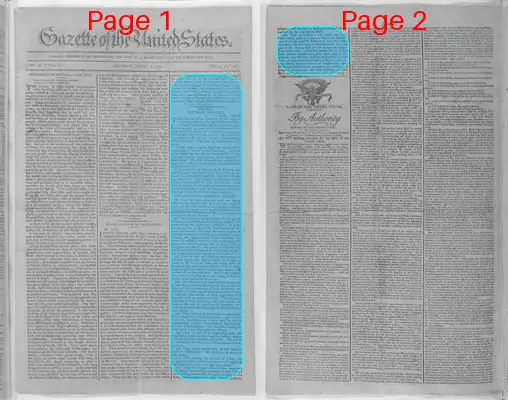
Gazette Of The United States
New York, New York County, New York
What is this article about?
The French National Assembly, on Saturday, May 22, debated and passed a decree on the right of peace and war, vesting it in the nation via the Legislative Body, with the King's notification required. Mirabeau defended his plan against objections from Barnave and others; the decree outlines powers, responsibilities, and procedures, receiving the King's assent.
Merged-components note: Continuation of the report on the French National Assembly decree across pages.
Clippings
1 of 2
OCR Quality
Full Text
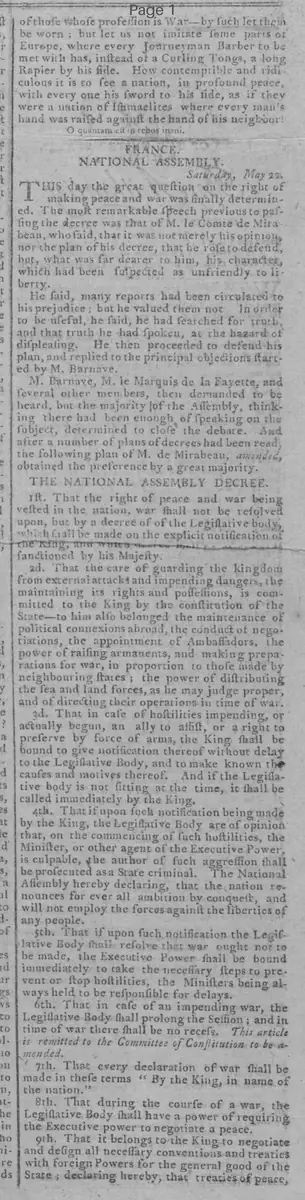
be worn; but let us not imitate some parts of
Europe, where every Journeyman Barber to be
met with has, instead of a Curling Tongs, a long
Rapier by his side. How contemptible and ridi-
culous it is to see a nation, in profound peace,
with every one his sword to his side, as if they
were a nation of Ishmaelites where every man's
hand was raised against the hand of his neighbour!
O quantum mutata in rebus inani.
FRANCE.
NATIONAL ASSEMBLY.
THIS day the great question stood the right of
making peace and war was finally deter-
mined.
Saturday, May 22.
The most remarkable speech previous to pass-
ing the decree was that of M. le Comte de Mira-
beau, who said, that it was not merely his opinion
nor the plan of his decree, that he rose to defend.
but, what was far dearer to him, his character,
which had been suspected as unfriendly to li-
berty.
He said, many reports had been circulated to
his prejudice; but he valued them not In order
to be useful, he said, he had searched for truth,
and that truth he had spoken, at the hazard of
displeasing. He then proceeded to defend his
plan, and replied to the principal objections start-
ed by M. Barnave.
M. Barnave, M. le Marquis de la Fayette, and
several other members, then demanded to be
heard, but the majority of the Assembly, think-
ing there had been enough of speaking on the
subject, determined to close the debate. And
after a number of plans of decrees had been read,
the following plan of M. de Mirabeau, amended,
obtained the preference by a great majority.
THE NATIONAL ASSEMBLY DECREE.
1st. That the right of peace and war being
vested in the nation, war shall not be resolved
upon, but by a decree of the Legislative body,
which shall be made on the explicit notification of
the King, and which
sanctioned by his Majesty.
2d. That the care of guarding the kingdom
from external attacks and impending dangers, the
maintaining its rights and possessions, is com-
mitted to the King by the constitution of the
State—to him also belonged the maintenance of
political connexions abroad, the conduct of nego-
tations, the appointment of Ambassadors, the
power of raising armaments, and making prepa-
rations for war, in proportion to those made by
neighbouring states; the power of distributing
the sea and land forces, as he may judge proper,
and of directing their operations in time of war.
3d. That in case of hostilities impending, or
actually begun, an ally to assist, or a right to
preserve by force of arms, the King shall be
bound to give notification thereof without delay
to the Legislative Body, and to make known the
causes and motives thereof. And if the Legisla-
tive body is not sitting at the time, it shall be
called immediately by the King.
4th. That if upon such notification being made
by the King, the Legislative Body are of opinion
that, on the commencing of such hostilities, the
Minister, or other agent of the Executive Power,
is culpable, the author of such aggression shall
be prosecuted as a State criminal. The National
Assembly hereby declaring, that the nation re-
nounces for ever all ambition by conquest, and
will not employ the forces against the liberties of
any people.
5th. That if upon such notification the Legis-
lative Body shall resolve that war ought not to
be made, the Executive Power shall be bound
immediately to take the necessary steps to pre-
vent or stop hostilities, the Ministers being al-
ways held to be responsible for delays.
6th. That in case of an impending war, the
Legislative Body shall prolong the Session; and in
time of war there shall be no recess. This article
is remitted to the Committee of Constitution to bea-
mended.
7th. That every declaration of war shall be
made in these terms "By the King, in name of
the nation."
8th. That during the course of a war, the
Legislative Body shall have a power of requiring
the Executive power to negotiate a peace.
9th. That it belongs to the King to negotiate
and design all necessary conventions and treaties
with foreign Powers for the general good of the
State; declaring hereby, that treaties of peace,
alliance, and commerce, shall not be effectual till
ratified by the Legislative Body.
10th. That the instant a war ceases the Legislative Body shall fix a day on which the extraordinary troops shall be disbanded, and the army reduced to its usual peace establishment; that the pay of the troops shall not be continued longer than such a day; and if the extraordinary troops shall remain undisbarded after such day so appointed, the Minister shall be responsible for the same, and prosecuted as a state criminal; that for that effect, the committee of constitution shall be bound forthwith to examine this article, and prepare a report on the responsibility of Ministers. This Decree received the assent of the King.
What sub-type of article is it?
What keywords are associated?
What entities or persons were involved?
Where did it happen?
Foreign News Details
Primary Location
France
Event Date
Saturday, May 22
Key Persons
Outcome
the decree obtained the preference by a great majority and received the assent of the king.
Event Details
The National Assembly debated the right of making peace and war. M. le Comte de Mirabeau delivered a remarkable speech defending his plan and character against suspicions and objections from M. Barnave. Other members including M. le Marquis de la Fayette sought to speak, but the debate was closed. Mirabeau's amended plan was adopted, outlining the Legislative Body's role in declaring war upon the King's notification, the King's responsibilities in defense and negotiations, procedures for hostilities, renunciations of conquest, session rules during war, declaration terms, peace negotiation powers, treaty ratifications, and post-war demobilization.