Thank you for visiting SNEWPapers!
Sign up free
Story
February 21, 1891
Frostburg Mining Journal
Frostburg, Allegany County, Maryland
What is this article about?
The great auk, a flightless bird once common in Iceland and North American waters, is likely extinct after the last two were killed in 1844 on Eldey islet. Eggs now sell for over $1,000 due to rarity, with historical accounts from Audubon and others.
Clipping
OCR Quality
88%
Good
Full Text
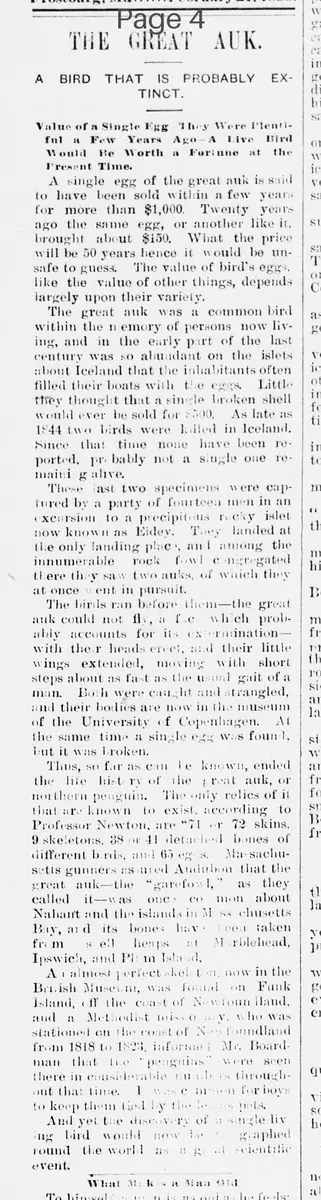
THE GREAT AUK.
A BIRD THAT IS PROBABLY EXTINCT.
Value of a Single Egg They Were Plentiful a Few Years Ago-A Live Bird Would Be Worth a Fortune at the Present Time
A single egg of the great auk is said to have been sold within a few years for more than $1,000. Twenty years ago the same egg, or another like it, brought about $150. What the price will be 50 years hence it would be unsafe to guess. The value of bird's eggs, like the value of other things, depends largely upon their rarity.
The great auk was a common bird within the memory of persons now living, and in the early part of the last century was so abundant on the islets about Iceland that the inhabitants often filled their boats with the eggs. Little they thought that a single broken shell would ever be sold for $500. As late as 1844 two birds were killed in Iceland. Since that time none have been reported, probably not a single one remaining alive.
These last two specimens were captured by a party of fourteen men in an excursion to a precipitous rocky islet now known as Eldey. They landed at the only landing place, and among the innumerable rock fowl congregated there they saw two auks, of which they at once set in pursuit.
The birds ran before them-the great auk could not fly, a fact which probably accounts for its extermination-with their heads erect, and their little wings extended, moving with short steps about as fast as the usual gait of a man. Both were caught and strangled, and their bodies are now in the museum of the University of Copenhagen. At the same time a single egg was found, but it was broken.
Thus, so far as can be known, ended the life history of the great auk, or another penguin. The only relics of it that are known to exist, according to Professor Newton, are "71 or 72 skins, 9 skeletons, 38 or 41 detached bones of different birds, and 65 eggs." Massachusetts gunners assured Audubon that the great auk-the "garfowl," as they called it-was once common about Nahant and the islands in Massachusetts Bay, and its bones have been taken from shell heaps at Marblehead, Ipswich, and Plum Island.
A nearly perfect skeleton, now in the British Museum, was found on Funk Island, off the coast of Newfoundland, and a Methodist missionary who was stationed on the coast of Newfoundland from 1818 to 1823, informed Mr. Boardman that the penguines were seen there in considerable numbers through out that time. It was common for boys to keep them tied by the legs in nets.
And yet the discovery of a single living bird would not go unheeded round the world as a scientific event.
A BIRD THAT IS PROBABLY EXTINCT.
Value of a Single Egg They Were Plentiful a Few Years Ago-A Live Bird Would Be Worth a Fortune at the Present Time
A single egg of the great auk is said to have been sold within a few years for more than $1,000. Twenty years ago the same egg, or another like it, brought about $150. What the price will be 50 years hence it would be unsafe to guess. The value of bird's eggs, like the value of other things, depends largely upon their rarity.
The great auk was a common bird within the memory of persons now living, and in the early part of the last century was so abundant on the islets about Iceland that the inhabitants often filled their boats with the eggs. Little they thought that a single broken shell would ever be sold for $500. As late as 1844 two birds were killed in Iceland. Since that time none have been reported, probably not a single one remaining alive.
These last two specimens were captured by a party of fourteen men in an excursion to a precipitous rocky islet now known as Eldey. They landed at the only landing place, and among the innumerable rock fowl congregated there they saw two auks, of which they at once set in pursuit.
The birds ran before them-the great auk could not fly, a fact which probably accounts for its extermination-with their heads erect, and their little wings extended, moving with short steps about as fast as the usual gait of a man. Both were caught and strangled, and their bodies are now in the museum of the University of Copenhagen. At the same time a single egg was found, but it was broken.
Thus, so far as can be known, ended the life history of the great auk, or another penguin. The only relics of it that are known to exist, according to Professor Newton, are "71 or 72 skins, 9 skeletons, 38 or 41 detached bones of different birds, and 65 eggs." Massachusetts gunners assured Audubon that the great auk-the "garfowl," as they called it-was once common about Nahant and the islands in Massachusetts Bay, and its bones have been taken from shell heaps at Marblehead, Ipswich, and Plum Island.
A nearly perfect skeleton, now in the British Museum, was found on Funk Island, off the coast of Newfoundland, and a Methodist missionary who was stationed on the coast of Newfoundland from 1818 to 1823, informed Mr. Boardman that the penguines were seen there in considerable numbers through out that time. It was common for boys to keep them tied by the legs in nets.
And yet the discovery of a single living bird would not go unheeded round the world as a scientific event.
What sub-type of article is it?
Curiosity
Animal Story
Historical Event
What themes does it cover?
Nature
Misfortune
What keywords are associated?
Great Auk
Extinction
Bird Eggs
Iceland
Eld Ey
1844
Rarity
Penguin
What entities or persons were involved?
Professor Newton
Audubon
Mr. Boardman
Where did it happen?
Iceland, Eldey Islet, Massachusetts Bay, Newfoundland
Story Details
Key Persons
Professor Newton
Audubon
Mr. Boardman
Location
Iceland, Eldey Islet, Massachusetts Bay, Newfoundland
Event Date
1844
Story Details
The great auk was abundant in the early 19th century around Iceland and North America but was exterminated due to inability to fly; last two killed in 1844 on Eldey, with bodies in Copenhagen museum; eggs now highly valuable due to rarity.