Thank you for visiting SNEWPapers!
Sign up free
Editorial
June 23, 1808
Norfolk Gazette And Publick Ledger
Norfolk, Virginia
What is this article about?
The Publick Ledger editorial from June 23, 1808, reports on a packet accident affecting publication, updates on the seized US ship Osage in France, speculations on US-Britain relations indicating peace, European conflicts including Russian retreat from Finland and Swedish invasion of Norway, and a letter detailing French seizures of American property and broader continental news.
Clipping
OCR Quality
98%
Excellent
Full Text
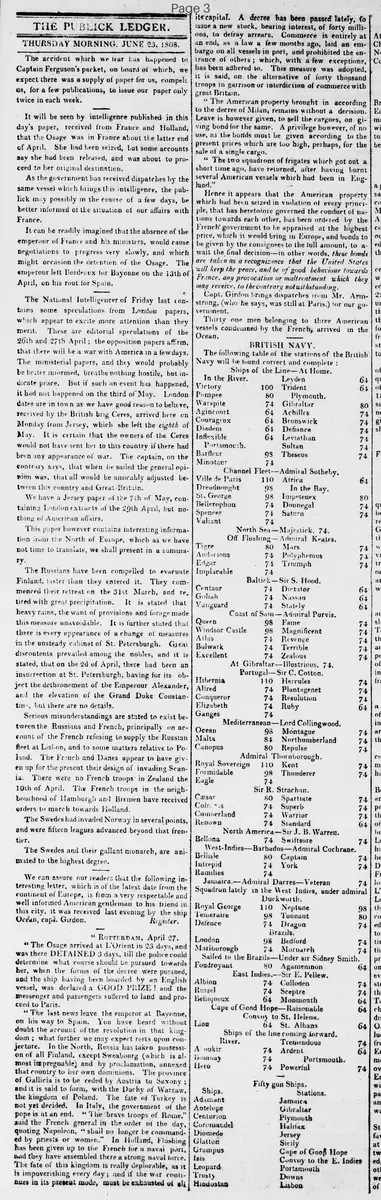
THE PUBLICK LEDGER.
THURSDAY MORNING, JUNE 23, 1808.
The accident which we learn has happened to Captain Ferguson's packet, on board of which, we expect there was a supply of paper for us, compels us, for a few publications, to issue our paper only twice in each week.
It will be seen by intelligence published in this day's paper, received from France and Holland, that the Osage was in France about the latter end of April. She had been seized, but some accounts say she had been released, and was about to proceed to her original destination.
As the government has received dispatches by the same vessel which brings this intelligence, the public may possibly in the course of a few days, be better informed of the situation of our affairs with France.
It can be readily imagined that the absence of the emperor of France and his ministers, would cause negotiations to progress very slowly, and which might occasion the detention of the Osage. The emperor left Bordeaux for Bayonne on the 13th of April, on his route for Spain.
The National Intelligencer of Friday last contains some speculations from London papers, which appear to excite more attention than they merit. These are editorial speculations of the 26th and 27th April; the opposition papers affirm, that there will be a war with America in a few days. The ministerial papers, and they would probably be better informed, breathe nothing hostile, but indicate peace. But if such an event has happened, it had not happened on the third of May. London dates are in town as we have good reason to believe, received by the British brig Ceres, arrived here on Monday from Jersey, which she left the eighth of May. It is certain that the owners of the Ceres would not have sent her to this country if there had been any appearance of war. The captain, on the contrary says, that when he sailed the general opinion was, that all would be amicably adjusted between this country and Great-Britain.
We have a Jersey paper of the 7th of May, containing London extracts of the 29th April, but nothing of American affairs.
This paper however contains interesting information from the North of Europe, which as we have not time to translate, we shall present in a summary.
The Russians have been compelled to evacuate Finland, faster than they entered it. They commenced their retreat on the 31st March, and retired with great precipitation. It is stated that heavy rains, the want of provisions and forage made this measure unavoidable. It is further stated that there is every appearance of a change of measures in the unsteady cabinet of St. Petersburgh. Great discontents prevailed among the nobles, and it is stated, that on the 2d of April, there had been an insurrection at St. Petersburgh, having for its object the dethronement of the Emperor Alexander, and the elevation of the Grand Duke Constantine, but there are no details.
Serious misunderstandings are stated to exist between the Russians and French, principally on account of the French refusing to supply the Russian fleet at Lisbon, and to some matters relative to Poland. The French and Danes appear to have given up for the present their design of invading Scandinavia. There were no French troops in Zealand the 10th of April. The French troops in the neighbourhood of Hamburgh and Bremen have received orders to march towards Holland.
The Swedes had invaded Norway in several points, and were fifteen leagues advanced beyond that frontier.
The Swedes and their gallant monarch, are animated to the highest degree.
We can assure our readers that the following interesting letter, which is of the latest date from the continent of Europe, is from a very respectable and well informed American gentleman to his friend in this city, it was received last evening by the ship Ocean, Capt. Girdon. Register.
"ROTTERDAM, April 27.
"The Osage arrived at L'Orient in 23 days, and was there detained 3 days, till the police could determine what course should be pursued towards her, when the forms of the decree were pursued, and the ship having been boarded by an English vessel, was declared a good prize! and the messenger and passengers suffered to land and proceed to Paris.
"The last news leave the emperor at Bayonne, on his way to Spain. You have heard without doubt the account of the revolution in that kingdom; what further we may expect rests upon conjecture. In the North, Russia has taken possession of all Finland, except Sweaborg (which is almost impregnable) and by proclamation, annexed that country to her own dominions. The province of Galicia is to be ceded by Austria to Saxony; and it is said to form, with the Duchy of Warsaw, the kingdom of Poland. The fate of Turkey is not yet decided. In Italy, the government of the pope is at an end. 'The brave troops of Rome,' said the French general in the order of the day, quoting Napoleon, 'shall no longer be commanded by priests or women.' In Holland, Flushing has been given up to the French for a naval port, and they have assembled there a strong naval force. The fate of this kingdom is really deplorable, as it is impoverishing every day; and if the war continues in its present mode, must be exhausted of all its capital. A decree has been passed lately, to issue a new stock, bearing interest, of forty millions, to defray arrears. Commerce is entirely at a end, as a law a few months ago, laid an embargo on all vessels in port, and prohibited the entrance of others; which, with a few exceptions, has been adhered to. This measure was adopted, it is said, on the alternative of forty thousand troops in garrison or interdiction of commerce with Great Britain.
"The American property brought in according to the decree of Milan, remains without a decision. Leave is however given, to sell the cargoes, on giving bond for the same. A privilege however, of no use, as the bonds must be given according to the present prices which are too high, perhaps, for the sale of a single cargo.
The two squadrons of frigates which got out a short time ago, have returned, after having burnt several American vessels which had been in England."
Hence it appears that the American property which had been seized in violation of every principle, that has heretofore governed the conduct of nations towards each other, has been ordered by the French government to be appraised at the highest price, which it would bring in Europe, and bonds to be given by the consignees to the full amount, to await the final decision--in other words, these bonds are taken as a recognizance that the United States will keep the peace, and be of good behaviour towards France, any provocation or maltreatment which they may receive, to the contrary notwithstanding.
Capt. Girdon brings dispatches from Mr. Armstrong, (who he says, was still at Paris,) for our government.
Thirty one men belonging to three American vessels condemned by the French, arrived in the Ocean.
THURSDAY MORNING, JUNE 23, 1808.
The accident which we learn has happened to Captain Ferguson's packet, on board of which, we expect there was a supply of paper for us, compels us, for a few publications, to issue our paper only twice in each week.
It will be seen by intelligence published in this day's paper, received from France and Holland, that the Osage was in France about the latter end of April. She had been seized, but some accounts say she had been released, and was about to proceed to her original destination.
As the government has received dispatches by the same vessel which brings this intelligence, the public may possibly in the course of a few days, be better informed of the situation of our affairs with France.
It can be readily imagined that the absence of the emperor of France and his ministers, would cause negotiations to progress very slowly, and which might occasion the detention of the Osage. The emperor left Bordeaux for Bayonne on the 13th of April, on his route for Spain.
The National Intelligencer of Friday last contains some speculations from London papers, which appear to excite more attention than they merit. These are editorial speculations of the 26th and 27th April; the opposition papers affirm, that there will be a war with America in a few days. The ministerial papers, and they would probably be better informed, breathe nothing hostile, but indicate peace. But if such an event has happened, it had not happened on the third of May. London dates are in town as we have good reason to believe, received by the British brig Ceres, arrived here on Monday from Jersey, which she left the eighth of May. It is certain that the owners of the Ceres would not have sent her to this country if there had been any appearance of war. The captain, on the contrary says, that when he sailed the general opinion was, that all would be amicably adjusted between this country and Great-Britain.
We have a Jersey paper of the 7th of May, containing London extracts of the 29th April, but nothing of American affairs.
This paper however contains interesting information from the North of Europe, which as we have not time to translate, we shall present in a summary.
The Russians have been compelled to evacuate Finland, faster than they entered it. They commenced their retreat on the 31st March, and retired with great precipitation. It is stated that heavy rains, the want of provisions and forage made this measure unavoidable. It is further stated that there is every appearance of a change of measures in the unsteady cabinet of St. Petersburgh. Great discontents prevailed among the nobles, and it is stated, that on the 2d of April, there had been an insurrection at St. Petersburgh, having for its object the dethronement of the Emperor Alexander, and the elevation of the Grand Duke Constantine, but there are no details.
Serious misunderstandings are stated to exist between the Russians and French, principally on account of the French refusing to supply the Russian fleet at Lisbon, and to some matters relative to Poland. The French and Danes appear to have given up for the present their design of invading Scandinavia. There were no French troops in Zealand the 10th of April. The French troops in the neighbourhood of Hamburgh and Bremen have received orders to march towards Holland.
The Swedes had invaded Norway in several points, and were fifteen leagues advanced beyond that frontier.
The Swedes and their gallant monarch, are animated to the highest degree.
We can assure our readers that the following interesting letter, which is of the latest date from the continent of Europe, is from a very respectable and well informed American gentleman to his friend in this city, it was received last evening by the ship Ocean, Capt. Girdon. Register.
"ROTTERDAM, April 27.
"The Osage arrived at L'Orient in 23 days, and was there detained 3 days, till the police could determine what course should be pursued towards her, when the forms of the decree were pursued, and the ship having been boarded by an English vessel, was declared a good prize! and the messenger and passengers suffered to land and proceed to Paris.
"The last news leave the emperor at Bayonne, on his way to Spain. You have heard without doubt the account of the revolution in that kingdom; what further we may expect rests upon conjecture. In the North, Russia has taken possession of all Finland, except Sweaborg (which is almost impregnable) and by proclamation, annexed that country to her own dominions. The province of Galicia is to be ceded by Austria to Saxony; and it is said to form, with the Duchy of Warsaw, the kingdom of Poland. The fate of Turkey is not yet decided. In Italy, the government of the pope is at an end. 'The brave troops of Rome,' said the French general in the order of the day, quoting Napoleon, 'shall no longer be commanded by priests or women.' In Holland, Flushing has been given up to the French for a naval port, and they have assembled there a strong naval force. The fate of this kingdom is really deplorable, as it is impoverishing every day; and if the war continues in its present mode, must be exhausted of all its capital. A decree has been passed lately, to issue a new stock, bearing interest, of forty millions, to defray arrears. Commerce is entirely at a end, as a law a few months ago, laid an embargo on all vessels in port, and prohibited the entrance of others; which, with a few exceptions, has been adhered to. This measure was adopted, it is said, on the alternative of forty thousand troops in garrison or interdiction of commerce with Great Britain.
"The American property brought in according to the decree of Milan, remains without a decision. Leave is however given, to sell the cargoes, on giving bond for the same. A privilege however, of no use, as the bonds must be given according to the present prices which are too high, perhaps, for the sale of a single cargo.
The two squadrons of frigates which got out a short time ago, have returned, after having burnt several American vessels which had been in England."
Hence it appears that the American property which had been seized in violation of every principle, that has heretofore governed the conduct of nations towards each other, has been ordered by the French government to be appraised at the highest price, which it would bring in Europe, and bonds to be given by the consignees to the full amount, to await the final decision--in other words, these bonds are taken as a recognizance that the United States will keep the peace, and be of good behaviour towards France, any provocation or maltreatment which they may receive, to the contrary notwithstanding.
Capt. Girdon brings dispatches from Mr. Armstrong, (who he says, was still at Paris,) for our government.
Thirty one men belonging to three American vessels condemned by the French, arrived in the Ocean.
What sub-type of article is it?
Foreign Affairs
War Or Peace
Trade Or Commerce
What keywords are associated?
Osage Seizure
French Embargo
Russian Finland
Swedish Norway
American Property
European Wars
Us Britain Relations
What entities or persons were involved?
Emperor Of France
Captain Ferguson
Osage
Mr. Armstrong
Emperor Alexander
Grand Duke Constantine
Capt. Girdon
Editorial Details
Primary Topic
Updates On Us Relations With France And Britain Amid European Conflicts
Stance / Tone
Neutral Reporting With Critical Commentary On French Seizures
Key Figures
Emperor Of France
Captain Ferguson
Osage
Mr. Armstrong
Emperor Alexander
Grand Duke Constantine
Capt. Girdon
Key Arguments
Osage Seized In France But Possibly Released
No Immediate War With Britain As Per Recent Arrivals
Russian Evacuation Of Finland Due To Logistical Issues
French Seizures Of American Property Violate International Principles
European Powers Shifting Alliances And Territories