Thank you for visiting SNEWPapers!
Sign up free
Virginia Argus
Richmond, Virginia
What is this article about?
William Cobbett criticizes British policy of impressing seamen from American ships, arguing it violates international law and has provoked unnecessary war with the United States. He laments failed peace efforts and defends American positions in diplomatic exchanges.
Merged-components note: Merged sequential reading order components forming a continuous reprint and commentary from Cobbett's Weekly Register on Anglo-American politics and the war, best classified as an editorial opinion piece.
Clippings
1 of 2
OCR Quality
Full Text
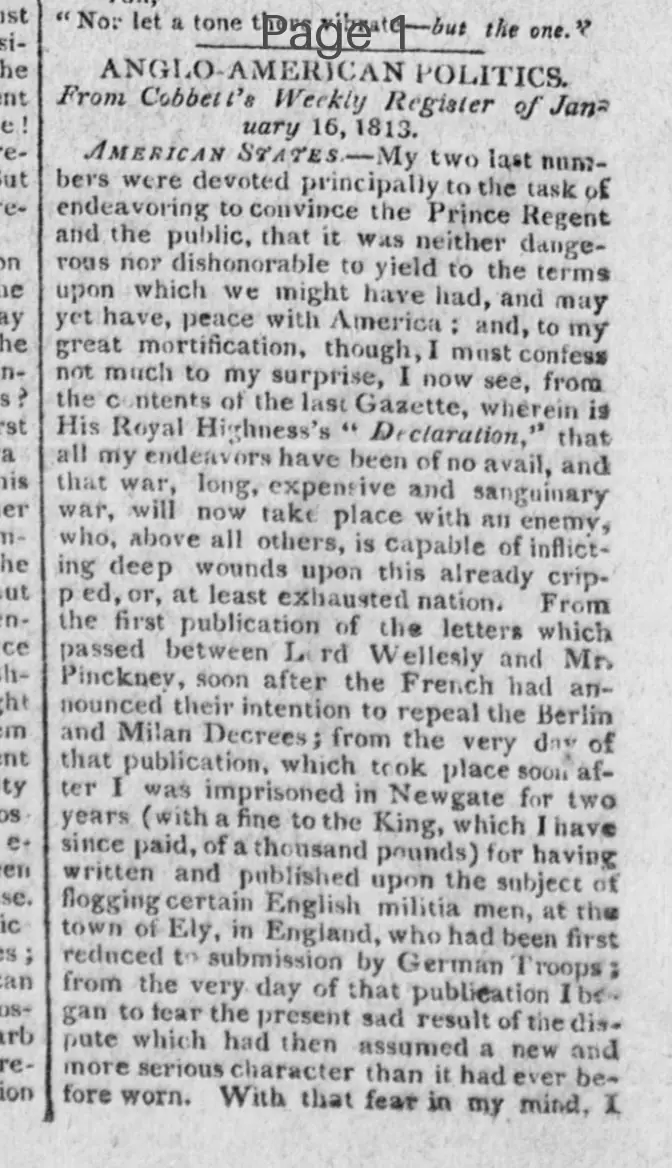
From Cobbett's Weekly Register of January 16, 1813.
AMERICAN STATES.-My two last numbers were devoted principally to the task of endeavoring to convince the Prince Regent and the public, that it was neither dangerous nor dishonorable to yield to the terms upon which we might have had, and may yet have, peace with America: and, to my great mortification, though, I must confess not much to my surprise, I now see, from the contents of the last Gazette, wherein is His Royal Highness's "Declaration," that all my endeavors have been of no avail, and that war, long, expensive and sanguinary war, will now take place with an enemy, who, above all others, is capable of inflicting deep wounds upon this already crippled, or, at least exhausted nation. From the first publication of the letters which passed between Lord Wellesley and Mr. Pinckney, soon after the French had announced their intention to repeal the Berlin and Milan Decrees; from the very day of that publication, which took place soon after I was imprisoned in Newgate for two years (with a fine to the King, which I have since paid, of a thousand pounds) for having written and published upon the subject of flogging certain English militia men, at the town of Ely, in England, who had been first reduced to submission by German Troops; from the very day of that publication I began to fear the present sad result of the dispute which had then assumed a new and more serious character than it had ever before worn. With that fear in my mind, I bent all my feeble powers towards preventing such result. I have failed; opinions and councils the direct opposite of mine have prevailed; and time will show who was right and who wrong. Upon former occasions the real grounds of war have, but too often, been lost sight of in the multitude and confusion of subsequent events; the government had the address to enlist the passions of men on its side, and the voice of reason has been stifled. But, here, as I was from the first resolved it should be, there is a clear, a distinct, and an undisguisable ground before our eyes; we know well what we are at war for, we know, and must bear in mind, that we are at war for the purpose of enforcing our practice of stopping American vessels upon the high seas, and taking out of them all such persons as our naval officers may deem to be British seamen. This is now become the clearly defined subject of the war with America. The "Declaration," which will be found below, inserted at full length, does not contain any new matter: it is a summary of what our ministers have before alleged and asserted in their correspondence with the American government and its divers agents. But, there are some few passages of it which require to be particularly noticed. The question relating to the Orders in Council has been before so amply discussed, in my several letters and articles upon the subject, that I will not encumber my present remarks with any thing relating thereunto; but, will confine myself to what relates to the impressment of persons out of American ships on the high seas. Upon this point the "Declaration" says; "His Royal Highness can never admit that in the exercise of the undoubted and hitherto undisputed right of searching neutral merchant vessels in time of war, the impressment of British seamen, when found therein, can be deemed any violation of a neutral flag. Neither can he admit, that the taking such seamen from on board such vessel can be considered by any neutral state as a hostile measure or a justifiable cause of war. There is no right more clearly established, than the right which a Sovereign has to the allegiance of his subjects, more especially in time of war. Their allegiance is no optional duty, which they can decline, and resume at pleasure. It is a call which they are bound to obey: it began with their birth; and can only terminate with their existence. If a similarity of language and manners may make the exercise of this right more liable to partial mistakes and occasional abuse, when practised towards the vessels of the United States, the same circumstances make it also a right, with the exercise of which in regard to such vessels, it is more difficult to dispense."
The doctrine of allegiance, as here laid down, (admit, with some exceptions; but, as to the right of impressing British seamen on the high seas, out of neutral ships, I deny it to be founded on any principle or maxim, laid down by any writer on public law. Indeed the "declaration" does not say searching neutral vessels in time of war is "undoubted" and has hitherto been "undisputed". This is not correct; for not only has even this right been doubted, not only are there two opinions about it in the books on public law, but the writers on public law are for the most part against the said right as we practice it, and they contend we have no right to seize enemy's goods on board of merchant ships which are neutral. Nay, the contest has given rise to military resistance on the part of our now ally Russia, Denmark and Sweden; and what is still more, Great Britain ceased upon their threats to exercise this, even this right of seizing enemy's goods on board of neutral ships of war. But this right; this right of searching neutral ships; what has it to do with the impressment of persons on board of such ships? That is what the Americans object to, and are at war against. They are not at war against our right of search, even in our own interpretation of that right. What they object to is the stopping of their vessels on the high seas and taking people out of them by force; a practice which, I repeat, is sanctioned by no principle or maxim of any writer on public law, nor by any usage heretofore in the world. The "Declaration" does not assert, as Lord Castlereagh did in his letter to Mr. Russell, that this practice is sanctioned by any former usage; but it declares the right from the right of search. It says that in exercising the right of search," that is to say, the right of search for articles contraband of war and for enemy's goods, we have a right to impress British seamen if we find them. So that this is the new shape of the defence of the practice: we do not now assert that we have a right to stop American vessels upon the high seas for the purpose of impressing our seamen; but having stopped them for the purpose of exercising our old "right of search," we have a right to avail ourselves of the opportunity to take out persons whom our own officers at their discretion may judge to be British seamen. This is not even plausible in my opinion; for what right can we have to impress if we have no right to stop for the purpose of impressing? I may enter another's house to search for a stolen coat, and if I find there my hat I may seize it as well as my coat, having due authority for the first; but be it observed that to steal the hat was as criminal as to steal the coat; and if I had known or suspected that the hat was there, I might have had a search warrant for the former as well as for the latter.
The law of nations call the high sea the common right of nations. A ship, there, is a parcel of the State to which she belongs, and the sovereign rights of that State travel with her. The sole exception is, as has been before stated, the belligerents have a right to search neutrals for goods of the enemy and for warlike stores and contraband, carrying for the enemy's use; because as far as neutrals are engaged in such a service they are deemed to be in the service of the enemy. In all other respects a neutral ship carries with her on the high seas the rights of sovereignty appertaining to the State to which she belongs. Now it is well known that no nation has a right to enter the territory of another to exercise any authority whatever, much less that of seizing persons and carrying them away by force; and, indeed is it not fresh in every one's memory what complaints were made against the French for entering the territory of the Elector of Baden and seizing the Duke of Enghien? If we have a right to enter American ships on the high seas, and take out of them by force of arms British seamen, what should hinder us from having the same right as to any of the sea ports of America? Nay, why should we not go and seize our numerous manufacturers who have been (contrary to our laws) carried to America with cloths and cutlery? Their alleging that they went thither to avoid the effect of prosecutions for libel or for some other of our state crimes, would be no bar to our claim upon them; and in short they could never be safe to the last moment of their lives.-- It is said that the seamen on board of American ships are deserters. Be it so. We may be sorry that they do desert; but it is no crime in the Americans that our sailors go into America. Is it not well known that numerous deserters from the Austrian and Prussian armies have at all times deserted into the neighboring States; & is it not equally well known that the neighboring State has invariably possessed the undisputed right of giving them protection and of enlisting them in its service? Why, therefore, should we deem it a crime in America, whose abundance of lands and provisions, whose high price of labor, and whose happiness to the lower orders of mankind, hold out their arms to the whole world? And here I cannot help introducing a remark upon the proposition made by Lord Castlereagh to Mr. Russell, that the American Government should stipulate to deliver up all British seamen in the service of Americans. Mr. Russell is said to have expressed himself as having been shocked at this proposition, which has afforded an abundant theme of abuse of him by our hireling writers. But, I have no scruple to say, that I firmly believe, that it is a proposition that never was before made to any independent State; even to the most petty state of Germany.- There was a plan some years ago in agitation among the States of Europe, for putting in force a mutual surrender of each other's subjects, whereupon the Abbe Raynal remarks, that, if it had gone into effect, each of the several States might have taken the motto of Dante over the entrance to his Infernal Regions: "He who enters here leaves even hope behind." He represents it as the utmost stretch of tyranny; a point he says which the world ought to perish rather than reach. And, therefore, though Lord Castlereagh's proposition did not go this length, although it was confined to British seamen, we have no reason to abuse Mr. Russell for his expression.
It will be said, may be, that Mr. Russell was ordered to stipulate for the surrender, on our part, of all American seamen. Aye, but the difference is, that Mr. Russell proposed those only who had been impressed by us; whereas we wanted to stipulate for the surrender of those British seamen who had gone into America of their own free will. We wanted to have surrendered to us men who were employed in American merchant ships; they wanted us to surrender men, whom we had seized in their ships & had forced into our men of war. But it is impossible that any one can find any thing to object to in a request that, as a preliminary, we should give up the Americans whom we had impressed into our service! What is the state of those men now in service?- What is their state? Has the reader reflected upon this? They must be useless on board of ships; they must not act; they must do no seamen's duty; or they must, according to our own doctrine lately exemplified at Horsemonger Lane, be TRAITORS worthy of being hanged ripped up and cut in quarters. His Royal Highness's Declaration says, that allegiance to his father and his successor begins with a man's birth and ends but with his death. And is it not the same with American citizens? Do they not owe similar allegiance to their country? Or is it about to be pretended, that none but kings can claim this sort of allegiance? I do not think that any one, even of the writers of the Times and Courier, will have the impudence to set up this doctrine; but this they must do before they can make out any good ground of charge against the Americans for having demanded as a preliminary the surrender of the impressed American seamen. Captain Dacres, in accounting for the loss of his frigate, expressly states that he had many Americans on board, whom he permitted to be spectators, from a reluctance to compel them to fight against their country. And can the reader believe that this was the only instance in which native Americans were unwillingly serving on board of British ships of war?- What then again I ask, must be the state of those Americans? And what are we to think of those writers, who abuse Mr. Russell for proposing to us their surrender as a step preliminary to any further arrangement? The declaration complains, that America demanded the abandonment of the practice of impressment as a preliminary to her passing a law to prevent British seamen from being received on board her ships. The hireling writers have treated this demand as something too insolent to be for a moment listened to. The 'DECLARATION' does not treat it in this lofty style; but it speaks of it in pretty strong terms, as thus "The proposal of an armistice, and of a simultaneous repeal of the restrictive measures on both sides, subsequently made by the commanding officer of his majesty's naval forces on the American coast, were received in the same hostile spirit by the government of the United States. The suspension of the practice of impressment was insisted upon in the correspondence which passed on that occasion, as a necessary preliminary to a cessation of hostilities. Negotiation, it was stated, might take place without any suspension of the exercise of this right, and also without any armistice being concluded: but Great Britain required previously to agree, without any knowledge of the adequacy of the system which could be substituted, to negotiate upon the basis, of accepting the legislative regulations of a foreign state, as the sole equivalent for the exercise of a right which she has felt to be essential to the support of her maritime power."
Well, and what then; "A right" it is called again, but, if America denied it to be a right, as she has uniformly done, what wonder was there that she made the proposition? Great Britain might "feel," though I should have chosen the word "deem," as smacking less of the boarding-school Miss's style. Great Britain might "feel," if feel she must, that the practice complained of was essential to the support of her maritime power; but, did it hence follow that America, and that impressed Americans, should like the practice the better for that? We have so long called ourselves the deliverers of the world, that we, at last, have fallen into the habit of squaring all our ideas to that appellation; and seem surprised that there should be any nation in the world inclined to wish for the diminution of our power. The Americans, however, clearly appear to see the thing in a different light They, in their homespun way, call us any thing but deliverers; and it must be confessed, that whatever, may be our general propensity, we do not seem to have been in haste to deliver impressed American seamen.
What sub-type of article is it?
What keywords are associated?
What entities or persons were involved?
Editorial Details
Primary Topic
British Impressment Of Seamen From American Vessels As Cause Of War
Stance / Tone
Strongly Critical Of British Policy And Supportive Of Peace With America
Key Figures
Key Arguments