Thank you for visiting SNEWPapers!
Sign up free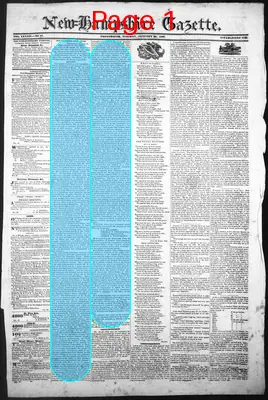
The New Hampshire Gazette
Portsmouth, Rockingham County, New Hampshire
What is this article about?
On January 11, the New Hampshire Legislature's House adopts committee resolutions recognizing states' exclusive jurisdiction over domestic slavery, opposing federal interference, and censuring abolitionist agitation as a threat to the Union. Report defends Southern institutions and echoes the Governor's views.
Clipping
OCR Quality
Full Text
Wednesday, January 11.
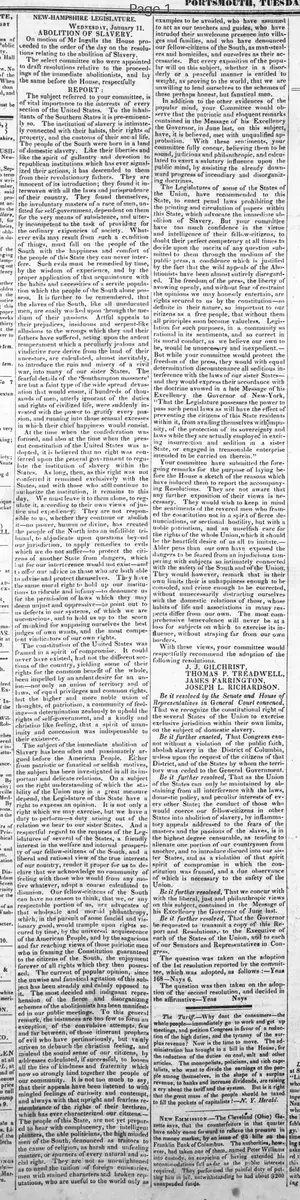
ABOLITION OF SLAVERY.
On motion of Mr Ingalls the House proceeded to the order of the day on the resolutions relating to the abolition of Slavery.
The select committee who were appointed to draft resolutions relative to the proceedings of the immediate abolitionists, and lay the same before the House, respectfully
REPORT:
The subject referred to your committee, is of vital importance to the interests of every section of the United States. To the inhabitants of the Southern States it is pre-eminently so. The institution of slavery is intimately connected with their habits, their rights of property, and the customs of their social life. The people of the South were born in a land of domestic slavery. Like their liberties and like the spirit of gallantry and devotion to republican institutions which has ever signalized their actions, it has descended to them from their revolutionary fathers. They are innocent of its introduction; they found it interwoven with all the laws and jurisprudence of their country. They found themselves, the involuntary masters of a race of men, unfitted for self-government, dependent on them for the very means of subsistence, and utterly incompetent to the task of providing for the ordinary exigencies of society. Whatever evils may result from such a condition of things, must fall on the people of the South with the happiness and comfort of the people of this State they can never interfere. Such evils must be remedied by time, by the wisdom of experience, and by the proper application of that acquaintance with the habits and necessities of a servile population which the people of the South alone possess. It is further to be remembered, that the slaves of the South, like all uneducated men, are easily worked upon through the medium of their passions. Artful appeals to their prejudices, insidious and serpent-like allusions to the wrongs which they and their fathers have suffered, acting upon the ardent temperament which a peculiarly jealous and vindictive race derive from the land of their ancestors, are calculated, almost inevitably, to introduce the ruin and misery of a civil war, into many of our sister States. The fearful details of the 'Southampton massacre are but a faint type of the wide spread devastation that would ensue, if hundreds of thousands of men, utterly ignorant of the duties and rights of civilized life, were suddenly invested with the power to gratify every passion, and running into those sensual excesses in which their chief happiness would consist. At the time when the confederation was formed, and also at the time when the present constitution of the United States was adopted, it is believed that no right was conferred upon the general government to regulate the institution of slavery within the States. As long, then, as this right was not conferred it remained exclusively with the States, and with those who still continue to authorize the institution, it remains to this day. We must leave it to them alone, to regulate it, according to their own views of justice and expediency. They are not responsible to us, whether they continue or abolish it—no power, human or divine, has created the people of the North into an infallible tribunal, to adjudicate upon questions beyond our jurisdiction, to apply remedies to evils which we do not suffer—to protect the citizens of another State from dangers, which but for our interference would not exist—and to offer our advice to those who are both able to advise and protect themselves. They have the same moral right to hold up our institutions to ridicule and infamy—to denounce us for the permission of laws which they may deem unjust and oppressive—to point out to us defects in our systems, of which we are unconscious, and to hold us up to the scorn of mankind for supposing ourselves the best judges of own wants, and the most competent vindicators of our own rights. The constitution of the United States was framed in a spirit of compromise. It could never have existed, had not the different sections of the country, yielding some of their rights for the common benefit of the whole, been impelled by an ardent desire for an union—not only an union of territory and of laws, of equal privileges and common rights, but the higher and more noble union of thoughts, of patriotism, a community of feelings—a determination zealously to uphold the rights of self-government, and a kindly and christian like feeling, that a spirit of unanimity and concession was indispensable to their existence. The subject of the immediate abolition of Slavery has been often and passionately argued before the American People. Either from patriotic or fanatical or selfish motives, the subject has been investigated in all its important and delicate relations. On a subject on the right understanding of which the stability of the Union may in a great measure depend, the Legislature of this State have a right to express an opinion. It is not only a right which we may exercise, but we have a duty to perform—a duty arising out of the relation we bear to our sister States. And a respectful regard to the requests of the Legislatures of several of the States, a friendly interest in the welfare and internal prosperity of our fellow-citizens of the South, and a liberal and rational view of the true interests of our country, render it proper for us to declare that we acknowledge no community of feeling with those who would from any motive whatever, adopt a course calculated to disunion. Our fellow-citizens of the South can have no reason to think, that we, or any respectable portion of us, are advocates of that wholesale and morbid philanthropy, which, in the pursuit of some fancied and visionary good, would trample upon rights secured by time, by the universal acquiescence of the American People, and by the sagacious and far reaching views of those patriotic men who in framing the Constitution guaranteed to the citizens of the South, the enjoyment forever of all rights which they then possessed. The current of popular opinion, since the unwise and fanatical agitation of this subject has been steadily and calmly opposed to it. The most decided and indignant reprehension of the fierce and disorganizing schemes of the abolitionists has been manifested in our public meetings. To this general remark, the instances are too few to form an exception, of the convulsive attempts, few and far between, of those itinerant prophets of evil who have pertinaciously, but vainly striven to debauch the christian feeling, and mislead the sound sense of our citizens, by addresses calculated, if successful, to loosen all the ties of kindness and fraternity which now so strongly bind together the people of our community. It is not too much to say, that their appeals have been listened to with mingled feelings of curiosity and contempt, and always with that upright and fearless remembrance of the rights of their brethren, which has ever characterized our citizens.— The people of this State, are not yet prepared to hear with complacency, the intelligent planters, the able politicians, the high minded men of the South, denounced as traitors to the cause of religion, as harsh and unfeeling masters, or spurners of every natural and social right. They are not so unenlightened as to need the tuition of foreign emissaries, men with stained characters and broken reputations, who are useful to the world only as examples to be avoided, who have assumed to act as our teachers and guides, who have intruded their unwelcome presence into villages and families, and who have denounced our fellow-citizens of the South, as man-stealers and homicides, and ourselves as their accessories. But every exposition of the popular will on this subject, whether in a disorderly or a peaceful manner is entitled to weight, as proving to the world, that we are unwilling to lend ourselves to the schemes of these perhaps honest, but fanatical men. In addition to the other evidences of the popular mind, your Committee would observe that the patriotic and eloquent remarks contained in the Message of his Excellency the Governor, in June last, on this subject, have, it is believed, met with unqualified approbation. With these sentiments, your committee fully concur, believing them to be sound, judicious and philanthropic, and calculated to exert a salutary influence upon the public mind, by assisting the already downward progress of incendiary and disorganizing doctrines. The Legislatures of some of the States of the Union, have recommended to this State, to enact penal laws prohibiting the printing and circulation of papers within this State, which advocate the immediate abolition of Slavery. But your committee have too much confidence in the virtue and intelligence of their fellow-citizens, to doubt their perfect competency at all times to decide upon the merits of any question submitted to them through the medium of the public press, a confidence which is justified by the fact that the wild appeals of the Abolitionists have been almost entirely disregarded. The freedom of the press, the liberty of avowing openly, and without fear of restraint the opinions we may honestly entertain, are rights secured to us by the constitution—so definite in their nature, so important to our citizens as a free people, that without them all principles soon become valueless. Legislation for such purposes, in a community so rational in its sentiments, and so correct in its moral conduct, as we believe our own to be, would be unnecessary and inexpedient.— But while your committee would protect the freedom of the press, they would with equal determination discountenance all seditious interference with the laws of our sister States— and they would express their accordance with the doctrine avowed in a late Message of his Excellency the Governor of New-York, "That the Legislature possesses the power to pass such penal laws as will have the effect of preventing the citizens of this State residents within it, from availing themselves with impunity, of the protection of its sovereignty and laws while they are actually employed in exciting insurrection and sedition in a sister State, or engaged in treasonable enterprise intended to be carried on therein." Your committee have submitted the foregoing remarks for the purpose of laying before the House a sketch of the reasons which have induced them to report the accompanying Resolutions. They are not aware that any further exposition of their views is necessary. They would wish to keep in mind the sentiments of the revered men who framed the constitution not in a spirit of fierce denunciations, or sectional hostility, but with a noble patriotism, and an unselfish care for the rights of the whole Union, which it should be the heartfelt desire of us all to imitate.— Abler pens than our own have exposed the dangers to be feared from an injudicious tampering with subjects so intimately connected with the safety of the South and of the Union. They would however, remark that in their own limits there is unhappiness enough to be consoled, and crime enough to be corrected, without unnecessarily distracting ourselves with the domestic relations of those, whose habits of life and associations in many respects differ from our own. The most comprehensive benevolence will never be at a loss for subjects on which to exercise its influence, without straying far from our own borders. With these views, your committee would respectfully recommend the adoption of the following resolutions.
J. J. GILCHRIST
THOMAS P. TREADWELL.
JAMES FARRINGTON
JOSEPH L. RICHARDSON
Be it resolved by the Senate and House of Representatives in General Court convened,
That we recognize the constitutional right of the several States of the Union to exercise exclusive jurisdiction within their own limits, on the subject of domestic slavery.
Be it further enacted, That Congress cannot without a violation of the public faith, abolish slavery in the District of Columbia, unless upon the request of the citizens of that District, and of the States by whom the territory was ceded to the General Government.
Be it further resolved, That as the Union of the States can only be maintained by abstaining from all interference with the laws, domestic policy, and peculiar interests of every other State; the conduct of those who would coerce our fellow-citizens in other States into abolition of slavery, by inflammatory appeals addressed to the fears of the masters and the passions of the slaves, is in the highest degree censurable, as tending to alienate one portion of our countrymen from another, and to introduce discord into our sister States, and as a violation of that spirit of compromise in which the constitution was framed, and a due observance of which is necessary to the safety of the Union.
Be it further resolved, That we concur with the liberal, just and philanthropic views on this subject, contained in the Message of his Excellency the Governor of June last.
Be it further resolved. That the Governor be requested to transmit a copy of this Report and Resolutions, to the Executive of each of the States of the Union, and to each of our Senators and Representatives in Congress.
The question was taken on the adoption of the 1st resolution reported by the committee, which was adopted, as follows:—Yeas 168—Nays 6.
The question was then taken on the adoption of the second resolution, and decided in the affirmative—Yeas Nays
What sub-type of article is it?
What themes does it cover?
What keywords are associated?
What entities or persons were involved?
Where did it happen?
Story Details
Key Persons
Location
New Hampshire
Event Date
Wednesday, January 11
Story Details
A select committee reports on resolutions against immediate abolition of slavery, defending Southern states' rights and warning of civil war risks from abolitionist agitation. Resolutions affirm exclusive state jurisdiction over slavery, oppose federal abolition in D.C. without consent, censure coercive tactics, endorse the Governor's views, and request transmission to other states and Congress. First resolution adopted 168-6; second affirmed.