Thank you for visiting SNEWPapers!
Sign up free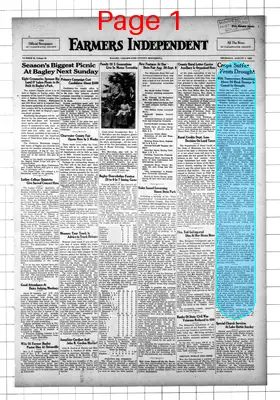
Farmers Independent
Bagley, Clearwater County, Minnesota
What is this article about?
In July 1930, a severe drought and record heat wave persisted across the US Midwest and Northwest, devastating crops, pastures, and dairy production in states like Minnesota, Kansas, and others. Agricultural leaders urged President Hoover for relief measures including low freight rates and credit extensions.
Clipping

OCR Quality
Full Text
Hopes for rain that would revive parched pastures and fields have been unfulfilled for another week and the record-breaking heat wave continued unbroken throughout the northwest.
Weather forecasts yesterday predicted no let up in the almost unprecedented drought which has baked the vast agricultural regions between the Rocky Mountains and the Appalachians for several weeks. Aside from light and scattered showers there was no prospect for general rain and weather bureau officials watching the drought report only the lightest rain and continued high temperatures.
The government station at Itasca State Park reports a rainfall of only 1.03 inches during the month of July, which is a great deal more than some other sections of the state report. The temperature has remained at over 90, Friday it reached 99 at the Park, on Saturday it reached 98. Sunday 95 and Monday 93.
Agricultural interests have started seeking relief through government and commercial channels. It is said the drought would assume proportions of a major catastrophe unless rain fell within 10 to 30 days. Louis J. Taber, master of the National Grange suggested to President Hoover that special low freight rates be made available to move hay and feed into cattle growing regions deprived of their natural pasturage. He urged also a maximum extension of credit facilities to farmers in the parched regions. Chairman Legge of the farm board has also asked bankers and business men to extend every credit facility to furnish feed for cattle and dairy hands as appeals reached the board for aid.
William F. Schilling of the farm board said 14 important dairy states had only 36 per cent rainfall during the growing months, not only damaging the crops, meadows and corn but decreasing milk production. The states he named were Minnesota, Kansas, Nebraska, Missouri, Oklahoma, Tennessee, Kentucky, Arkansas, Michigan, Ohio, Illinois, Iowa, Indiana, and North Dakota.
Moorhead.-The fate of the potato crop in the ordinarily heavy producing South end of the Red River Valley, embracing the area between Grand Forks and Breckenridge, will depend on the amount of rain falling this week.
Moorhead dealers, after a check of the area, are convinced that unless a downpour is received, 50 per cent of the crop will be a loss.
Potatoes in the North end on the other hand are in excellent condition, due to sufficient moisture, and will produce as large a crop as last year, it was predicted.
The only jubilant note in the 1930 valley situation, dealers say, is in the prospect that a good market is in sight. Realization of this hope, however will depend on the outcome of the Government's check on the August 1 condition which will be released Aug. 10th. Local dealers are confident it will show a large reduction from the previous estimates.
July, 1930, passed into history on Friday with preliminary figures at the weather bureau indicating it was the hottest month ever recorded.
A compilation of temperatures registered at the larger stations shows it was hotter for a longer time and over a larger area than in any previous period since temperature records were established.
From July 4 to July 30 not a single day passed without a temperature of 100 or hotter being officially registered at some place in the country. The coming of August brought no sign of relief from the crop-devastating and water supply menacing drought and also has set a record for duration and extent of territory affected. The July hot spell was the worst the south ever experienced.
"August usually averages a shade cooler than July," the weather bureau states. As a result prospects of there being another spell like the recent one are very unlikely.
What sub-type of article is it?
What themes does it cover?
What keywords are associated?
What entities or persons were involved?
Where did it happen?
Story Details
Key Persons
Location
Northwest Us, Between Rocky Mountains And Appalachians, Red River Valley, Moorhead
Event Date
July 1930
Story Details
A prolonged drought and heat wave in July 1930 caused extensive damage to crops and pastures across the Midwest and Northwest, leading to calls for government aid including low freight rates and credit extensions to farmers and cattle regions.