Thank you for visiting SNEWPapers!
Sign up free
Daily National Intelligencer
Washington, District Of Columbia
What is this article about?
In a House of Representatives debate, Mr. Ervin of South Carolina passionately defends Major General Arthur St. Clair's claim for interest on an $1800 loan he advanced to the U.S. during the Revolutionary War. He highlights St. Clair's heroic services, argues against Treasury review, and urges justice for the aging veteran.
Merged-components note: Continuation of Mr. Ervin's remarks on the bill for the relief of Major General Arthur St. Clair in the House of Representatives.
Clipping
OCR Quality
Full Text
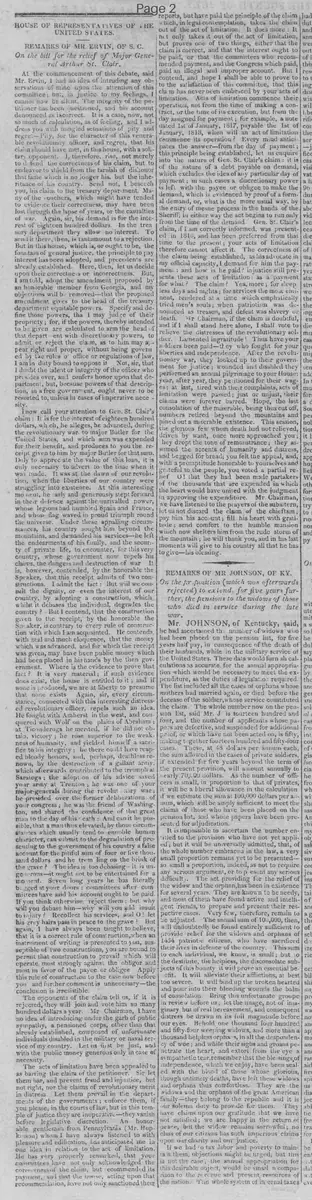
REMARKS OF MR. ERVIN, OF S. C.
On the bill for the relief of Major General Arthur St. Clair.
At the commencement of this debate, said Mr. Ervin, I had no idea of intruding any observations of mine upon the attention of this committee; but, in justice to my feelings, I cannot now be silent. The integrity of the petitioner has been questioned, and his account denounced as incorrect. It is a case, now, not so much of calculation, as of feeling, and I address you with mingled sensations of pity and regret—Pity, for the character of this venerable revolutionary officer, and regret, that his claim should have met, in this house, with a solitary opponent. I, therefore, rise, not merely to defend the correctness of his claim, but to endeavor to shield from the tarnish of dishonor that fame which is no longer his, but the inheritance of his country. Send not, I beseech you, his claim to the treasury department. Many of the vouchers, which might have tended to evidence their correctness, may have been lost through the lapse of years, or the casualties of war. Again, sir, his demand is for the interest of eighteen hundred dollars. In the treasury department they allow no interest. To send it there, then, is tantamount to a rejection. But in this house, which is, or ought to be, the fountain of general justice, the principle to pay interest has been adopted, and precedents are already established. Here, then, let us decide upon their correctness or incorrectness. But, I am told, adopt the amendment proposed by an honorable member from Georgia, and my objections will be removed—that the proposed amendment gives to the head of the treasury department equitable powers. Specify and define those powers, that I may judge of their propriety; for, if the powers, thereby intended to be given are calculated to arm the head of that department with discretionary powers, to admit or reject the claim, as to him may appear right and proper, without being governed by the rules of office or regulations of law, I am in duty bound to oppose it. Not, sir, that I doubt the talent or integrity of the officer who presides over, and confers honor upon that department, but, because powers of that description, in a free government, ought never to be resorted to, unless in cases of imperative necessity.
I now call your attention to Gen. St. Clair's claim: It is for the interest of eighteen hundred dollars, which, he alleges, he advanced, during the revolutionary war to major Butler for the United States, and which sum was expended for their benefit, and produces to you the receipt given to him by major Butler for that sum. Duly to appreciate the value of this loan, it is only necessary to advert to the time when it was made. It was at the dawn of our revolution, when the liberties of our country were struggling into existence. At this interesting moment, he early and generously stepped forward in their defence against the unrivalled power, whose legions had humbled Spain and France, and whose flag waved in proud triumph round the universe. Under these appalling circumstances, his country sought him beyond the mountains, and demanded his services—he left the endearments of his family, and the security of private life, to encounter, for this very country, whose government now repels his claims, the dangers and destruction of war. It is, however, contended, by the honorable the Speaker, that this receipt admits of two constructions. I admit the fact: But will we consult the dignity, or even the interest of our country, by adopting a construction, which whilst it debases the individual, degrades the country? But I contend, that the construction given to the receipt, by the honorable the Speaker, is contrary to every rule of construction with which I am acquainted. He contends, with zeal and much eloquence, that the money which was advanced, and for which the receipt was given, may have been public money which had been placed in his hands by the then government. Where is the evidence to prove that fact? It is very material: if such evidence does exist, the house is entitled to it: and if none is produced, we are at liberty to presume that none exists. Again, sir, every circumstance, connected with this interesting distressed revolutionary officer, repels such an idea. He fought with Amherst in the west, and conquered with Wolf on the plains of Abraham: at Ticonderoga he merited, if he did not obtain, victory; he rose superior to the weakness of humanity, and yielded himself a sacrifice to his integrity; he there could have reaped bloody honors, and, perhaps, deathless renown, by the destruction of a gallant army, which afterwards contributed to the triumph at Saratoga; the adoption of his advice saved your army at Trenton: he was one of your major-generals during the revolutionary war; he presided over the former deliberations of your congress; he was the friend of Washington, and shared the confidence of that great man to the day of his death: And can it be possible, that a man thus elevated, by those circumstances which usually tend to ennoble human character, can submit to the degradation of presenting to the government of his country a false account for the pitiful sum of four or five thousand dollars, and he trembling on the brink of the grave? The idea is too debasing—it is ungenerous—it ought not to be entertained for a moment. Seven long years he has literally begged at your doors: committees after committees have said his account ought to be paid. If you think otherwise, reject them; but why will you debase him—why will you add insult to injury? Recollect his services, and O! let his grey hairs pass in peace to the grave! But again, I have always been taught to believe, that it is a correct rule of construction, when an instrument of writing is presented to you, susceptible of two constructions, you are bound to permit that construction to prevail which will operate most strongly against the obligor and most in favor of the payee or obligee. Apply this rule of construction to the case now before you and further comment is unnecessary—the conclusion is irresistible.
The opponents of the claim tell us, if it is rejected, they will join and vote him so many hundred dollars a year. Mr. Chairman, I have no idea of introducing under the garb of public sympathy, a pensioned corps, other than that already established, composed of unfortunate individuals disabled in the military or naval service of my country. Let us first be just, and with the public money generous only in case of necessity.
The acts of limitation have been appealed to as barring the claim of the petitioner. Sir let them bar, and prevent fraud and injustice, but not right, nor the claims of revolutionary merit in distress. Let them prevail in the departments of the governments; enforce them, if you please, in the courts of law, but in this temple of justice they are inoperative—they vanish before legislative discretion. An honorable gentleman from Pennsylvania (Mr. Hopkinson) whom I have always listened to with pleasure and edification, has anticipated me in one idea in relation to the act of limitation. He has very properly remarked, that your committees have not only acknowledged the correctness of the claim, but recommended its payment, and that the house, acting upon that recommendation, have not only sanctioned them
reports, but have paid the principle of the claim which, in legal contemplation, takes the claim out of the act of limitation. It does more: It not only takes it out of the act of limitation, but proves one of two things, either that the claim is correct, and that the interest ought to be paid, or that the committees who recommended payment, and the Congress which paid, paid an illegal and improper account. But I contend, and hope I shall be able to prove to the satisfaction of this committee, that this claim has never been embraced by your acts of limitation. Acts of limitation commence their operation, not from the time of making a contract, or the time of its execution, but from the day assigned for payment; for example, a note dated 1st of January, 1817, payable the 1st of January, 1818, when will an act of limitation commence its operation? Every mind anticipates the answer—from the day of payment; this principle being established, let us enquire into the nature of Gen. St. Clair's claim: it is of the nature of a debt payable on demand, which excludes the idea of any particular day of payment; in such cases a discretionary power is left with the payee or obligee to make the demand, which is evidenced by proof of a formal demand, or, what is the more usual way, by the entry of mesne process in the hands of the Sheriff; in either way the act begins to run only from the time of the demand. Gen. St. Clair's claim, if I am correctly informed, was presented in 1810, and has been preferred from that time to the present; your acts of limitation therefore cannot affect it. The correctness of the claim being established, as his advocate in my official capacity, I demand for him the payment: and how is he paid? Injustice still presents these acts of limitation: as a payment for what? The claim? Yea, more; for sleepless days and nights; for services the most eminent, rendered at a time which emphatically tried men's souls: when patriotism was denounced as treason, and defeat was slavery or death. Mr. Chairman, if the claim is doubtful, and if I shall stand here alone, I shall vote to relieve the distresses of the revolutionary soldier. Lamented ingratitude! Thus have your soldiers been paid—they who fought for your liberties and independence. After the revolutionary war, they looked up to their government for justice: wounded and disabled they performed an annual pilgrimage to your House; year after year, they petitioned for their wages; at last, tired with their complaints, acts of limitation were passed; just or unjust, their claims were forever barred. Hope, the last consolation of the miserable, being thus cut off, numbers retired beyond the mountains and pined out a miserable existence. This session, the glorious few whom death had not relieved, driven by want, once more approached you; they dropt the tone of remonstrance; they assumed the accents of humanity and distress, and begged for bread; you felt the appeal, and, with a promptitude honorable to yourselves and grateful to the people, you voted a partial relief. O! that they had been made partakers of the thousands that are expended in which the heart would have united with the judgment in approving the expenditure. Mr. Chairman, we have listened to the prayers of the subaltern, let us not discard the claim of the chieftain; pay him his account; fill his heart with gratitude; send comfort to the humble mansion which now shelters him from the rude storm of the mountain; he will thank you, and in his last moments will give to his country all that he has to give—his blessing.
What sub-type of article is it?
What themes does it cover?
What keywords are associated?
What entities or persons were involved?
Where did it happen?
Story Details
Key Persons
Location
House Of Representatives Of The United States
Event Date
Revolutionary War, Claim Presented In 1810
Story Details
Mr. Ervin defends Gen. St. Clair's claim for interest on $1800 loaned during the Revolutionary War, citing his heroic services in battles like Ticonderoga and Trenton, friendship with Washington, and arguing against statutes of limitation and Treasury review to ensure justice for the aging veteran.