Thank you for visiting SNEWPapers!
Sign up free
Gazette Of The United States
New York, New York County, New York
What is this article about?
A member of the North Carolina House of Assembly submits a protest against intemperate resolutions criticizing the state's Senators in Congress for neglect and lack of correspondence, arguing for dispassionate political proceedings and defending the Senators' integrity and the nature of their office.
Clipping
OCR Quality
Full Text
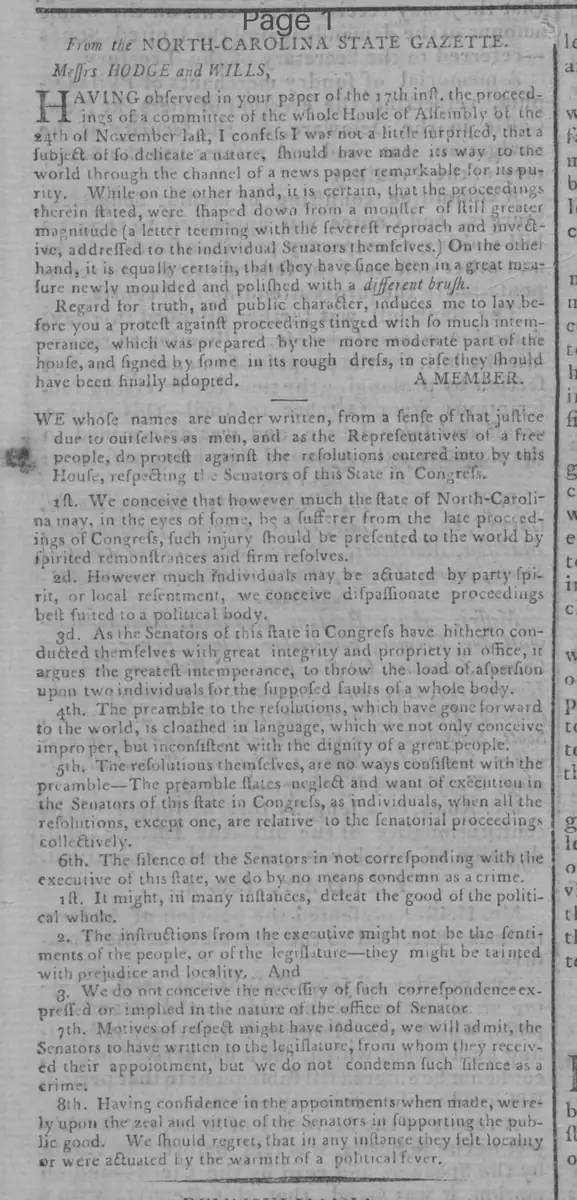
Messrs. HODGE and WILLS,
Having observed in your paper of the 17th inst. the proceedings of a committee of the whole House of Assembly of the 24th of November last, I confess I was not a little surprised, that a subject of so delicate a nature, should have made its way to the world through the channel of a news paper remarkable for its purity. While on the other hand, it is certain, that the proceedings therein stated, were shaped down from a moulder of still greater magnitude (a letter teeming with the severest reproach and invective, addressed to the individual Senators themselves.) On the other hand, it is equally certain, that they have since been in a great measure newly moulded and polished with a different brush.
Regard for truth, and public character, induces me to lay before you a protest against proceedings tinged with so much intemperance, which was prepared by the more moderate part of the house, and signed by some in its rough dress, in case they should have been finally adopted.
A MEMBER.
WE whose names are under written, from a sense of that justice due to ourselves as men, and as the Representatives of a free people, do protest against the resolutions entered into by this House, respecting the Senators of this State in Congress.
1st. We conceive that however much the state of North-Carolina may, in the eyes of some, be a sufferer from the late proceedings of Congress, such injury should be presented to the world by spirited remonstrances and firm resolves.
2d. However much Individuals may be actuated by party spirit, or local resentment, we conceive dispassionate proceedings best suited to a political body.
3d. As the Senators of this state in Congress have hitherto conducted themselves with great integrity and propriety in office, it argues the greatest intemperance, to throw the load of aspersions upon two individuals for the supposed faults of a whole body.
4th. The preamble to the resolutions, which have gone forward to the world, is clothed in language, which we not only conceive improper, but inconsistent with the dignity of a great people.
5th. The resolutions themselves, are no ways consistent with the preamble—The preamble states neglect and want of execution in the Senators of this state in Congress, as individuals, when all the resolutions, except one, are relative to the senatorial proceedings collectively.
6th. The silence of the Senators in not corresponding with the executive of this state, we do by no means condemn as a crime.
1st. It might, in many instances, defeat the good of the political whole.
2. The instructions from the executive might not be the sentiments of the people, or of the legislature—they might be tainted with prejudice and locality. And
3. We do not conceive the necessity of such correspondence expressed or implied in the nature of the office of Senator.
7th. Motives of respect might have induced, we will admit, the Senators to have written to the legislature, from whom they received their appointment, but we do not condemn such silence as a crime.
8th. Having confidence in the appointments when made, we rely upon the zeal and virtue of the Senators in supporting the public good. We should regret, that in any instance they felt locality or were actuated by the warmth of a political fever.
What sub-type of article is it?
What themes does it cover?
What keywords are associated?
What entities or persons were involved?
Letter to Editor Details
Author
A Member
Recipient
Messrs. Hodge And Wills
Main Argument
the resolutions against the north carolina senators in congress are intemperate and improper, as they unfairly blame individuals for collective actions, use undignified language, and condemn silence in correspondence that is not required by the office; a more dispassionate and moderate approach is advocated.
Notable Details