Thank you for visiting SNEWPapers!
Sign up free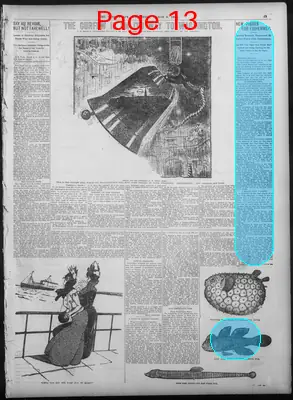
Worcester Morning Daily Spy
Worcester, Worcester County, Massachusetts
What is this article about?
The United States Fish Commission discovers several new fish species in US waters, including Lyosphoera globosa in Virginia's Rappahannock River, Corythrichthys cayorum and others in Florida, highlighting strange marine life like fish with keels and peculiar behaviors.
Clipping
OCR Quality
Full Text
FISHES
FOR FISHERMEN.
Species Recently Discovered By
United States Fish Commission.
Fish With Two Keels—One Fellow Bites
Sardines and Sleeps Standing On His
Head—Hidden in Sea for Years.
Fishermen take note.
There are stranger fish in the sea than
have ever been caught before.
The United States fish commission re-
ports the finding of several new varie-
ties of them absolutely unknown to fish-
ermen.
This happens at precisely the right
season, for it is now that the amateur
fisherman gets out his rod and reel
and puts them in fishing order.
A VIRGINIA FISH.
That ancient and secretive fellow, the
sea, gives up his mysteries reluctantly.
In waters most familiar, where many
generations have stirred and scraped
and explored the depths with nets and
dredges, there still hide strange forms.
So, in commonplace home waters, in
the Rappahannock river, in Virginia, the
United States fish commission recently
discovered a new species, the grotesque
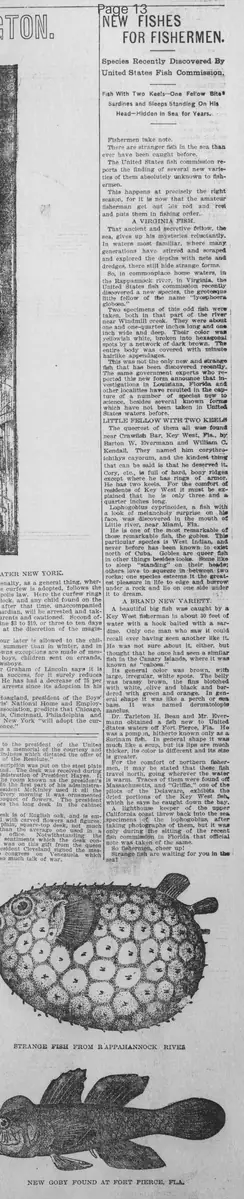
little fellow of the name
"Lyosphoera
globosa."
Two specimens of this odd fish were
taken, both in that part of the river
near Windmill creek. They were about
one and one-quarter inches long and one
inch wide and deep. Their color was
yellowish white, broken into hexagonal
spots by a network of dark brown. The
entire body was covered with minute
hairlike appendages.
This was not the only new and strange
fish that has been discovered recently.
The same government experts who re-
ported this new form announce that in-
vestigations in Louisiana, Florida and
other localities have resulted in the cap-
ture of a number of species new to
science, besides several known forms
which have not been taken in United
States waters before.
LITTLE FELLOW WITH TWO KEELS
The queerest of them all was found
near Crawfish Bar, Key West, Fla., by
Barton W. Evermann and William C.
Kendall. They named him Corythre-
ichthys cayorum, and the kindest thing
that can be said is that he deserved it.
Cory, etc., is full of hard, bony ridges
except where he has rings of armor.
He has two keels. For the comfort of
residents of Key West it must be ex-
plained that he is only three and a
quarter inches long.
Lophogobius cyprinoides, a fish with
a look of melancholy surprise on his
face, was discovered in the mouth of
Little river, near Miami, Fla.
He is one of the most remarkable of
those remarkable fish, the gobies. This
particular species is West Indian, and
never before has been known to exist
north of Cuba. Gobies are queer fish
in other things besides looks. Some like
to sleep "standing" on their heads;
others love to squeeze in between two
rocks; one species esteems it the great-
est pleasure in life to edge and burrow
under a rock and lie on one side under
it to dream.
A BRAND NEW VARIETY
A beautiful big fish was caught by a
Key West fisherman in about 30 feet of
water with a hook baited with a sar-
dine. Only one man who saw it could
recall ever having seen another like it.
He was not sure about it, either, but
thought that he once had seen a similar
fish in the Canary Islands, where it was
known as "cabosa."
Its general color was brown, with
large, irregular, white spots. The belly
was brassy brown, the fins blotched
with white, olive and black and bor-
dered with green and orange. In gen-
eral shape it was like a perch or sea
bass.
It
was
named Dermato-
lepis zanclus.
Dr. Tarleton H. Bean and Mr. Ever-
mann obtained a fish new to United
States waters off Fort Pierce, Fla. He
was a pompon, hitherto known only as a
Surinam fish. In general shape it was
much like a scup, but its lips are much
thicker, its color is different and its size
is greater.
For the comfort of northern fisher-
men, it may be stated that these fish
travel north, going wherever the water
is warm. Traces of them were found off
Massachusetts, and "Griffin," one of the
pilots of the Delaware, exhibits the
dried portions of the Key West fish,
which he says he caught down the bay.
A lighthouse keeper of the upper
California coast threw back into the sea
specimens of the lophogobius, after
taking photographs of them, but it was
only during the sitting of the recent
fish commission in Florida that official
note was taken of the same.
So fishermen, cheer up!
Strange fish are waiting for you in the
STRANGE FISH FROM RAPPAHANNOCK RIVER
NEW GOBY FOUND AT FORT PIERCE, FLA.
What sub-type of article is it?
What themes does it cover?
What keywords are associated?
What entities or persons were involved?
Where did it happen?
Story Details
Key Persons
Location
Rappahannock River, Virginia; Key West, Fla.; Little River Near Miami, Fla.; Fort Pierce, Fla.; Louisiana; Massachusetts; Upper California Coast
Story Details
United States Fish Commission discovers new species including Lyosphoera globosa in Rappahannock River, Corythrichthys cayorum near Key West, Lophogobius cyprinoides near Miami, Dermato-lepis zanclus caught by fisherman, and a pompon off Fort Pierce, with notes on their appearances and behaviors.