Thank you for visiting SNEWPapers!
Sign up free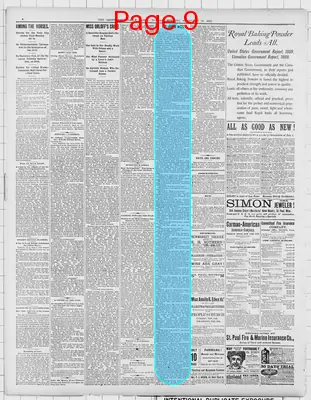
Story
February 10, 1890
St. Paul Daily Globe
Saint Paul, Ramsey County, Minnesota
What is this article about?
In pre-Revolutionary France, Maurepas tricks the court with beet sugar, causing a poisoning scare. Inventor Dumonet seeks funding for mass production but is denied by Louis XVI and Marie Antoinette, underscoring royal shortsightedness amid extravagance.
Clipping

OCR Quality
98%
Excellent
Full Text
THE QUEEN WINS.
From the French.
The Bastile had not yet fallen. The thoughtless youth of the French aristocracy still danced through the salons of the royal castles. Maurepas still reigned prime minister-that same friend of humanity who made the compassionate decision concerning the people's welfare: "Why build hospitals? Can not the people die on the roads if they like?" This evening Maurepas had the honor of being permitted to lead the beautiful Mary Antoinette to the card table, but, complaining of a severe headache as they passed through the saloon, the good queen excused him from further attendance that the pain might not be increased. As he was hastening back through the ante-chamber to the dancing hall, where the king was taking his coffee, he perceived beneath the gobelin tapestry of the famous Louvois window a man in citizen's dress, who regarded him expectantly, and bowed low before him.
"It is all right, Dumonet," whispered the asthmatic old man. "This evening his majesty will taste of it." And he trilled out one of his hundred madrigals, which, in truth, were tame enough, but which his flatterers found very witty. In the royal apartment he saw just then Louis XVI. take from a sugar basin two delicately broken lumps of sugar and sweeten his coffee with them. As the king took a mouthful of the coffee the ministerial friend of his people approached and asked respectfully:
"How does your Majesty find the coffee this evening?"
"As usual, excellent."
"The best Mocha is always upon your Majesty's table, but does the sugar sufficiently moderate the bitterness of the coffee?"
Louis XVI. was sensitive to mockery and irony even to timidity; therefore he said, inquiringly:
"What do you mean by that?"
Maurepas laughed. "Your Majesty, permit me one question. How much, sire, do you think these two pieces of sugar cost?" The king looked uneasy.
"Do you wish to test my mathematical ability?"
Maurepas continued to laugh.
"Well, then, I will answer your problem: Sugar costs the people about 80 cents a pound. If I reckon eighty pieces to the pound it makes 1 sou for each piece; but since to me as king everything is quadrupled, I have this evening consumed 8 sous' worth of sugar."
"This sugar is the gift of one of your subjects, who counts himself happy that it is considered worthy of a place on your Majesty's table; therefore it costs you nothing, sire, but the giver values every piece at a full louis d'or."
"You are beside yourself, M. de Maurepas. Eighty louis d'or for a pound of sugar! At that rate I should be compelled to sell Rambouillet to supply my brother with sugar for a year, for you know he takes a handful to every cup. But explain to me your jest."
"In a moment, your majesty." And he took the sugar-basin and emptied the contents upon the marble table and counted the pieces. "Forty-three, with the ones used forty-five, worth 1,080 francs; but look, your majesty, what dazzling whiteness, and how light it is, and how sweet, without any bitter after-taste."
"Come now," said Louis, interrupting his babble, "is sugar ever bitter?"
"And your majesty will never guess from what this sugar is made."
The king was not without some knowledge of chemistry, therefore answered hesitatingly:
"Naturally from the sugar cane."
"Pardon me, your majesty, it is beet root sugar."
"Beet root? What is beet root?"
The Duchess of Chartreuse, who was listening, drew near and said: "Beets, sire, are little red leaves, of which my servants make salad."
M. de Maurepas cut off her explanation with a malicious laugh. "Beets are edible roots, which people as well as cattle find palatable, and now they have been found to yield sugar."
Respect kept the brilliant company out of hearing distance, and they watched eagerly the strange proceedings. All this examining, weighing and counting of the sugar tossed up the court gossip among them like a bright soap bubble. Who first whispered it:
"The king has been poisoned by a cup of coffee?"
"Heaven forbid! And we have drank the same coffee!"
"No, not the coffee; it was the sugar."
"Some one go tell the queen!"
So whispered, murmured and chattered the excluded circle.
Marie Antoinette sat with the Duchess of Polignac, her tenderly loving friend, at cards.
"What ails you, Agatha?" asked she kindly, as the favorite sighed.
Agatha de Polignac raised her roguish brown head and said, saucily, "Three millions, my adored queen!"
"Sigh not, my angel; I will beg Louis to grant them to you. We owe it to the great families."
The designing princess lifted the queen's lace sleeve to her red lips, whispered gratefully. "O, that I might be permitted to die for my beloved queen!"
"Live for me, you dear child, and, my word for it, I will provide the 3,000,000, for which you will be willing to live."
At this moment a courtier approached and broke to them the dreadful tidings:
"His majesty has been poisoned by M. de Maurepas with sugar.'"
A moment later, the queen, white to the very lips, stood beside her husband.
"For heaven's sake, Louis," cried she, in her distress, unmindful of all ceremony.
"What is the matter, my queen?" asked Louis, in the gentle way he had never abandoned toward his beloved wife. "What brought you to me? You are very pale." He seized a glass of water, poured some of the newly discovered sugar in it and handed her the glass.
"Drink. It is too warm in the saloon, and the company is too exciting. This sugar water will refresh you."
The queen cast a penetrating glance at Maurepas, who now fully understood what he had only half heard. With a quick movement he took the glass from the king's hand and drained it at a draught.
Red with anger, the king demanded an explanation of this insolence, but Marie Antoinette offered the minister her hand and was about to explain to the king, when suddenly the broad leaves of the great door flew open and the palace guard led in a man quite up to the feet of the king.
The terrified appearance of the prisoner, his coarse coat, the brown waistcoat and pantaloons, the broad, clumsy shoes with leaden buckles, contrasted strangely with the gay silken attire, the gilded hangings, the laces and diamonds of the surroundings.
"What does this mean?" asked the king, astonished.
"Permit me, your majesty, to bring this man before you who understands how to make sugar out of vegetables."
"Dumonot is trying to ruin our colonies and make them useless to us. This is the discoverer of beet sugar."
"Discoverer? No, that honor does not belong to me," exclaimed the Chemist Dumonet. "It was a learned major, Serre, who, during the regency, deceived by the beautiful red color the beet gives out in cooking, fancied he could make red wine out of it. Instead of the desired wine he found the bottom of his retort covered with fine sugar. At that time France was rich in colonies on the Mississippi, therefore no one paid any heed to the discovery. Nor was it fully developed. I learned abroad, in Prussia, new improvements, expended my small possessions to test it, and I hope have succeeded."
"It is not a poison, then?" cried Marie Antoinette, meaningly. The king for the first time understood what had preceded, and discovered also that the chemist was bound. At a sign the bond was cut and the guard left the room without Dumonet.
Meanwhile the queen bravely took a piece of sugar in her lovely mouth. That was the signal for the young court iers to rush upon the before-distrusted sugar, vying with each other to exhibit their courage, their devotion through this harmless poison.
"Gently, my ladies, my lords," cried Maurepas, "every little piece of that sugar cost a golden louis."
"But the sugar is not one bit better than our ordinary sugar," remonstrated the queen, "and it is only a curiosity leading to ruin."
Dumonot dropped on one knee. "Your majesty is in a measure correct. Experimenting in a small way, at the same expense as a great trade, naturally makes this sample excessively dear; but if your majesty will advance me two millions for the development of larger facilities for the manufacture I shall be able to furnish a pound of sugar for 10 sous instead of 4 francs."
The king recoiled involuntarily, and Marie Antoinette grasped her famous necklace, which had cost two millions, as if the plain man before her had been a robber. Her disapproving glance gave direction to the king's answer.
"Dr. Dumonet, I honor enterprise: accept this snuff box as a recognition of it. But two millions the state cannot possibly lend you. That is too much money for the exhausted exchequer."
Dumonot received the gift respectfully.
"Sire, sooner or later my enterprise will find the money."
The whole shallow, subservient swarms of courtierlings cried out an excited echo to the royal words:
"Two millions for sugar! Two millions! The man should be in a mad house! How can anyone be so shameless? Just as if it were not all the same whether one pays ten sous or four francs for a pound of sugar. And if any can't pay it let him take his food unsweetened. What has the government to do with that!"
And so Dumonet was dismissed. He had only needed 1,000,000; the second was the price demanded by the minister for the introduction. This evening Maurepas composed the only good verse of his life, which, translated, runs somewhat thus:
Aitho' his life to sweeten Is all his royal care, Two million francs for sugar The king finds rather dear.
The furor which his wit created at the court consoled him somewhat for the lost 1,000,000, and was it not all the same whether at his death there should be a deficit of one paltry million more or less. He left, in fact, a round 10,000,000 in debts. It was a noble sum; nine would not have sounded so impressive.
Dumonot migrated to Belgium, where he found more appreciation, and lived, safe and respected, while the revolution storm swept over his unhappy fatherland. Who laughs last" etc.
"And my Queen would have died with me?" asked Louis, as he accompanied her to their chamber that night. She was so beautiful, so dainty; in her wonderful eyes beamed the reflection of loving tears. The next morning the king granted 3,500,000 out of the state coffers to the "unfortunate" Duchess of Polignac.
From the French.
The Bastile had not yet fallen. The thoughtless youth of the French aristocracy still danced through the salons of the royal castles. Maurepas still reigned prime minister-that same friend of humanity who made the compassionate decision concerning the people's welfare: "Why build hospitals? Can not the people die on the roads if they like?" This evening Maurepas had the honor of being permitted to lead the beautiful Mary Antoinette to the card table, but, complaining of a severe headache as they passed through the saloon, the good queen excused him from further attendance that the pain might not be increased. As he was hastening back through the ante-chamber to the dancing hall, where the king was taking his coffee, he perceived beneath the gobelin tapestry of the famous Louvois window a man in citizen's dress, who regarded him expectantly, and bowed low before him.
"It is all right, Dumonet," whispered the asthmatic old man. "This evening his majesty will taste of it." And he trilled out one of his hundred madrigals, which, in truth, were tame enough, but which his flatterers found very witty. In the royal apartment he saw just then Louis XVI. take from a sugar basin two delicately broken lumps of sugar and sweeten his coffee with them. As the king took a mouthful of the coffee the ministerial friend of his people approached and asked respectfully:
"How does your Majesty find the coffee this evening?"
"As usual, excellent."
"The best Mocha is always upon your Majesty's table, but does the sugar sufficiently moderate the bitterness of the coffee?"
Louis XVI. was sensitive to mockery and irony even to timidity; therefore he said, inquiringly:
"What do you mean by that?"
Maurepas laughed. "Your Majesty, permit me one question. How much, sire, do you think these two pieces of sugar cost?" The king looked uneasy.
"Do you wish to test my mathematical ability?"
Maurepas continued to laugh.
"Well, then, I will answer your problem: Sugar costs the people about 80 cents a pound. If I reckon eighty pieces to the pound it makes 1 sou for each piece; but since to me as king everything is quadrupled, I have this evening consumed 8 sous' worth of sugar."
"This sugar is the gift of one of your subjects, who counts himself happy that it is considered worthy of a place on your Majesty's table; therefore it costs you nothing, sire, but the giver values every piece at a full louis d'or."
"You are beside yourself, M. de Maurepas. Eighty louis d'or for a pound of sugar! At that rate I should be compelled to sell Rambouillet to supply my brother with sugar for a year, for you know he takes a handful to every cup. But explain to me your jest."
"In a moment, your majesty." And he took the sugar-basin and emptied the contents upon the marble table and counted the pieces. "Forty-three, with the ones used forty-five, worth 1,080 francs; but look, your majesty, what dazzling whiteness, and how light it is, and how sweet, without any bitter after-taste."
"Come now," said Louis, interrupting his babble, "is sugar ever bitter?"
"And your majesty will never guess from what this sugar is made."
The king was not without some knowledge of chemistry, therefore answered hesitatingly:
"Naturally from the sugar cane."
"Pardon me, your majesty, it is beet root sugar."
"Beet root? What is beet root?"
The Duchess of Chartreuse, who was listening, drew near and said: "Beets, sire, are little red leaves, of which my servants make salad."
M. de Maurepas cut off her explanation with a malicious laugh. "Beets are edible roots, which people as well as cattle find palatable, and now they have been found to yield sugar."
Respect kept the brilliant company out of hearing distance, and they watched eagerly the strange proceedings. All this examining, weighing and counting of the sugar tossed up the court gossip among them like a bright soap bubble. Who first whispered it:
"The king has been poisoned by a cup of coffee?"
"Heaven forbid! And we have drank the same coffee!"
"No, not the coffee; it was the sugar."
"Some one go tell the queen!"
So whispered, murmured and chattered the excluded circle.
Marie Antoinette sat with the Duchess of Polignac, her tenderly loving friend, at cards.
"What ails you, Agatha?" asked she kindly, as the favorite sighed.
Agatha de Polignac raised her roguish brown head and said, saucily, "Three millions, my adored queen!"
"Sigh not, my angel; I will beg Louis to grant them to you. We owe it to the great families."
The designing princess lifted the queen's lace sleeve to her red lips, whispered gratefully. "O, that I might be permitted to die for my beloved queen!"
"Live for me, you dear child, and, my word for it, I will provide the 3,000,000, for which you will be willing to live."
At this moment a courtier approached and broke to them the dreadful tidings:
"His majesty has been poisoned by M. de Maurepas with sugar.'"
A moment later, the queen, white to the very lips, stood beside her husband.
"For heaven's sake, Louis," cried she, in her distress, unmindful of all ceremony.
"What is the matter, my queen?" asked Louis, in the gentle way he had never abandoned toward his beloved wife. "What brought you to me? You are very pale." He seized a glass of water, poured some of the newly discovered sugar in it and handed her the glass.
"Drink. It is too warm in the saloon, and the company is too exciting. This sugar water will refresh you."
The queen cast a penetrating glance at Maurepas, who now fully understood what he had only half heard. With a quick movement he took the glass from the king's hand and drained it at a draught.
Red with anger, the king demanded an explanation of this insolence, but Marie Antoinette offered the minister her hand and was about to explain to the king, when suddenly the broad leaves of the great door flew open and the palace guard led in a man quite up to the feet of the king.
The terrified appearance of the prisoner, his coarse coat, the brown waistcoat and pantaloons, the broad, clumsy shoes with leaden buckles, contrasted strangely with the gay silken attire, the gilded hangings, the laces and diamonds of the surroundings.
"What does this mean?" asked the king, astonished.
"Permit me, your majesty, to bring this man before you who understands how to make sugar out of vegetables."
"Dumonot is trying to ruin our colonies and make them useless to us. This is the discoverer of beet sugar."
"Discoverer? No, that honor does not belong to me," exclaimed the Chemist Dumonet. "It was a learned major, Serre, who, during the regency, deceived by the beautiful red color the beet gives out in cooking, fancied he could make red wine out of it. Instead of the desired wine he found the bottom of his retort covered with fine sugar. At that time France was rich in colonies on the Mississippi, therefore no one paid any heed to the discovery. Nor was it fully developed. I learned abroad, in Prussia, new improvements, expended my small possessions to test it, and I hope have succeeded."
"It is not a poison, then?" cried Marie Antoinette, meaningly. The king for the first time understood what had preceded, and discovered also that the chemist was bound. At a sign the bond was cut and the guard left the room without Dumonet.
Meanwhile the queen bravely took a piece of sugar in her lovely mouth. That was the signal for the young court iers to rush upon the before-distrusted sugar, vying with each other to exhibit their courage, their devotion through this harmless poison.
"Gently, my ladies, my lords," cried Maurepas, "every little piece of that sugar cost a golden louis."
"But the sugar is not one bit better than our ordinary sugar," remonstrated the queen, "and it is only a curiosity leading to ruin."
Dumonot dropped on one knee. "Your majesty is in a measure correct. Experimenting in a small way, at the same expense as a great trade, naturally makes this sample excessively dear; but if your majesty will advance me two millions for the development of larger facilities for the manufacture I shall be able to furnish a pound of sugar for 10 sous instead of 4 francs."
The king recoiled involuntarily, and Marie Antoinette grasped her famous necklace, which had cost two millions, as if the plain man before her had been a robber. Her disapproving glance gave direction to the king's answer.
"Dr. Dumonet, I honor enterprise: accept this snuff box as a recognition of it. But two millions the state cannot possibly lend you. That is too much money for the exhausted exchequer."
Dumonot received the gift respectfully.
"Sire, sooner or later my enterprise will find the money."
The whole shallow, subservient swarms of courtierlings cried out an excited echo to the royal words:
"Two millions for sugar! Two millions! The man should be in a mad house! How can anyone be so shameless? Just as if it were not all the same whether one pays ten sous or four francs for a pound of sugar. And if any can't pay it let him take his food unsweetened. What has the government to do with that!"
And so Dumonet was dismissed. He had only needed 1,000,000; the second was the price demanded by the minister for the introduction. This evening Maurepas composed the only good verse of his life, which, translated, runs somewhat thus:
Aitho' his life to sweeten Is all his royal care, Two million francs for sugar The king finds rather dear.
The furor which his wit created at the court consoled him somewhat for the lost 1,000,000, and was it not all the same whether at his death there should be a deficit of one paltry million more or less. He left, in fact, a round 10,000,000 in debts. It was a noble sum; nine would not have sounded so impressive.
Dumonot migrated to Belgium, where he found more appreciation, and lived, safe and respected, while the revolution storm swept over his unhappy fatherland. Who laughs last" etc.
"And my Queen would have died with me?" asked Louis, as he accompanied her to their chamber that night. She was so beautiful, so dainty; in her wonderful eyes beamed the reflection of loving tears. The next morning the king granted 3,500,000 out of the state coffers to the "unfortunate" Duchess of Polignac.
What sub-type of article is it?
Historical Event
Curiosity
What themes does it cover?
Misfortune
Triumph
Social Manners
What keywords are associated?
Beet Sugar Discovery
French Court Intrigue
Royal Rejection
Invention Funding
Pre Revolutionary France
What entities or persons were involved?
Marie Antoinette
Louis Xvi
Maurepas
Dumonot
Duchess Of Polignac
Where did it happen?
French Royal Court
Story Details
Key Persons
Marie Antoinette
Louis Xvi
Maurepas
Dumonot
Duchess Of Polignac
Location
French Royal Court
Event Date
Pre Revolution, During Maurepas' Ministry
Story Details
Minister Maurepas presents beet sugar to King Louis XVI as a curiosity, sparking a poisoning rumor at court. Inventor Dumonet, who improved the process, requests two million francs for production but is rejected by the king, swayed by the queen's disapproval amid royal extravagance.