Thank you for visiting SNEWPapers!
Sign up free
Gazette Of The United States, & Philadelphia Daily Advertiser
Philadelphia, Philadelphia County, Pennsylvania
What is this article about?
The Maryland General Assembly, via an address moved by Ephraim K. Wilson and seconded by P. B. Key, expresses strong support for President John Adams' firm and dignified handling of French aggressions, praising his measures to protect American independence and peace amid international tensions.
Merged-components note: Merging the continuation of the Maryland General Assembly address to the President.
Clipping
OCR Quality
Full Text
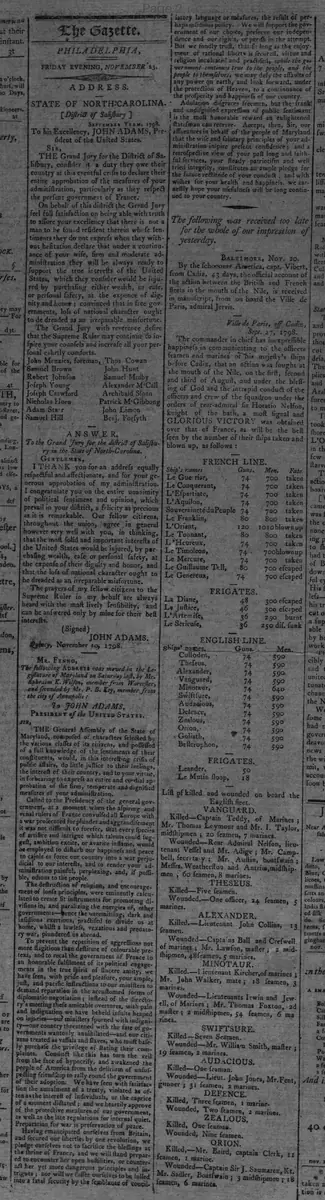
The following Address was moved in the Legislature of Maryland on Saturday last, by Mr. Ephraim K. Wilson, member from Worcester, and seconded by Mr. P. B. Key, member from the city of Annapolis:
To JOHN ADAMS, PRESIDENT of the UNITED STATES.
SIR,
THE General Assembly of the State of Maryland, composed of characters elected by the various classes of its citizens, and possessed of a full knowledge of the sentiments of their constituents, would, in this interesting crisis of public affairs, do little justice to their feelings, the interest of their country, and to your virtue, in forbearing to express an entire and cordial approbation of the firm, temperate and dignified measures of your administration.
Called to the Presidency of the general government, at a moment when the aspiring and venal rulers of France convulsed all Europe with a war prosecuted for plunder and aggrandizement it was not difficult to foresee, that every species of artifice and intrigue which talents could suggest, ambition excite, or avarice inflame, would be employed to disturb our happiness and peace to cajole or force our country into a war prejudicial to our interests, and to render your administration painful, perplexing, and, if possible, odious to the people.
The destruction of religion, and encouragement of loose principles, were eminently calculated to create fit instruments for promoting divisions in, and paralizing the energies of, other governments—hence the unremitting, dark and insidious exertions, practiced to divide us at home, whilst a lawless, vexatious and predatory war, plundered us abroad.
To prevent the repetition of aggressions not more flagitious than destitute of colourable pretext, and to recall the government of France to an honorable fulfilment of its political engagements in the true spirit of sincere amity, we have seen, with pride and pleasure, your ample, just, and pacific instructions to our ministers to demand reparation in the accustomed forms of diplomatic negotiation; instead of the directory's meeting these amicable overtures, with pain and indignation we have beheld insults heaped on injuries—our ministers spurned with indignity—our country threatened with the fate of governments wantonly annihilated—and our citizens treated as vassals and slaves, who must basely purchase the privilege of stating their complaints. Conduct like this has torn the veil from the face of hypocrisy, and awakened the people of America from the delirium of unsuspecting friendship to rally round the government of their adoption. We have seen with satisfaction the annulment of a treaty, violated as often as the interest of individuals, or the caprice of a moment dictated; and we heartily approve of the protective measures of our government, as well as the late regulations for internal quiet.
Preparation for war is preservation of peace.
Having emancipated ourselves from Britain, and secured our liberties by one revolution, we pledge ourselves not to sacrifice the blessings at the shrine of France, and we will stand prepared to encounter her open hostilities, or counteract her yet more dangerous principles and intrigues; nor will we suffer ourselves to be lulled into a fatal security by the semblance of conciliatory language or measures, the result of perhaps insidious policy. We will support the government of our choice, preserve our independence and our rights, or perish in the attempt.
But we fondly trust, that as long as the enjoyment of rational liberty is secured, virtue and religion inculcated and practiced, while the government continues true to the people, and the people to themselves, we may defy the assaults of any power on earth, and look forward, under the protection of Heaven, to a continuance of the prosperity and happiness of our country.
Adulation disgraces freemen, but the frank and undisguised expression of public sentiment is the most honorable reward an enlightened statesman can receive. Accept, then, Sir, our assurances in behalf of the people of Maryland that the wise and salutary principles of your administration inspire present confidence; and a retrospective view of your past long and faithful services, your steady patriotism and well tried integrity, constitutes an ample pledge for the future rectitude of your conduct; and with wishes for your health and happiness. we earnestly hope your usefulness will be long continued to your country.
What sub-type of article is it?
What themes does it cover?
What keywords are associated?
What entities or persons were involved?
Where did it happen?
Story Details
Key Persons
Location
Maryland
Event Date
Saturday Last
Story Details
The Maryland General Assembly addresses President John Adams, approving his administration's response to French aggressions, including diplomatic demands for reparation, treaty annulment, and preparations for defense, while pledging support for American independence against foreign intrigue.