Thank you for visiting SNEWPapers!
Sign up free
Story
January 20, 1931
The Daily Alaska Empire
Juneau, Juneau County, Alaska
What is this article about?
In Washington, D.C., radio expert G. G. Kruesi invents a 10-pound homing device that connects to radio receivers to guide aviators to destinations via broadcasts or beacons, with potential for watercraft and wartime use, developed after aircraft assisted his beam testing work.
Clipping
OCR Quality
98%
Excellent
Full Text
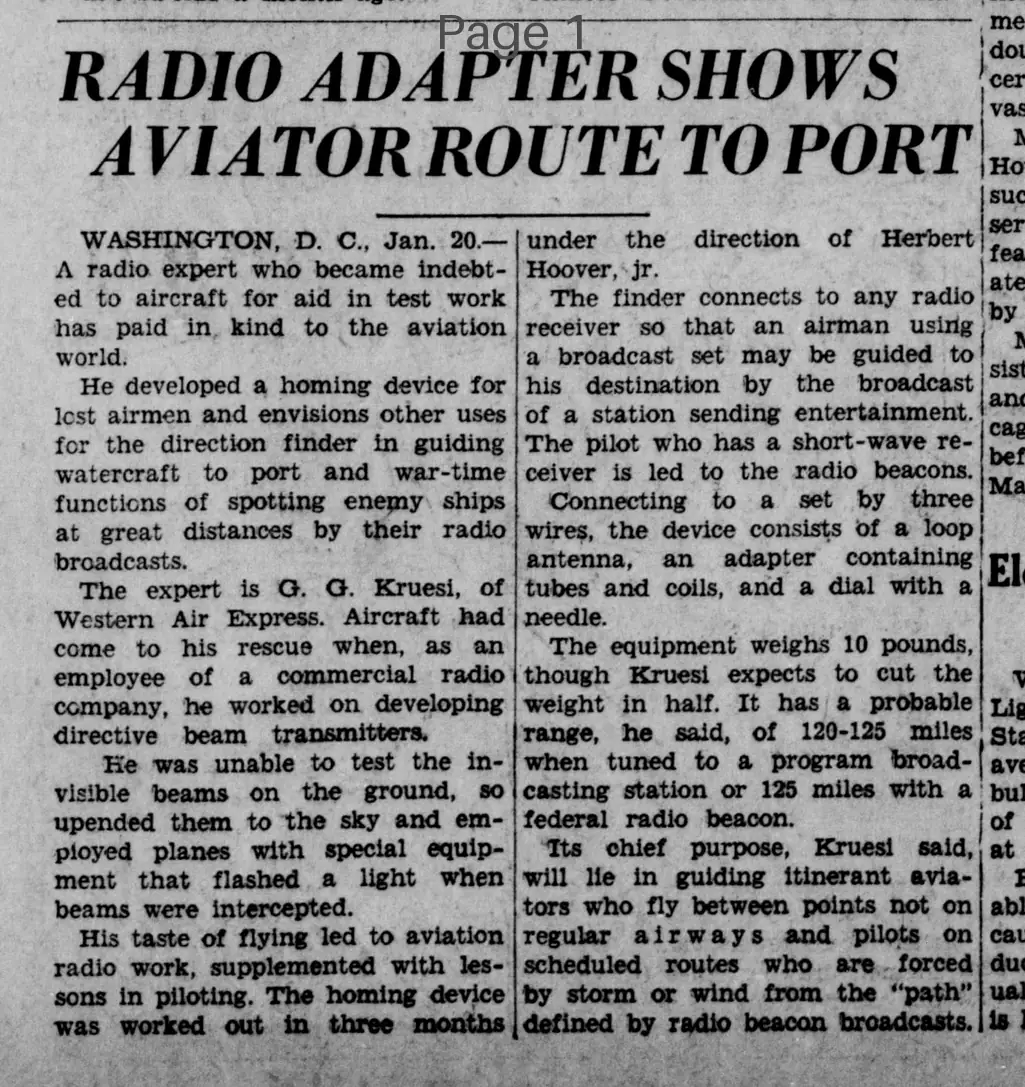
RADIO ADAPTER SHOWS AVIATOR ROUTE TO PORT
WASHINGTON, D. C., Jan. 20.—A radio expert who became indebted to aircraft for aid in test work has paid in kind to the aviation world.
He developed a homing device for lost airmen and envisions other uses for the direction finder in guiding watercraft to port and war-time functions of spotting enemy ships at great distances by their radio broadcasts.
The expert is G. G. Kruesi, of Western Air Express. Aircraft had come to his rescue when, as an employee of a commercial radio company, he worked on developing directive beam transmitters.
He was unable to test the invisible beams on the ground, so upended them to the sky and employed planes with special equipment that flashed a light when beams were intercepted.
His taste of flying led to aviation radio work, supplemented with lessons in piloting. The homing device was worked out in three months under the direction of Herbert Hoover, Jr.
The finder connects to any radio receiver so that an airman using a broadcast set may be guided to his destination by the broadcast of a station sending entertainment.
The pilot who has a short-wave receiver is led to the radio beacons.
Connecting to a set by three wires, the device consists of a loop antenna, an adapter containing tubes and coils, and a dial with a needle.
The equipment weighs 10 pounds, though Kruesi expects to cut the weight in half. It has a probable range, he said, of 120-125 miles when tuned to a program broadcasting station or 125 miles with a federal radio beacon.
Its chief purpose, Kruesi said, will lie in guiding itinerant aviators who fly between points not on regular airways and pilots on scheduled routes who are forced by storm or wind from the “path” defined by radio beacon broadcasts.
WASHINGTON, D. C., Jan. 20.—A radio expert who became indebted to aircraft for aid in test work has paid in kind to the aviation world.
He developed a homing device for lost airmen and envisions other uses for the direction finder in guiding watercraft to port and war-time functions of spotting enemy ships at great distances by their radio broadcasts.
The expert is G. G. Kruesi, of Western Air Express. Aircraft had come to his rescue when, as an employee of a commercial radio company, he worked on developing directive beam transmitters.
He was unable to test the invisible beams on the ground, so upended them to the sky and employed planes with special equipment that flashed a light when beams were intercepted.
His taste of flying led to aviation radio work, supplemented with lessons in piloting. The homing device was worked out in three months under the direction of Herbert Hoover, Jr.
The finder connects to any radio receiver so that an airman using a broadcast set may be guided to his destination by the broadcast of a station sending entertainment.
The pilot who has a short-wave receiver is led to the radio beacons.
Connecting to a set by three wires, the device consists of a loop antenna, an adapter containing tubes and coils, and a dial with a needle.
The equipment weighs 10 pounds, though Kruesi expects to cut the weight in half. It has a probable range, he said, of 120-125 miles when tuned to a program broadcasting station or 125 miles with a federal radio beacon.
Its chief purpose, Kruesi said, will lie in guiding itinerant aviators who fly between points not on regular airways and pilots on scheduled routes who are forced by storm or wind from the “path” defined by radio beacon broadcasts.
What sub-type of article is it?
Historical Event
Personal Triumph
Curiosity
What themes does it cover?
Triumph
Exploration
What keywords are associated?
Radio Adapter
Homing Device
Aviation Navigation
Aircraft Guidance
Direction Finder
What entities or persons were involved?
G. G. Kruesi
Herbert Hoover, Jr.
Where did it happen?
Washington, D. C.
Story Details
Key Persons
G. G. Kruesi
Herbert Hoover, Jr.
Location
Washington, D. C.
Event Date
Jan. 20.
Story Details
G. G. Kruesi develops a radio homing device for guiding lost airmen to ports using broadcast stations or beacons, inspired by aircraft aiding his earlier radio tests, completed in three months under Herbert Hoover, Jr.'s direction.