Thank you for visiting SNEWPapers!
Sign up free
Independent Journal, Or, The General Advertiser
New York, New York County, New York
What is this article about?
Biographical remarks on Frederick William II, King of Prussia, covering his birth in 1744, family, education, military service, affable character, relations with Russia and Austria, and clemency upon ascending the throne after his uncle's death.
Merged-components note: Continuation across pages of the article 'Remarks on the present King of Prussia'.
Clippings
1 of 2
OCR Quality
Full Text
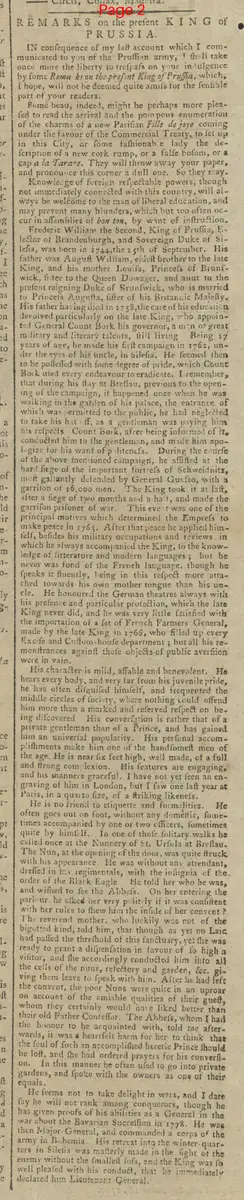
IN consequence of my last account which I communicated to you of the Prussian army, I shall take once more the liberty to trespass on your indulgence by some Remarks on the present King of Prussia, which, I hope, will not be deemed quite amiss for the sensible part of your readers.
Some beaux, indeed, might be perhaps more pleased to read the arrival and the pompous enumeration of the charms of a new Parisian Fille de joie coming under the favour of the Commercial Treaty, to set up in this City, or some fashionable lady the description of a new cork rump, or a false bum, or a cap a la Tarare. They will throw away your paper, and pronounce this corner a dull one. So they may.
Knowledge of foreign respectable powers, though not immediately connected with this country, will always be welcome to the man of liberal education, and may prevent many blunders, which but too often occur in assemblies of bon ton, by want of instruction.
Frederic William the Second, King of Prussia, Elector of Brandenburg, and Sovereign Duke of Silesia, was born in 1744, the 25th of September. His father was Augustus William, eldest brother to the late King, and his mother Louisa, Princess of Brunswick, Sister to the Queen Dowager, and aunt to the present reigning Duke of Brunswick, who is married to Princess Augusta, sister of his Britannic Majesty.
His father having died in 1758, the care of his education devolved particularly on the late King, who appointed General Count Bock his governor, a man of great military and literary talents, still living. Being 17 years of age, he made his first campaign in 1762, under the eyes of his uncle, in Silesia. He seemed then to be possessed with some degree of pride, which Count Bock used every endeavour to eradicate. I remember, that during his stay at Breslau, previous to the opening of the campaign, it happened once when he was walking in the garden of his palace, the entrance of which was permitted to the public, he had neglected to take his hat off, as a gentleman was paying him his respects. Count Bock, after being informed of it, conducted him to the gentleman, and made him apologize for his want of politeness. During the course of the above mentioned campaign, he assisted at the siege of the important fortress of Schweidnitz, most gallantly defended by General Guasco, with a garrison of 16,000 men. The King took it at last, after a siege of two months and a half, and made the garrison prisoners of war. This event was one of the principal motives which determined the Empress to make peace in 1763. After that peace he applied himself, besides his military occupations and reviews in which he always accompanied the King, to the knowledge of literature and modern languages; but he never was fond of the French language, though he speaks it fluently, being in this respect more attached towards his own mother tongue than his uncle. He honoured the German theatres always with his presence and particular protection, which the late King never did, and he was very little satisfied with the importation of a set of French Farmers General, made by the late King in 1766, who filled up every Excise and Custom-house department; but all his remonstrances against those objects of public aversion were in vain.
His character is mild, affable and benevolent. He hears every body, and very far from his juvenile pride, he has often disguised himself, and frequented the middle circles of society, where nothing could offend him more than a marked and reserved respect on being discovered. His conversation is rather that of a private gentleman than of a Prince, and has gained him an universal popularity. His personal accomplishments make him one of the handsomest men of the age. He is near six feet high, well made, of a full and strong complexion. His features are engaging, and his manners graceful. I have not yet seen an engraving of him in London, but I saw one last year at Paris, in a quarto size, of a striking likeness.
He is no friend to etiquette and formalities. He often goes out on foot, without any domestic, sometimes accompanied by one or two officers, sometimes quite by himself. In one of those solitary walks he called once at the Nunnery of St. Ursula at Breslau. The Nun, at the opening of the door, was quite struck with his appearance. He was without an attendant, dressed in his regimentals, with the insignia of the order of the Black Eagle. He told her who he was, and wished to see the Abbess. On her entering the parlour he asked her very politely if it was consistent with her rules to shew him the inside of her convent? The reverend mother, who luckily was not of the bigotted kind, told him, that though as yet no Laic had passed the threshold of this sanctuary, yet she was ready to grant a dispensation in favour of so high a visitor, and she accordingly conducted him into all the cells of the nuns, refectory and garden, &c. giving them leave to speak with him. After he had left the convent, the poor Nuns were quite in an uproar on account of the amiable qualities of their guest, whom they certainly would have liked better than their old Father Confessor. The Abbess, whom I had the honour to be acquainted with, told me afterwards, it was a heartfelt harm for her to think that the soul of such an accomplished heroic Prince should be lost, and she had ordered prayers for his conversion. In this manner he often used to go into private gardens, and spoke with the owners as one of their equals.
He seems not to take delight in wars, and I dare say he will not rank among conquerors, though he has given proofs of his abilities as a General in the war about the Bavarian Succession in 1778. He was then Major-General, and commanded a corps of the army in Bohemia. His retreat into the winter-quarters in Silesia was masterly made in the sight of the enemy without the smallest loss, and the King was so well pleased with his conduct, that he immediately declared him Lieutenant-General.
Himself and the Empress know one another very well. They have met twice; first in 1769, when the Emperor paid a visit to the King at the review at Nys, in Silesia, and the year after, when the King and the Prince of Prussia went to the Emperor's review in Moravia.
In 1781, the Empress of Russia sent him an invitation to pay her a visit at Petersburg, which he accordingly did. Catherine, who never did much like his uncle, their projects of aggrandizement clashing sometimes with each other, was the more friendly towards the nephew. She entertained him with every kind of magnificence at her Court, and he in return behaved with a generosity becoming his station. The old King made him not a little outlays, as the bill of his requirements and gratifications amounted to some 100,000 dollars; and not less so, when the Prince afterwards showed a desire to make a tour to other European Courts, when he certainly would have visited England; but which expensive request the King absolutely refused to comply with.
During the latter illness of his uncle, he attended on him with a particular attachment, so that the King once told him: "I pity you very much that you must wait so long for me; but I wish you may make your successor wait as long as I do." A few weeks before Frederic's death, Prince Bus. Ambassador of the Emperor, complimented him with the great concern his master, and the whole empire were in, at the ill state of his health. To which the King with a smile replied: "Never mind, my dear Prince. Tell them they need not be afraid, my nephew will begin me anew." (Il me recommencera.)
After his death, the new King assisted at his funeral together with all the Princes of the Royal House, and ordered it to be executed in the most magnificent style, twenty-five days having been employed in its preparation, from the 17th of August to the 10th of September, and thousands of persons of the highest rank, from far distant places having resorted to Potsdam to see the burial of the hero of the age.
The very moment of his ascension to Royalty, he seized an opportunity to show his Royal clemency. It happened that on the same morning of the King's death, a private man of the artillery corps at Berlin was to be shot, for having drawn his sword against his corporal. His Majesty remembered, amidst all the distractions of his new high elevation, to have seen the deceased King sign the death-warrant three days before, and he immediately made use of that power so newly devolved upon him. He dispatched a courier to Berlin, (being then at Potsdam) to stop the execution which was just on the point to proceed, and reprieved the criminal without any punishment.
A Friend to the Eagle.
(To be concluded in our next.)
What sub-type of article is it?
What keywords are associated?
What entities or persons were involved?
Where did it happen?
Foreign News Details
Primary Location
Prussia
Key Persons
Event Details
Biographical sketch of Frederick William II, King of Prussia, including his birth on September 25, 1744, family connections, education under Count Bock, first military campaign in 1762, participation in the siege of Schweidnitz, literary interests, mild and affable character, aversion to etiquette, military abilities shown in 1778, diplomatic meetings with Austrian and Russian rulers, attendance during his uncle's illness, organization of the funeral, and immediate act of clemency upon ascension.