Thank you for visiting SNEWPapers!
Sign up free
Letter to Editor
February 21, 1811
Alexandria Daily Gazette, Commercial & Political
Alexandria, Virginia
What is this article about?
A letter to the Alexandria Gazette editor critiques recent US presidential nominations and provides an extract from Goldsmith's work detailing Napoleon Bonaparte's scandalous early life, crimes, and rise to power, portraying him as a ruthless opportunist and murderer.
Clipping
OCR Quality
92%
Excellent
Full Text
For the Alexandria Gazette.
Mr. Snowden,
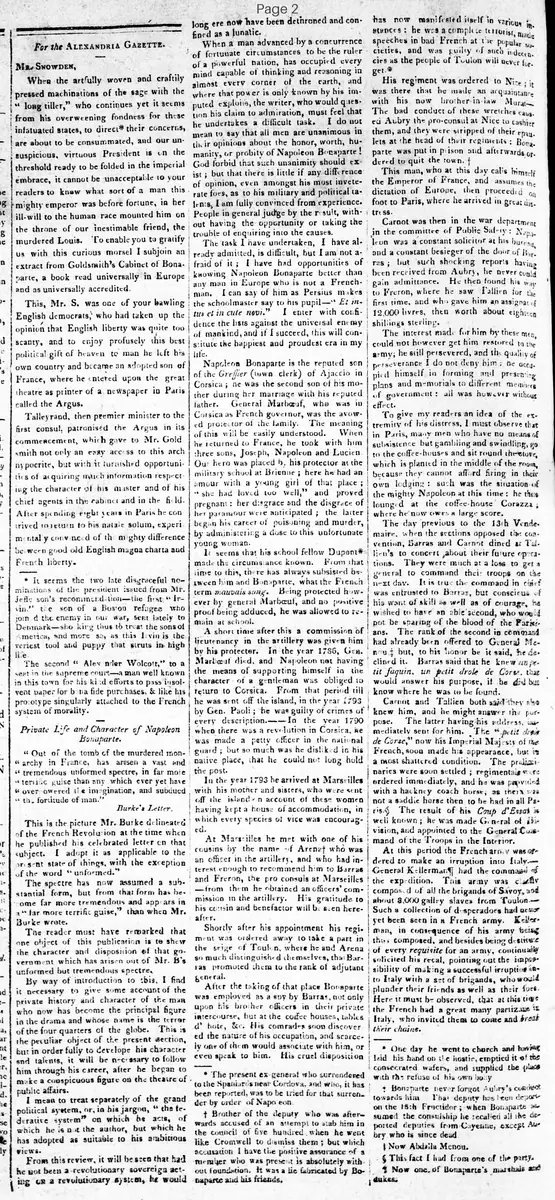
When the artfully woven and craftily pressed machinations of the sage with the "long tiller," who continues yet it seems from his overweening fondness for these infatuated states, to direct their concerns, are about to be consummated, and our unsuspicious, virtuous President is on the threshold ready to be folded in the imperial embrace, it cannot be unacceptable to your readers to know what sort of a man this mighty emperor was before fortune, in her ill-will to the human race mounted him on the throne of our inestimable friend, the murdered Louis. To enable you to gratify us with this curious morsel I subjoin an extract from Goldsmith's Cabinet of Bonapartes, a book read universally in Europe and as universally accredited.
This, Mr. S. was one of your bawling English democrats, who had taken up the opinion that English liberty was quite too scanty, and to enjoy profusely this best political gift of heaven to man he left his own country and became an adopted son of France, where he entered upon the great theatre as printer of a newspaper in Paris called the Argus.
Talleyrand, then premier minister to the first consul, patronised the Argus in its commencement, which gave to Mr. Goldsmith not only an easy access to this arch hypocrite, but with it furnished opportunities of acquiring much information respecting the character of his master and of his chief agents in the cabinet and in the field.
After spending eight years in Paris he contrived to return to his native soil, experimentally convinced of the mighty difference between good old English magna charta and French liberty.
* It seems the two late disgraceful nominations of the president issued from Mr. Jefferson's recommendation—the first "Irvin," the son of a Boston refugee who joined the enemy in our war, sent lately to Denmark—showing thus to treat the sons of America, and more so, as this Irvin is the veriest tool and puppy that struts in high life.
The second "Alexander Wolcott," to a seat in the supreme court—a man well known in this town for his kind efforts to pass insolvent paper for bona fide purchases, & like his prototype singularly attached to the French system of morality.
Private Life and Character of Napoleon Bonaparte.
"Out of the tomb of the murdered monarchy in France, has arisen a vast and tremendous unformed spectre, in far more terrific guise than any which ever yet have overpowered the imagination, and subdued the fortitude of man."
Burke's Letter.
This is the picture Mr. Burke delineated of the French Revolution at the time when he published his celebrated letter on that subject. I adopt it as applicable to the present state of things, with the exception of the word "unformed."
The spectre has now assumed a substantial form, but from that form has become far more tremendous and appears in a "far more terrific guise," than when Mr. Burke wrote.
The reader must have remarked that one object of this publication is to shew the character and disposition of that government which has arisen out of Mr. Burke's unformed but tremendous spectre.
By way of introduction to this, I find it necessary to give some account of the private history and character of the man who now has become the principal figure in the drama and whose name is the terror of the four quarters of the globe. This is the peculiar object of the present section.
But in order fully to develop his character and talents, it will be necessary to follow him through his career, after he began to make a conspicuous figure on the theatre of public affairs.
I mean to treat separately of the grand political system, or, in his jargon, "the derivative system" on which he acts, of which he is not the author, but which he has adopted as suitable to his ambitious views.
From this review, it will be seen that had he not been a revolutionary sovereign acting on a revolutionary system, he would long ere now have been dethroned and confined as a lunatic.
When a man advanced by a concurrence of fortunate circumstances to be the ruler of a powerful nation, has occupied every mind capable of thinking and reasoning in almost every corner of the earth, and where that power is only known by his imputed exploits, the writer, who would question his claim to admiration, must feel that he undertakes a difficult task. I do not mean to say that all men are unanimous in their opinions about the honor, worth, humanity, or probity of Napoleon Bonaparte! God forbid that such unanimity should exist; but that there is little if any difference of opinion, even amongst his most inveterate foes, as to his military and political talents. I am fully convinced from experience.
People in general judge by the result, without having the opportunity or taking the trouble of enquiring into the causes.
The task I have undertaken, I have already admitted, is difficult, but I am not afraid of it; I have had opportunities of knowing Napoleon Bonaparte better than any man in Europe who is not a Frenchman. I can say of him as Persius makes the schoolmaster say to his pupil—"Et intus et in cute novi." I enter with confidence the lists against the universal enemy of mankind, and if I succeed, this will constitute the happiest and proudest era in my life.
Napoleon Bonaparte is the reputed son of the Greffier (town clerk) of Ajaccio in Corsica; he was the second son of his mother during her marriage with his reputed father. General Marboeuf, who was in Corsica as French governor, was the avowed protector of the family. The meaning of this will be easily understood. When he returned to France, he took with him three sons, Joseph, Napoleon and Lucien.
Our hero was placed by his protector at the military school at Brienne; here he had an amour with a young girl of that place: "she had loved too well," and proved pregnant: her disgrace and the disgrace of her paramour were anticipated; the latter began his career of poisoning and murder, by administering a dose to this unfortunate young woman.
It seems that his school fellow Dupont made the circumstance known. From that time to this, there has always subsisted between him and Bonaparte, what the French term mauvais sang. Being protected however by general Marboeuf, and no positive proof being adduced, he was allowed to remain at school.
A short time after this a commission of lieutenancy in the artillery was given him by his protector. In the year 1786, Gen. Marboeuf died, and Napoleon not having the means of supporting himself in the character of a gentleman was obliged to return to Corsica. From that period till he was sent off the island, in the year 1793 by Gen. Paoli: he was guilty of crimes of every description.—In the year 1790 when there was a revolution in Corsica, he was made a petty officer in the national guard; but so much was he disliked in his native place, that he could not long hold the post.
In the year 1793 he arrived at Marseilles with his mother and sisters, who were sent off the island on account of these women having kept a house of accommodation, in which every species of vice was encouraged.
At Marseilles he met with one of his cousins by the name of Arenat who was an officer in the artillery, and who had interest enough to recommend him to Barras and Freron, the pro consuls at Marseilles—from them he obtained an officer's commission in the artillery. His gratitude to his cousin and benefactor will be seen hereafter.
Shortly after his appointment his regiment was ordered away to take a part in the siege of Toulon, where he and Arena so much distinguished themselves, that Barras promoted them to the rank of adjutant general.
After the taking of that place Bonaparte was employed as a spy by Barras, not only upon his brother officers in their private intercourse, but at the coffee houses, tables d'hote, &c. His comrades soon discovered the nature of his occupation, and scarcely one of them would associate with him, or even speak to him. His cruel disposition
* The present ex-general who surrendered to the Spaniards near Cordova, and who, it has been reported, was to be tried for that surrender by order of Napoleon.
Brother of the deputy who was afterwards accused of an attempt to stab him in the council of five hundred, when he went like Cromwell to dismiss them; but which accusation I have the positive assurance of a member who was present is absolutely without foundation. It was a lie fabricated by Bonaparte and his friends.
has now manifested itself in various instances: he was a complete itinerant, made speeches in bad French at popular societies, and was guilty of such indecencies as the people of Toulon will never forget.*
His regiment was ordered to Nice; it was there that he made an acquaintance with his now brother-in-law Murat~ The bad conduct of these wretches caused Aubry the pro-consul at Nice to cashier them, and they were stripped of their epaulets at the head of their regiments: Bonaparte was put in prison and afterwards ordered to quit the town.†
This man, who at this day calls himself the Emperor of France, and assumes the dictation of Europe, then proceeded on foot to Paris, where he arrived in great distress.
Carnot was then in the war department in the committee of Public Safety: Napoleon was a constant solicitor at his bureau, and a constant besieger of the door of Barras; but such shocking reports having been received from Aubry, he never could gain admittance. He then found his way to Freron, where he saw Tallien for the first time, and who gave him an assignat of 12,000 livres, then worth about eighteen shillings sterling g•
The interest made for him by these men, could not however get him restored to the army; he still persevered, and the quality of perseverance I do not deny him: he occupied himself in forming and presenting plans and memorials to different members of government: all was however without effect.
To give my readers an idea of the extremity of his distress. I must observe that in Paris, many men who have no means of subsistence but gambling and swindling, go to the coffee-houses and sit round the stove, which is planted in the middle of the room, because they cannot afford firing in their own lodging: such was the situation of the mighty Napoleon at this time: he thus lounged at the coffee-house Corazza: where he now owes a large score.
The day previous to the 13th Vendemiaire, when the sections opposed the convention, Barras and Carnot dined at Tallien's to concert about their future operations. They were much at a loss to get a general to command their troops on the next day. It is true the command in chief was entrusted to Barras, but conscious his want of skill as well as of courage, he wished to have an able second, who would not be sparing of the blood of the Parisians. The rank of the second in command had already been offered to General Menou‡ but, to his honor be it said, he declined it. Barras said that he knew un petit faquin, un petit drole de Corse, that would answer his purpose, if he did but know where he was to be found.
Carnot and Tallien both said they knew him, and he might answer the purpose. The latter having his address, immediately sent for him. The "petit drole de Corse," now his Imperial Majesty of the French, soon made his appearance, but in a most shattered condition. The preliminaries were soon settled; regimentals were ordered immediately, and he was provided with a hackney coach horse, as there was not a saddle horse then to be had in all Paris. The result of his Coup d'Essai is well known; he was made General of Brigade, and appointed to the General Command of the Troops in the Interior.
At this period the French army was ordered to make an irruption into Italy.—General Kellermann had the command the expedition. This army was composed of all the brigands of Savoy, and about 3000 galley slaves from Toulon.—Such a collection of desperadoes had never yet been seen in a French army. Kellermann, in consequence of his army being thus composed, and besides being destitute of every requisite for an army, continually solicited his recall, pointing out the impossibility of making a successful irruption into Italy with a set of brigands, who would plunder their friends as well as their foes.
Here it must be observed, that at this crisis the French had a great many partizans in Italy, who invited them to come and break their chains.
* One day he went to church and having laid his hand on the hostic, emptied it of the consecrated wafers, and supplied the place with the refuse of his own body
: Bonaparte never forgot Aubry's conduct towards him That deputy has been deported on the 18th Fructidor; when Bonaparte assumed the consulate he recalled all the deported deputies from Cayenne, except Aubry who is since dead
† Now Abdallah Menou.
‡ Now one of Bonaparte's marshals and dukes.
. This fact I had from one of the party.
Mr. Snowden,
When the artfully woven and craftily pressed machinations of the sage with the "long tiller," who continues yet it seems from his overweening fondness for these infatuated states, to direct their concerns, are about to be consummated, and our unsuspicious, virtuous President is on the threshold ready to be folded in the imperial embrace, it cannot be unacceptable to your readers to know what sort of a man this mighty emperor was before fortune, in her ill-will to the human race mounted him on the throne of our inestimable friend, the murdered Louis. To enable you to gratify us with this curious morsel I subjoin an extract from Goldsmith's Cabinet of Bonapartes, a book read universally in Europe and as universally accredited.
This, Mr. S. was one of your bawling English democrats, who had taken up the opinion that English liberty was quite too scanty, and to enjoy profusely this best political gift of heaven to man he left his own country and became an adopted son of France, where he entered upon the great theatre as printer of a newspaper in Paris called the Argus.
Talleyrand, then premier minister to the first consul, patronised the Argus in its commencement, which gave to Mr. Goldsmith not only an easy access to this arch hypocrite, but with it furnished opportunities of acquiring much information respecting the character of his master and of his chief agents in the cabinet and in the field.
After spending eight years in Paris he contrived to return to his native soil, experimentally convinced of the mighty difference between good old English magna charta and French liberty.
* It seems the two late disgraceful nominations of the president issued from Mr. Jefferson's recommendation—the first "Irvin," the son of a Boston refugee who joined the enemy in our war, sent lately to Denmark—showing thus to treat the sons of America, and more so, as this Irvin is the veriest tool and puppy that struts in high life.
The second "Alexander Wolcott," to a seat in the supreme court—a man well known in this town for his kind efforts to pass insolvent paper for bona fide purchases, & like his prototype singularly attached to the French system of morality.
Private Life and Character of Napoleon Bonaparte.
"Out of the tomb of the murdered monarchy in France, has arisen a vast and tremendous unformed spectre, in far more terrific guise than any which ever yet have overpowered the imagination, and subdued the fortitude of man."
Burke's Letter.
This is the picture Mr. Burke delineated of the French Revolution at the time when he published his celebrated letter on that subject. I adopt it as applicable to the present state of things, with the exception of the word "unformed."
The spectre has now assumed a substantial form, but from that form has become far more tremendous and appears in a "far more terrific guise," than when Mr. Burke wrote.
The reader must have remarked that one object of this publication is to shew the character and disposition of that government which has arisen out of Mr. Burke's unformed but tremendous spectre.
By way of introduction to this, I find it necessary to give some account of the private history and character of the man who now has become the principal figure in the drama and whose name is the terror of the four quarters of the globe. This is the peculiar object of the present section.
But in order fully to develop his character and talents, it will be necessary to follow him through his career, after he began to make a conspicuous figure on the theatre of public affairs.
I mean to treat separately of the grand political system, or, in his jargon, "the derivative system" on which he acts, of which he is not the author, but which he has adopted as suitable to his ambitious views.
From this review, it will be seen that had he not been a revolutionary sovereign acting on a revolutionary system, he would long ere now have been dethroned and confined as a lunatic.
When a man advanced by a concurrence of fortunate circumstances to be the ruler of a powerful nation, has occupied every mind capable of thinking and reasoning in almost every corner of the earth, and where that power is only known by his imputed exploits, the writer, who would question his claim to admiration, must feel that he undertakes a difficult task. I do not mean to say that all men are unanimous in their opinions about the honor, worth, humanity, or probity of Napoleon Bonaparte! God forbid that such unanimity should exist; but that there is little if any difference of opinion, even amongst his most inveterate foes, as to his military and political talents. I am fully convinced from experience.
People in general judge by the result, without having the opportunity or taking the trouble of enquiring into the causes.
The task I have undertaken, I have already admitted, is difficult, but I am not afraid of it; I have had opportunities of knowing Napoleon Bonaparte better than any man in Europe who is not a Frenchman. I can say of him as Persius makes the schoolmaster say to his pupil—"Et intus et in cute novi." I enter with confidence the lists against the universal enemy of mankind, and if I succeed, this will constitute the happiest and proudest era in my life.
Napoleon Bonaparte is the reputed son of the Greffier (town clerk) of Ajaccio in Corsica; he was the second son of his mother during her marriage with his reputed father. General Marboeuf, who was in Corsica as French governor, was the avowed protector of the family. The meaning of this will be easily understood. When he returned to France, he took with him three sons, Joseph, Napoleon and Lucien.
Our hero was placed by his protector at the military school at Brienne; here he had an amour with a young girl of that place: "she had loved too well," and proved pregnant: her disgrace and the disgrace of her paramour were anticipated; the latter began his career of poisoning and murder, by administering a dose to this unfortunate young woman.
It seems that his school fellow Dupont made the circumstance known. From that time to this, there has always subsisted between him and Bonaparte, what the French term mauvais sang. Being protected however by general Marboeuf, and no positive proof being adduced, he was allowed to remain at school.
A short time after this a commission of lieutenancy in the artillery was given him by his protector. In the year 1786, Gen. Marboeuf died, and Napoleon not having the means of supporting himself in the character of a gentleman was obliged to return to Corsica. From that period till he was sent off the island, in the year 1793 by Gen. Paoli: he was guilty of crimes of every description.—In the year 1790 when there was a revolution in Corsica, he was made a petty officer in the national guard; but so much was he disliked in his native place, that he could not long hold the post.
In the year 1793 he arrived at Marseilles with his mother and sisters, who were sent off the island on account of these women having kept a house of accommodation, in which every species of vice was encouraged.
At Marseilles he met with one of his cousins by the name of Arenat who was an officer in the artillery, and who had interest enough to recommend him to Barras and Freron, the pro consuls at Marseilles—from them he obtained an officer's commission in the artillery. His gratitude to his cousin and benefactor will be seen hereafter.
Shortly after his appointment his regiment was ordered away to take a part in the siege of Toulon, where he and Arena so much distinguished themselves, that Barras promoted them to the rank of adjutant general.
After the taking of that place Bonaparte was employed as a spy by Barras, not only upon his brother officers in their private intercourse, but at the coffee houses, tables d'hote, &c. His comrades soon discovered the nature of his occupation, and scarcely one of them would associate with him, or even speak to him. His cruel disposition
* The present ex-general who surrendered to the Spaniards near Cordova, and who, it has been reported, was to be tried for that surrender by order of Napoleon.
Brother of the deputy who was afterwards accused of an attempt to stab him in the council of five hundred, when he went like Cromwell to dismiss them; but which accusation I have the positive assurance of a member who was present is absolutely without foundation. It was a lie fabricated by Bonaparte and his friends.
has now manifested itself in various instances: he was a complete itinerant, made speeches in bad French at popular societies, and was guilty of such indecencies as the people of Toulon will never forget.*
His regiment was ordered to Nice; it was there that he made an acquaintance with his now brother-in-law Murat~ The bad conduct of these wretches caused Aubry the pro-consul at Nice to cashier them, and they were stripped of their epaulets at the head of their regiments: Bonaparte was put in prison and afterwards ordered to quit the town.†
This man, who at this day calls himself the Emperor of France, and assumes the dictation of Europe, then proceeded on foot to Paris, where he arrived in great distress.
Carnot was then in the war department in the committee of Public Safety: Napoleon was a constant solicitor at his bureau, and a constant besieger of the door of Barras; but such shocking reports having been received from Aubry, he never could gain admittance. He then found his way to Freron, where he saw Tallien for the first time, and who gave him an assignat of 12,000 livres, then worth about eighteen shillings sterling g•
The interest made for him by these men, could not however get him restored to the army; he still persevered, and the quality of perseverance I do not deny him: he occupied himself in forming and presenting plans and memorials to different members of government: all was however without effect.
To give my readers an idea of the extremity of his distress. I must observe that in Paris, many men who have no means of subsistence but gambling and swindling, go to the coffee-houses and sit round the stove, which is planted in the middle of the room, because they cannot afford firing in their own lodging: such was the situation of the mighty Napoleon at this time: he thus lounged at the coffee-house Corazza: where he now owes a large score.
The day previous to the 13th Vendemiaire, when the sections opposed the convention, Barras and Carnot dined at Tallien's to concert about their future operations. They were much at a loss to get a general to command their troops on the next day. It is true the command in chief was entrusted to Barras, but conscious his want of skill as well as of courage, he wished to have an able second, who would not be sparing of the blood of the Parisians. The rank of the second in command had already been offered to General Menou‡ but, to his honor be it said, he declined it. Barras said that he knew un petit faquin, un petit drole de Corse, that would answer his purpose, if he did but know where he was to be found.
Carnot and Tallien both said they knew him, and he might answer the purpose. The latter having his address, immediately sent for him. The "petit drole de Corse," now his Imperial Majesty of the French, soon made his appearance, but in a most shattered condition. The preliminaries were soon settled; regimentals were ordered immediately, and he was provided with a hackney coach horse, as there was not a saddle horse then to be had in all Paris. The result of his Coup d'Essai is well known; he was made General of Brigade, and appointed to the General Command of the Troops in the Interior.
At this period the French army was ordered to make an irruption into Italy.—General Kellermann had the command the expedition. This army was composed of all the brigands of Savoy, and about 3000 galley slaves from Toulon.—Such a collection of desperadoes had never yet been seen in a French army. Kellermann, in consequence of his army being thus composed, and besides being destitute of every requisite for an army, continually solicited his recall, pointing out the impossibility of making a successful irruption into Italy with a set of brigands, who would plunder their friends as well as their foes.
Here it must be observed, that at this crisis the French had a great many partizans in Italy, who invited them to come and break their chains.
* One day he went to church and having laid his hand on the hostic, emptied it of the consecrated wafers, and supplied the place with the refuse of his own body
: Bonaparte never forgot Aubry's conduct towards him That deputy has been deported on the 18th Fructidor; when Bonaparte assumed the consulate he recalled all the deported deputies from Cayenne, except Aubry who is since dead
† Now Abdallah Menou.
‡ Now one of Bonaparte's marshals and dukes.
. This fact I had from one of the party.
What sub-type of article is it?
Persuasive
Political
Provocative
What themes does it cover?
Politics
Military War
Morality
What keywords are associated?
Napoleon Bonaparte
Character Criticism
French Revolution
Military Career
Us Nominations
Jefferson Recommendations
Goldsmith Extract
Burke Letter
What entities or persons were involved?
Mr. Snowden
Letter to Editor Details
Recipient
Mr. Snowden
Main Argument
napoleon bonaparte is a ruthless murderer and opportunist whose scandalous early life and crimes reveal his true character, unfit for admiration, as detailed in goldsmith's account; recent us nominations reflect poor judgment influenced by similar flawed systems.
Notable Details
Extract From Goldsmith's Cabinet Of Bonapartes
Quote From Burke's Letter On The French Revolution
Anecdotes Of Poisoning A Pregnant Lover, Spying On Comrades, Cashiering At Nice, Distress In Paris
Criticism Of Nominations Of Irvin And Alexander Wolcott