Thank you for visiting SNEWPapers!
Sign up free
Letter to Editor
January 16, 1830
Constitutional Whig
Richmond, Virginia
What is this article about?
Letter to the Editor of the Whig correcting James Monroe's speech on the expulsion of free people of color from Cincinnati, Ohio, arguing it was not representative of state sentiment but driven by a mob and low-class whites, and criticizing Virginia's policy of banishing free blacks.
Clipping
OCR Quality
98%
Excellent
Full Text
TO THE EDITOR OF THE WHIG.
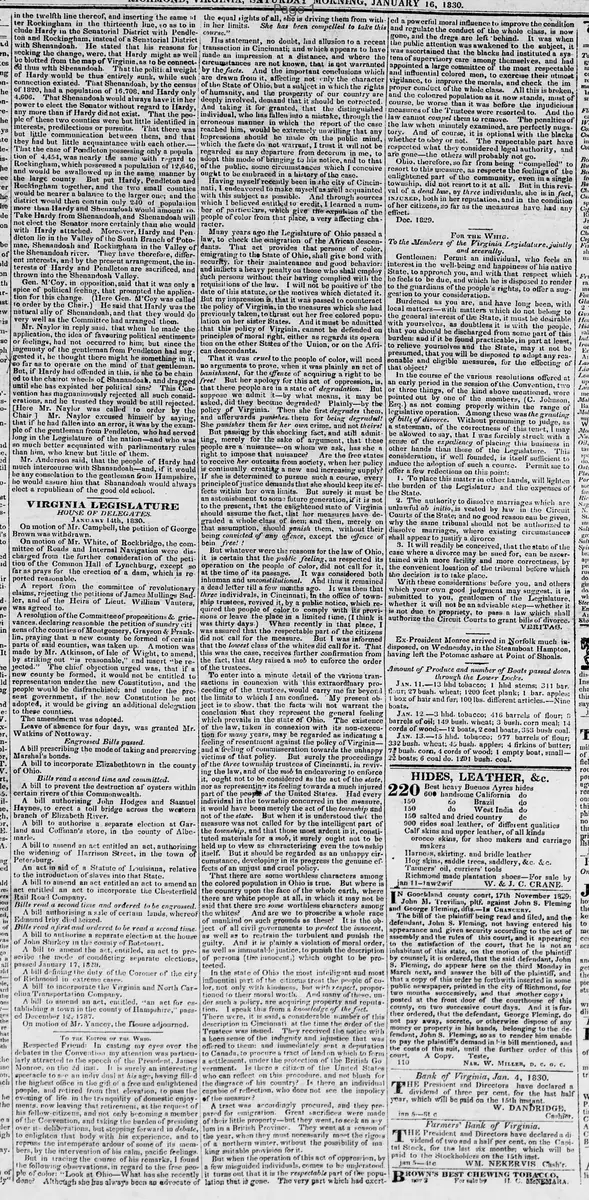
Respected Friend: In casting my eyes over the debates in the Convention my attention was particularly attracted to the speech of the President, James Monroe, on the 2d inst. It is surely an interesting spectacle to see an individual at his age, having filled the highest office in the gift of a free and enlightened people, and retired from that elevation, to pass the evening of life in the tranquility of domestic enjoyments, now leaving that retirement, at the request of his fellow-citizens, and not only becoming a member of the Convention, and taking the burden of presiding over its deliberations, but stepping forward in debate, to enlighten that body with his experience, and to repress the intemperate ardour of some of its members, by the intervention of his calm, pacific feelings. But in tracing the course of his remarks, I found the following observations, in regard to the free people of color: "Look at Ohio--What has she recently done? Although she has always been an advocate of course."
His statement, no doubt, had allusion to a recent transaction in Cincinnati; and which appears to have made an impression at a distance, and where the circumstances are not known, that is not warranted by the facts. And the important conclusions which are drawn from it, affecting not only the character of the State of Ohio, but a subject in which the rights of humanity, and the prosperity of our country are deeply involved, demand that it should be corrected. And taking it for granted, that the distinguished individual, who has fallen into a mistake, through the erroneous manner in which the report of this case reached him, would be extremely unwilling that any impressions should be made on the public mind, which the facts do not warrant, I trust it will not be regarded as any departure from decorum in me, to adopt this mode of bringing to his notice, and to that of the public, some circumstances which I conceive ought to be embraced in a history of the case.
Having myself recently been in the city of Cincinnati, I endeavored to make myself as well acquainted with this subject as possible. And through sources which I believed entitled to credit, I learned a number of particulars, which give the expulsion of the people of color from that place, a very affecting character.
Many years ago the Legislature of Ohio passed a law, to check the emigration of the African descendants. That act provides that persons of color, emigrating to the State of Ohio, shall give bond with security, for their maintenance and good behavior: and inflicts a heavy penalty on those who shall employ such persons without their having complied with the requisitions of the law. I will not be positive of the date of this statute, or the motives which dictated it. But my impression is, that it was passed to counteract the policy of Virginia, in the measures which she had previously taken, to thrust out her free colored population on her sister States. And it must be admitted that this policy of Virginia, cannot be defended on principles of moral right, either as regards its operation on the other States of the Union, or on the African descendants.
That it was cruel to the people of color, will need no arguments to prove, when it was plainly an act of banishment, for the offence of acquiring a right to be free! But her apology for this act of oppression, is, that these people are in a state of degradation. But suppose we admit it--by what means, it may be asked, did they become degraded? Plainly--by the policy of Virginia. Then she first degrades them, and afterwards punishes them for being degraded! She punishes them for her own crime, and not theirs! But passing by this shocking fact, and still admitting, merely for the sake of argument, that these people are a nuisance--on whom we ask, has she a right to impose that nuisance? Are the free states to receive her outcasts from society, when her policy is continually creating a new and increasing supply? If she is determined to pursue such a course, every principle of justice demands that she should keep its effects within her own limits. But surely it must be an astonishment to some future generation, if it is not to the present, that the enlightened state of Virginia should assume the fact, that her measures have degraded a whole class of men; and then, merely on that assumption, should punish them, without their being convicted of any offence, except the offence of being free!!
But whatever were the reasons for the law of Ohio, it is certain that the public feeling, as respected its operation on the people of color, did not call for it, at the time of its passage. It was considered both inhuman and unconstitutional. And thus it remained a dead letter till a few months ago. It was then that three individuals, in Cincinnati, in the office of township trustees, revived it, by a public notice, which required the people of color to comply with its provisions or leave the place in a limited time, (I think it was thirty days.) When recently in that place, I was assured that the respectable part of the citizens did not call for the measure.
But I was informed that the lowest class of the whites did call for it. That this was the case, receives further confirmation from the fact, that they raised a mob to enforce the order of the trustees.
To enter into a minute detail of the various transactions in connexion with this extraordinary proceeding of the trustees, would carry me far beyond the limits to which I am confined. My present object is to show, that the facts will not warrant the conclusion that they represent the general feeling which prevails in the state of Ohio. The existence of the law, taken in connexion with its non-execution for many years, may be regarded as indicating a feeling of resentment against the policy of Virginia--and a feeling of commisseration towards the unhappy victims of that policy. But surely the proceedings of the three township trustees of Cincinnati, in reviving the law, and of the mob in endeavoring to enforce it, ought not to be considered as the act of the state nor as representing its feeling towards a much injured part of the people of the United States. Had every individual in the township concurred in the measure, it would have been merely the act of the township and not of the state. But when it is understood that the measure was not called for by the intelligent part of the township, and that those most ardent in it, constituted materials for a mob, it surely ought not to be held up to view as characterising even the township itself. But it should be regarded as an unhappy circumstance, developing in its progress the genuine effects of an unjust and cruel policy.
That there are some worthless characters among the colored population in Ohio is true. But where is the country upon the face of the whole earth, where there are white people at all, in which it may not be said that there are some worthless characters among the whites? And are we to proscribe a whole race of mankind on such grounds as these? It is the object of all civil governments to protect the innocent, as well as to restrain the turbulent and punish the guilty. And it is plainly a violation of moral order, as well as immutable justice, to punish the description of persons (the innocent,) which ought to be protected.
In the state of Ohio the most intelligent and most influential part of the citizens treat the people of color, not only with kindness, but with respect, proportioned to their moral worth. And many of these, under such a policy, are acquiring property and reputation. I speak this from a knowledge of the fact.
There were, it is said, a considerable number of this description in Cincinnati at the time the order of the Trustees was issued. They received the notice with a keen sense of the indignity and injustice that was offered to them: and immediately sent a deputation to Canada, to procure a tract of land on which to form a settlement, under the protection of the British Government. Is there a citizen of the United States who can reflect on this procedure, and not blush for the disgrace of his country? Is there an individual capable of reflection, who does not see the impolicy of the measure?
A tract was accordingly procured, and they prepared for emigration. Great sacrifices were made of their little property--but they went, to seek an asylum in a British Province. They went at a season of the year, when they must necessarily meet the rigors of a northern winter, without the possibility of making suitable provision for it.
But when the operation of this act of oppression, by a few misguided individuals, comes to be understood it turns out that it is the respectable part of the population that is gone. The very part which had exerted a powerful moral influence to improve the condition and regulate the conduct of the whole class, is now gone, and the dregs are left behind. It was when the public attention was awakened to the subject, it was ascertained that the blacks had instituted a system of supervisory care among themselves, and had appointed a large committee of the most respectable and influential colored men, to exercise their utmost vigilance, to improve the morals, and check the improper conduct of the whole class. All this is broken, and the coloured population as it now stands, must of course, be worse than it was before the injudicious measures of the Trustees were resorted to. And the law cannot compel them to remove. The penalties of the law when minutely examined, are perfectly nugatory. And of course, it is optional with the blacks whether to obey or not. The respectable part have respected what they considered legal authority, and are gone--the others will probably not go.
Ohio, therefore, so far from being "compelled" to resort to this measure, as respects the feelings of the enlightened part of the community, even in a single township, did not resort to it at all. But in this revival of a dead law, by three individuals, she is in fact, injured, both in her reputation, and in the condition of her citizens, so far as the measures have had any effect.
Dec. 1829.
Respected Friend: In casting my eyes over the debates in the Convention my attention was particularly attracted to the speech of the President, James Monroe, on the 2d inst. It is surely an interesting spectacle to see an individual at his age, having filled the highest office in the gift of a free and enlightened people, and retired from that elevation, to pass the evening of life in the tranquility of domestic enjoyments, now leaving that retirement, at the request of his fellow-citizens, and not only becoming a member of the Convention, and taking the burden of presiding over its deliberations, but stepping forward in debate, to enlighten that body with his experience, and to repress the intemperate ardour of some of its members, by the intervention of his calm, pacific feelings. But in tracing the course of his remarks, I found the following observations, in regard to the free people of color: "Look at Ohio--What has she recently done? Although she has always been an advocate of course."
His statement, no doubt, had allusion to a recent transaction in Cincinnati; and which appears to have made an impression at a distance, and where the circumstances are not known, that is not warranted by the facts. And the important conclusions which are drawn from it, affecting not only the character of the State of Ohio, but a subject in which the rights of humanity, and the prosperity of our country are deeply involved, demand that it should be corrected. And taking it for granted, that the distinguished individual, who has fallen into a mistake, through the erroneous manner in which the report of this case reached him, would be extremely unwilling that any impressions should be made on the public mind, which the facts do not warrant, I trust it will not be regarded as any departure from decorum in me, to adopt this mode of bringing to his notice, and to that of the public, some circumstances which I conceive ought to be embraced in a history of the case.
Having myself recently been in the city of Cincinnati, I endeavored to make myself as well acquainted with this subject as possible. And through sources which I believed entitled to credit, I learned a number of particulars, which give the expulsion of the people of color from that place, a very affecting character.
Many years ago the Legislature of Ohio passed a law, to check the emigration of the African descendants. That act provides that persons of color, emigrating to the State of Ohio, shall give bond with security, for their maintenance and good behavior: and inflicts a heavy penalty on those who shall employ such persons without their having complied with the requisitions of the law. I will not be positive of the date of this statute, or the motives which dictated it. But my impression is, that it was passed to counteract the policy of Virginia, in the measures which she had previously taken, to thrust out her free colored population on her sister States. And it must be admitted that this policy of Virginia, cannot be defended on principles of moral right, either as regards its operation on the other States of the Union, or on the African descendants.
That it was cruel to the people of color, will need no arguments to prove, when it was plainly an act of banishment, for the offence of acquiring a right to be free! But her apology for this act of oppression, is, that these people are in a state of degradation. But suppose we admit it--by what means, it may be asked, did they become degraded? Plainly--by the policy of Virginia. Then she first degrades them, and afterwards punishes them for being degraded! She punishes them for her own crime, and not theirs! But passing by this shocking fact, and still admitting, merely for the sake of argument, that these people are a nuisance--on whom we ask, has she a right to impose that nuisance? Are the free states to receive her outcasts from society, when her policy is continually creating a new and increasing supply? If she is determined to pursue such a course, every principle of justice demands that she should keep its effects within her own limits. But surely it must be an astonishment to some future generation, if it is not to the present, that the enlightened state of Virginia should assume the fact, that her measures have degraded a whole class of men; and then, merely on that assumption, should punish them, without their being convicted of any offence, except the offence of being free!!
But whatever were the reasons for the law of Ohio, it is certain that the public feeling, as respected its operation on the people of color, did not call for it, at the time of its passage. It was considered both inhuman and unconstitutional. And thus it remained a dead letter till a few months ago. It was then that three individuals, in Cincinnati, in the office of township trustees, revived it, by a public notice, which required the people of color to comply with its provisions or leave the place in a limited time, (I think it was thirty days.) When recently in that place, I was assured that the respectable part of the citizens did not call for the measure.
But I was informed that the lowest class of the whites did call for it. That this was the case, receives further confirmation from the fact, that they raised a mob to enforce the order of the trustees.
To enter into a minute detail of the various transactions in connexion with this extraordinary proceeding of the trustees, would carry me far beyond the limits to which I am confined. My present object is to show, that the facts will not warrant the conclusion that they represent the general feeling which prevails in the state of Ohio. The existence of the law, taken in connexion with its non-execution for many years, may be regarded as indicating a feeling of resentment against the policy of Virginia--and a feeling of commisseration towards the unhappy victims of that policy. But surely the proceedings of the three township trustees of Cincinnati, in reviving the law, and of the mob in endeavoring to enforce it, ought not to be considered as the act of the state nor as representing its feeling towards a much injured part of the people of the United States. Had every individual in the township concurred in the measure, it would have been merely the act of the township and not of the state. But when it is understood that the measure was not called for by the intelligent part of the township, and that those most ardent in it, constituted materials for a mob, it surely ought not to be held up to view as characterising even the township itself. But it should be regarded as an unhappy circumstance, developing in its progress the genuine effects of an unjust and cruel policy.
That there are some worthless characters among the colored population in Ohio is true. But where is the country upon the face of the whole earth, where there are white people at all, in which it may not be said that there are some worthless characters among the whites? And are we to proscribe a whole race of mankind on such grounds as these? It is the object of all civil governments to protect the innocent, as well as to restrain the turbulent and punish the guilty. And it is plainly a violation of moral order, as well as immutable justice, to punish the description of persons (the innocent,) which ought to be protected.
In the state of Ohio the most intelligent and most influential part of the citizens treat the people of color, not only with kindness, but with respect, proportioned to their moral worth. And many of these, under such a policy, are acquiring property and reputation. I speak this from a knowledge of the fact.
There were, it is said, a considerable number of this description in Cincinnati at the time the order of the Trustees was issued. They received the notice with a keen sense of the indignity and injustice that was offered to them: and immediately sent a deputation to Canada, to procure a tract of land on which to form a settlement, under the protection of the British Government. Is there a citizen of the United States who can reflect on this procedure, and not blush for the disgrace of his country? Is there an individual capable of reflection, who does not see the impolicy of the measure?
A tract was accordingly procured, and they prepared for emigration. Great sacrifices were made of their little property--but they went, to seek an asylum in a British Province. They went at a season of the year, when they must necessarily meet the rigors of a northern winter, without the possibility of making suitable provision for it.
But when the operation of this act of oppression, by a few misguided individuals, comes to be understood it turns out that it is the respectable part of the population that is gone. The very part which had exerted a powerful moral influence to improve the condition and regulate the conduct of the whole class, is now gone, and the dregs are left behind. It was when the public attention was awakened to the subject, it was ascertained that the blacks had instituted a system of supervisory care among themselves, and had appointed a large committee of the most respectable and influential colored men, to exercise their utmost vigilance, to improve the morals, and check the improper conduct of the whole class. All this is broken, and the coloured population as it now stands, must of course, be worse than it was before the injudicious measures of the Trustees were resorted to. And the law cannot compel them to remove. The penalties of the law when minutely examined, are perfectly nugatory. And of course, it is optional with the blacks whether to obey or not. The respectable part have respected what they considered legal authority, and are gone--the others will probably not go.
Ohio, therefore, so far from being "compelled" to resort to this measure, as respects the feelings of the enlightened part of the community, even in a single township, did not resort to it at all. But in this revival of a dead law, by three individuals, she is in fact, injured, both in her reputation, and in the condition of her citizens, so far as the measures have had any effect.
Dec. 1829.
What sub-type of article is it?
Persuasive
Ethical Moral
Reflective
What themes does it cover?
Slavery Abolition
Social Issues
Morality
What keywords are associated?
Free People Of Color
Cincinnati Expulsion
Ohio Law
Virginia Policy
James Monroe
Racial Injustice
Mob Enforcement
What entities or persons were involved?
Editor Of The Whig
Letter to Editor Details
Recipient
Editor Of The Whig
Main Argument
the expulsion of free people of color from cincinnati does not reflect ohio's general sentiment but was enforced by a mob and township trustees reviving an old law; it criticizes virginia's cruel policy of banishing free blacks and highlights the injustice and impolicy of such measures.
Notable Details
James Monroe's Speech On 2d Inst.
Ohio Law Requiring Bonds For Emigrating People Of Color
Virginia Policy Thrusting Out Free Colored Population
Deputation To Canada For Settlement
Respectable Colored Population Emigrates, Leaving 'Dregs' Behind