Thank you for visiting SNEWPapers!
Sign up free
The Weekly Elko Independent
Elko, Elko County, Nevada
What is this article about?
A pawnbroker aids a young woman pawning her ill husband's family seal amid poverty in London. A reverend collector recognizes its heraldic value, facilitates aid, and reunites the dying baronet's son with his father, but the son dies during reconciliation.
Merged-components note: Sequential reading order and continuous narrative of 'A Pawnbroking Incident' story split across components.
Clipping
OCR Quality
Full Text
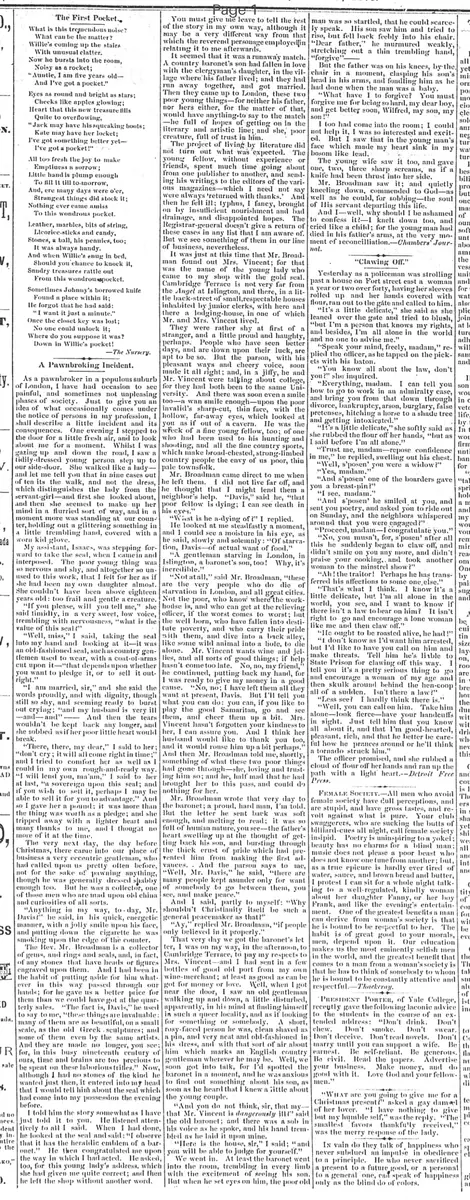
As a pawnbroker in a populous suburb of London, I have had occasion to see painful, and sometimes not unpleasing phases of society. Just to give you an idea of what occasionally comes under the notice of persons in my profession, I shall describe a little incident and its consequences. One evening I stepped to the door for a little fresh air, and to look about me for a moment. Whilst I was gazing up and down the road, I saw a tidily-dressed young person step up to our side-door. She walked like a lady—and let me tell you that in nine cases out of ten it's the walk, and not the dress, which distinguishes the lady from the servant-girl—and first she looked about, and then she seemed to make up her mind in a flurried sort of way, and in a moment more was standing at our counter, holding out a glittering something in a little trembling hand, covered with a worn kid glove.
My assistant, Isaacs, was stepping forward to take the seal, when I came in and interposed. The poor young thing was so nervous and shy, and altogether so unused to this work, that I felt for her as if she had been my own daughter almost. She couldn't have been above eighteen years old: too frail and gentle a creature.
"If you please, will you tell me," she said timidly, in a very sweet, low voice, trembling with nervousness, "what is the value of this seal?"
"Well, miss." I said, taking the seal into my hand and looking at it—it was an old-fashioned seal, such as country gentlemen used to wear, with a coat-of-arms cut upon it—"that depends upon whether you want to pledge it, or to sell it outright."
"I am married, sir," and she said the words proudly, and with dignity, though still so shy, and seeming ready to burst out crying; "and my husband is very ill—and—and"
And then the tears wouldn't be kept back any longer, and she sobbed as if her poor little heart would break.
"There, there, my dear," I said to her; "don't cry; it will all come right in time;" and I tried to comfort her as well as I could in my own rough-and-ready way.
"I will lend you, ma'am," I said to her at last, "a sovereign upon this seal; and if you wish to sell it, perhaps I may be able to sell it for you to advantage." And so I gave her a pound: it was more than the thing was worth as a pledge; and she tripped away with a lighter heart and many thanks to me, and I thought no more of it at the time.
The very next day, the day before Christmas, there came into our place of business a very eccentric gentleman, who had called upon us pretty often before, not for the sake of pawning anything, though he was generally dressed shabby enough too. But he was a collector, one of those men who are mad upon old china and curiosities of all sorts.
"Anything in my way, to-day, Mr. Davis?" he said, in his quick, energetic manner, with a jolly smile upon his face, and putting down the cigarette he was smoking upon the edge of the counter.
The Rev. Mr. Broadman is a collector of gems, and rings and seals, and, in fact, of any stones that have heads or figures engraved upon them. And I had been in the habit of putting aside for him whatever in this way passed through our hands; for he gave us a better price for them than we could have got at the quarterly sales. "The fact is, Davis," he used to say to me, "these things are invaluable: many of them are as beautiful, on a small scale, as the old Greek sculptures; and some of them even by the same artists. And they are made no longer, you see: for, in this busy nineteenth century of ours, time and brains are too precious to be spent on these laborious trifles." Now, although I had no stones of the kind he wanted just then, it entered into my head that I would tell him about the seal which had come into my possession the evening before.
I told him the story somewhat as I have just told it to you. He listened attentively to all I said. When I had done, he looked at the seal and said: "I observe that it has the heraldic emblem of a baronet." He then congratulated me upon the way in which I had acted. He asked, too, for this young lady's address, which she had given me quite correctly; and then he left the shop without another word.
You must give me leave to tell the rest of the story in my own way, although it may be a very different way from that which the reverend personage employed in relating it to me afterwards.
It seemed that it was a runaway match. A country baronet's son had fallen in love with the clergyman's daughter, in the village where his father lived; and they had run away together, and got married. Then they came up to London, these two poor young things—for neither his father, nor hers either, for the matter of that, would have anything to say to the match—he full of hopes of getting on in the literary and artistic line; and she, poor creature, full of trust in him.
The project of living by literature did not turn out what was expected. The young fellow, without experience or friends, spent much time going about from one publisher to another, and sending his writings to the editors of the various magazines—which I need not say were always 'returned with thanks.' And then he fell ill; typhus, I fancy, brought on by insufficient nourishment and bad drainage, and disappointed hopes. The Registrar-general doesn't give a return of these cases in any list that I am aware of. But we see something of them in our line of business, nevertheless.
It was just at this time that Mr. Broadman found out Mrs. Vincent: for that was the name of the young lady who came to my shop with the gold seal. Cambridge Terrace is not very far from the Angel at Islington, and there, in a little back-street of small, respectable houses inhabited by junior clerks, with here and there a lodging-house, in one of which Mr. and Mrs. Vincent lived.
They were rather shy at first of a stranger, and a little proud and haughty, perhaps. People who have seen better days, and are down upon their luck, are apt to be so. But the parson, with his pleasant ways and cheery voice, soon made it all right; and, in a jiffy, he and Mr. Vincent were talking about college, for they had both been to the same University. And there was soon even a smile too—a wan smile enough—upon the poor invalid's sharp-cut, thin face, with the hollow, far-away eyes, which looked at you as if out of a cavern. He was the wreck of a fine young fellow, too; of one who had been used to his hunting and shooting, and all the fine country sports, which make broad-chested, strong-limbed country people the envy of us poor, thin pale townsfolk.
Mr. Broadman came direct to me when he left them. I did not live far off, and he thought that I might lend them a neighbor's help. "Davis," said he, "that poor fellow is dying; I can see death in his eyes."
"What is he a-dying of?" I replied.
He looked at me steadfastly a moment, and I could see a moisture in his eye, as he said, slowly and solemnly: "Of starvation, Davis—of actual want of food."
"A gentleman starving in London, in Islington, a baronet's son, too! Why, it's incredible."
"Not at all," said Mr. Broadman, "these are the very people who do die of starvation in London, and all great cities. Not the poor, who know where the workhouse is, and who can get at the relieving officer, if the worst comes to worst; but the well born, who have fallen into destitute poverty, and who carry their pride with them, and dive into a back alley, like some wild animal into a hole, to die alone. Mr. Vincent wants wine and jellies, and all sorts of good things: if help hasn't come too late." "No, no, my friend," he continued, putting back my hand, for I was ready to give my money in a good cause. "No, no; I have left them all they want at present, Davis. But I'll tell you what you can do: you can, if you like to play the good Samaritan, go and see them, and cheer them up a bit. Mrs. Vincent hasn't forgotten your kindness to her, I can assure you. And I think her husband would like to thank you too, and it would rouse him up a bit perhaps."
And then Mr. Broadman told me, shortly, something of what these two poor things had gone through—she, loving and trusting him so; and he, half mad that he had brought her to this pass, and could do nothing for her.
Mr. Broadman wrote that very day to the baronet; a proud, hard man, I'm told. But the letter he sent back was soft enough, and melting to read: it was so full of human nature, you see—the father's heart swelling up at the thought of getting back his son, and bursting through the thick crust of pride which had prevented him from making the first advances. And the parson says to me, "Well, Mr. Davis," he said, "there are many people kept asunder only for want of somebody to go between them, you see, and make peace."
And I said, partly to myself: "why shouldn't Christianity itself be such a general peacemaker as that?"
"Ay," replied Mr. Broadman, "if people only believed in it properly."
That very day we got the baronet's letter, I was on my way, in the afternoon, to Cambridge Terrace, to pay my respects to Mrs. Vincent—and I had sent in a few bottles of good old port from my own wine-merchant; at least as good as can be got for money or love. Well, when I got near the door, I saw an old gentleman walking up and down, a little disturbed, apparently, in his mind at finding himself in such a queer locality, and as if looking for something or somebody. A short, rosy-faced person he was, clean shaved as a pin, and very neat and old-fashioned in his dress, and with that sort of air about him which marks an English country gentleman wherever he may be. Well, we soon got into talk, for I'd spotted the baronet in a moment, and he was anxious to find out something about his son, as soon as he heard that I knew a little about the young couple.
"And you do not think, sir, that my—that Mr. Vincent is dangerously ill?" said the old baronet: and there was a sob in his voice as he spoke, and his hand trembled as he laid it upon mine.
"Here is the house, sir." I said; "and you will be able to judge for yourself."
We went in. At least the baronet went into the room, trembling in every limb with the excitement of seeing his son. But when he set eyes on him, the poor old man was so startled, that he could scarcely speak. His son saw him and tried to rise, but fell back feebly into his chair.
"Dear father," he murmured weakly, stretching out a thin trembling hand, "forgive"
But the father was on his knees by the chair in a moment, clasping his son's head in his arms, and fondling him as he had done when the man was a baby.
"What have I to forgive? You must forgive me for being so hard, my dear boy, and get better soon, Wilfred, my son, my son"
I too had come into the room; I could not help it, I was so interested and excited. But I saw that in the young man's face which made my heart sink in my bosom like lead.
The young wife saw it too, and gave one, two, three sharp screams, as if a knife had been thrust into her side.
Mr. Broadman saw it; and quietly kneeling down, commended to God—as well as he could, for sobbing—the soul of his servant departing this life.
And I—well, why should I be ashamed to confess it?—I knelt down too, and cried like a child; for the young man had died in his father's arms, at the very moment of reconciliation.—Chambers' Journal.
What sub-type of article is it?
What themes does it cover?
What keywords are associated?
What entities or persons were involved?
Where did it happen?
Story Details
Key Persons
Location
London, Islington, Cambridge Terrace
Event Date
Nineteenth Century, Day Before Christmas
Story Details
A baronet's son and clergyman's daughter elope to London, face poverty and illness from failed literary ambitions. Wife pawns family seal; pawnbroker and reverend aid, reconcile with father, but son dies in reconciliation.