Thank you for visiting SNEWPapers!
Sign up free
Editorial
June 2, 1813
Norfolk Gazette And Publick Ledger
Norfolk, Virginia
What is this article about?
Editorial critiques the economic costs of the War of 1812, estimating annual direct expenses at $25 million plus indirect losses exceeding $50 million from reduced exports and shipping, contrasting pre-war prosperity with current hardships.
Merged-components note: Continuation of the same editorial article on the economic losses from the war.
Clipping
OCR Quality
95%
Excellent
Full Text
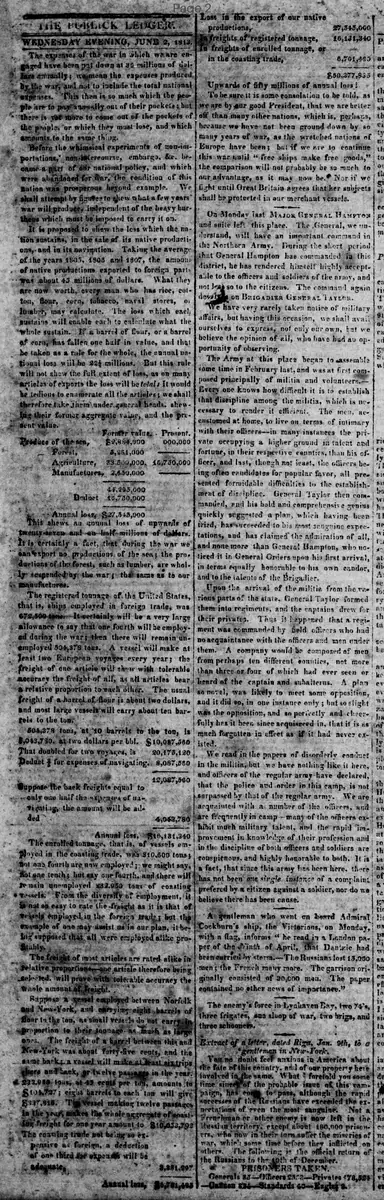
THE PUBLIC LEDGER.
WEDNESDAY EVENING, JUNE 2, 1813.
The expenses of the war in which we are engaged have been put down at 25 millions of dollars annually; we mean the expenses produced by this war, and not to include the total national expenses. This then is so much which the people are to pay annually out of their pockets; but there is more to come out of the pockets of the people, or which they must lose, and which amounts to the same thing.
Before the whimsical experiments of non-importations, non-intercourse, embargo, etc. became a part of our national policy, and which were abandoned for war, the condition of this nation was prosperous beyond example. We shall attempt by figures to show what a few years war will produce independent of the heavy burdens which must be imposed to carry it on.
It is proposed to show the loss which the nation sustains, in the sale of its native productions, and in its navigation. Taking the average of the years 1805, 1806 and 1807, the amount of native productions exported to foreign parts was about 45 millions of dollars. What they are now worth, every man who has rice, cotton, flour, corn, tobacco, naval stores, lumber, may calculate. The loss which each sustains will enable each to calculate what the whole sustains. If a barrel of flour, or a barrel of corn, has fallen one half in value, and that be taken as a rule for the whole, the annual national loss will be 22 1/2 millions. But this rule will not show the full extent of loss, as on many articles of export the loss will be total; It would be tedious to enumerate all the articles we shall therefore take them under general heads, showing in their former aggregate value, and the present value.
Former value Present
Produce of the sea $2,884,000 0
Forest, 3,264,000 0
Agriculture, 23,600,000 16,000,000
Manufactures, 2,650,000 0
44,395,000
Deduct 18,780,000
Annual loss 27,348,000
This shows an annual loss of upwards of twenty-seven and a half millions of dollars.
It is certainly a fact, that during the war we can export no productions of the sea; the productions of the forest, such as lumber, are wholly suspended by the war as the same as to our manufactures.
The registered tonnage of the United States, that is, ships employed in foreign trade, was 672,500 tons. It certainly will be a very large allowance to say that one fourth will be employed during the war then there will remain unemployed 504,375 tons. A vessel will make at least two European voyages every year; the freight of one article will show with tolerable accuracy the freight of all, as all articles bear a relative proportion to each other. The usual freight of a barrel of flour is about two dollars, and most large vessels will carry about ten barrels to the ton.
504,375 tons, at 10 barrels to the ton, is 5,043,750, at two dollars per bbl., $10,087,500. That doubled for two voyages; is 20,175,120. Deduct for expenses of navigating. 8,087,560. 12,087,560.
Suppose the back freights equal to only one half these expenses of navigating the amount will be added 4,043,780.
Annual loss, 16,181,340.
The enrolled tonnage, that is, of vessels employed in the coasting trade, was 810,600 tons; not one fourth are now employed as we might say not one tenth but say one fourth, and there will remain unemployed 607,950 tons of coasting vessels. From the diversity of employment, it is not so easy to rate the freight as it is that of vessels employed in the foreign trade but the example of one may assist us in our plan, it being supposed that all were employed alike profitably.
The freights of most articles are rated alike in relative proportions some article therefore being selected, will prove with tolerable accuracy the whole amount of freight.
Suppose a vessel employed between Norfolk and New York, and carrying eight barrels of flour to the ton, as small vessels do not carry proportion to their tonnage, as much as large ones. The freight of a barrel between this and New York was about forty-five cents and the same back; a vessel will make at least six trips there and back, or twelve passages in the year.
607,950 tons, at 45 cents per ton amounts to $273,777; eight barrels to each ton will give $2,190,216. A vessel making twelve passages in the year twice the whole aggregate of coasting freight for one year amount to. $5,180,432.
The coasting trade not being so expensive as foreign, a deduction of one third for expenses will be adequate. $3,453,621.
Annual loss.
Loss in the export of our native productions 27,545,000 freights of registered tonnage. 16,131,340 In freights of enrolled tonnage, or in the coasting trade, 6,701,295 $50,377,835 Upwards of fifty millions of annual loss!
To be sure it is some consolation to be told, as we are by our good President, that we are better off than many other nations, which is, perhaps, because we have not been ground down by so many years of war, as the wretched nations of Europe have been; but if we are to continue this war until "free ships make free goods," the comparison will not probably be so much to our advantage, as it may now be. Nor if we fight until Great Britain agrees that her subjects shall be protected in our merchant vessels.
WEDNESDAY EVENING, JUNE 2, 1813.
The expenses of the war in which we are engaged have been put down at 25 millions of dollars annually; we mean the expenses produced by this war, and not to include the total national expenses. This then is so much which the people are to pay annually out of their pockets; but there is more to come out of the pockets of the people, or which they must lose, and which amounts to the same thing.
Before the whimsical experiments of non-importations, non-intercourse, embargo, etc. became a part of our national policy, and which were abandoned for war, the condition of this nation was prosperous beyond example. We shall attempt by figures to show what a few years war will produce independent of the heavy burdens which must be imposed to carry it on.
It is proposed to show the loss which the nation sustains, in the sale of its native productions, and in its navigation. Taking the average of the years 1805, 1806 and 1807, the amount of native productions exported to foreign parts was about 45 millions of dollars. What they are now worth, every man who has rice, cotton, flour, corn, tobacco, naval stores, lumber, may calculate. The loss which each sustains will enable each to calculate what the whole sustains. If a barrel of flour, or a barrel of corn, has fallen one half in value, and that be taken as a rule for the whole, the annual national loss will be 22 1/2 millions. But this rule will not show the full extent of loss, as on many articles of export the loss will be total; It would be tedious to enumerate all the articles we shall therefore take them under general heads, showing in their former aggregate value, and the present value.
Former value Present
Produce of the sea $2,884,000 0
Forest, 3,264,000 0
Agriculture, 23,600,000 16,000,000
Manufactures, 2,650,000 0
44,395,000
Deduct 18,780,000
Annual loss 27,348,000
This shows an annual loss of upwards of twenty-seven and a half millions of dollars.
It is certainly a fact, that during the war we can export no productions of the sea; the productions of the forest, such as lumber, are wholly suspended by the war as the same as to our manufactures.
The registered tonnage of the United States, that is, ships employed in foreign trade, was 672,500 tons. It certainly will be a very large allowance to say that one fourth will be employed during the war then there will remain unemployed 504,375 tons. A vessel will make at least two European voyages every year; the freight of one article will show with tolerable accuracy the freight of all, as all articles bear a relative proportion to each other. The usual freight of a barrel of flour is about two dollars, and most large vessels will carry about ten barrels to the ton.
504,375 tons, at 10 barrels to the ton, is 5,043,750, at two dollars per bbl., $10,087,500. That doubled for two voyages; is 20,175,120. Deduct for expenses of navigating. 8,087,560. 12,087,560.
Suppose the back freights equal to only one half these expenses of navigating the amount will be added 4,043,780.
Annual loss, 16,181,340.
The enrolled tonnage, that is, of vessels employed in the coasting trade, was 810,600 tons; not one fourth are now employed as we might say not one tenth but say one fourth, and there will remain unemployed 607,950 tons of coasting vessels. From the diversity of employment, it is not so easy to rate the freight as it is that of vessels employed in the foreign trade but the example of one may assist us in our plan, it being supposed that all were employed alike profitably.
The freights of most articles are rated alike in relative proportions some article therefore being selected, will prove with tolerable accuracy the whole amount of freight.
Suppose a vessel employed between Norfolk and New York, and carrying eight barrels of flour to the ton, as small vessels do not carry proportion to their tonnage, as much as large ones. The freight of a barrel between this and New York was about forty-five cents and the same back; a vessel will make at least six trips there and back, or twelve passages in the year.
607,950 tons, at 45 cents per ton amounts to $273,777; eight barrels to each ton will give $2,190,216. A vessel making twelve passages in the year twice the whole aggregate of coasting freight for one year amount to. $5,180,432.
The coasting trade not being so expensive as foreign, a deduction of one third for expenses will be adequate. $3,453,621.
Annual loss.
Loss in the export of our native productions 27,545,000 freights of registered tonnage. 16,131,340 In freights of enrolled tonnage, or in the coasting trade, 6,701,295 $50,377,835 Upwards of fifty millions of annual loss!
To be sure it is some consolation to be told, as we are by our good President, that we are better off than many other nations, which is, perhaps, because we have not been ground down by so many years of war, as the wretched nations of Europe have been; but if we are to continue this war until "free ships make free goods," the comparison will not probably be so much to our advantage, as it may now be. Nor if we fight until Great Britain agrees that her subjects shall be protected in our merchant vessels.
What sub-type of article is it?
War Or Peace
Economic Policy
Trade Or Commerce
What keywords are associated?
War Of 1812
Economic Losses
Exports Decline
Shipping Freights
National Prosperity
War Expenses
Trade Suspension
What entities or persons were involved?
President
Great Britain
United States
Editorial Details
Primary Topic
Economic Losses From The War Of 1812
Stance / Tone
Critical Of War's Financial Burden
Key Figures
President
Great Britain
United States
Key Arguments
Annual Direct War Expenses: $25 Million
Pre War Prosperity Contrasted With Current Losses From Non Importation Policies And War
Export Losses: Over $27 Million Annually Due To Reduced Values And Suspended Trade
Foreign Shipping Tonnage Losses: Approximately $16 Million In Freights
Coasting Trade Losses: About $6.7 Million In Freights
Total Annual Indirect Losses Exceed $50 Million
Skeptical Of Presidential Consolation Regarding Comparison To European Nations