Thank you for visiting SNEWPapers!
Sign up free
Literary Cadet And Rhode Island Statesman
Providence, Providence County, Rhode Island
What is this article about?
A narrator recounts his early love for Ellen Stanley, who marries his friend Ormsby for wealth despite prior vows to poor schoolteacher Arthur Annesley. Their marriage leads to jealousy, Ormsby's alcoholism and death, and Ellen's eventual suicide by laudanum, confessed in a letter revealing her regrets.
Merged-components note: Narrative story 'Ellen Stanley, or the Victim of Vanity' split across multiple components; changed from 'literary' to 'story' as it is a full narrative article.
Clipping
OCR Quality
Full Text
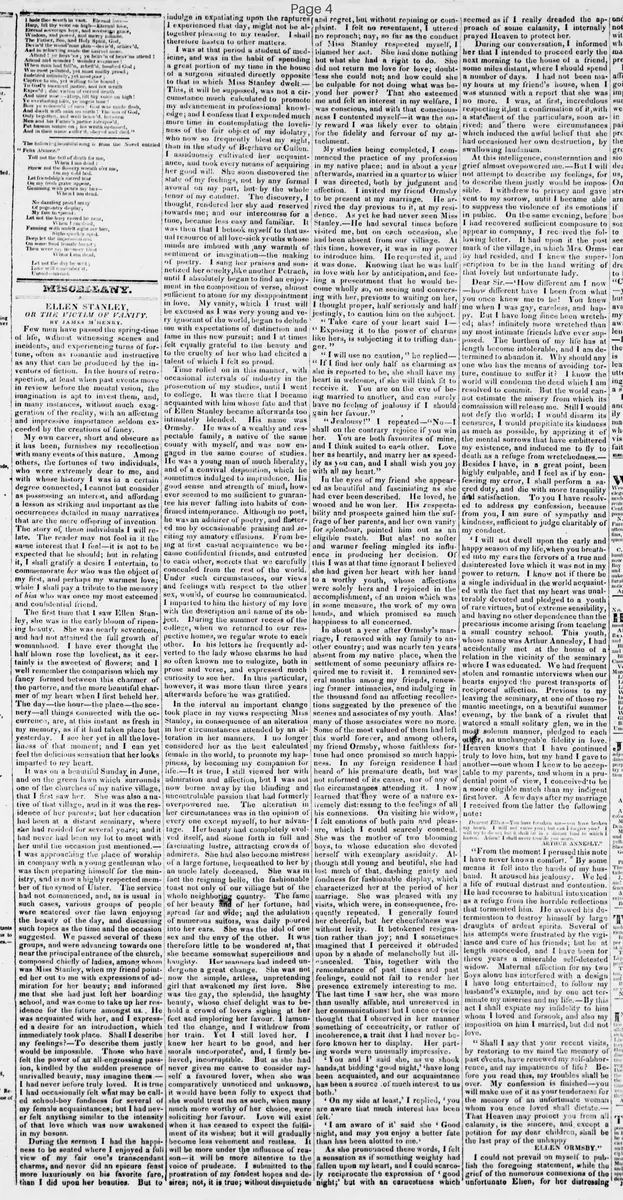
ELLEN STANLEY,
OR THE VICTIM OF VANITY.
BY JAMES M'HENRY.
Few men have passed the spring-time of life, without witnessing scenes and incidents, and experiencing turns of fortune, often as romantic and instructive as any that can be produced by the inventors of fiction. In the hours of retrospection, at least when past events move in review before the mental vision, the imagination is apt to invest them, and, in many instances, without much exaggeration of the reality, with an affecting and impressive importance seldom exceeded by the creations of fancy.
My own career, short and obscure as it has been, furnishes my recollection with many events of this nature. Among others, the fortunes of two individuals, who were extremely dear to me, and with whose history I was in a certain degree connected, I cannot but consider as possessing an interest, and affording a lesson as striking and important as the occurrences detailed in many narratives that are the mere offspring of invention.
The story of these individuals I will relate. The reader may not feel in it the same interest that I feel—it is not to be expected that he should; but in relating it, I shall gratify a desire I entertain, to commemorate her who was the object of my first, and perhaps my warmest love; while I shall pay a tribute to the memory of him who was once my most esteemed and confidential friend.
The first time that I saw Ellen Stanley, she was in the early bloom of ripening beauty. She was nearly seventeen, and had not attained the full growth of womanhood. I have ever thought the half blown rose the loveliest, as it certainly is the sweetest of flowers; and I well remember the comparison which my fancy formed between this charmer of the parterre, and the more beautiful charmer of my heart when I first beheld her.
The day—the hour—the place—the scenery—all things connected with the occurrence, are, at this instant as fresh in my memory, as if it had taken place but yesterday. I see her yet in all the loveliness of that moment; and I can yet feel the delicious sensation that her looks imparted to my heart.
It was on a beautiful Sunday in June, and on the green lawn which surrounds one of the churches of my native village, that I first saw her. She was also a native of that village, and in it was the residence of her parents; but her education had been at a distant seminary, where she had resided for several years; and it had never been my lot to meet with her until the occasion just mentioned.—
I was approaching the place of worship in company with a young gentleman who was then preparing himself for the ministry, and is now a highly respected member of the synod of Ulster. The service had not commenced, and, as is usual in such cases, various groups of people were scattered over the lawn enjoying the beauty of the day, and discussing such topics as the time and the occasion suggested. We passed several of these groups, and were advancing towards one near the principal entrance of the church, composed chiefly of ladies, among whom was Miss Stanley, when my friend pointed her out to me with expressions of admiration for her beauty; and informed me that she had just left her boarding school, and was come to take up her residence for the future amongst us. He was acquainted with her, and I expressed a desire for an introduction, which immediately took place. Shall I describe my feelings?—To describe them justly would be impossible. Those who have felt the power of an all-engrossing passion, kindled by the sudden presence of unrivalled beauty, may imagine them.—
I had never before truly loved. It is true I had occasionally felt what may be called school-boy fondness for several of my female acquaintances; but I had never felt anything similar to the intensity of that love which was now awakened in my bosom.
During the sermon I had the happiness to be seated where I enjoyed a full view of my fair one's transcendent charms, and never did an epicure feast more luxuriously on his favorite fare, than I did upon her beauties. But to indulge in expatiating upon the raptures I experienced that day, might not be altogether pleasing to my reader. I shall therefore hasten to other matters.
I was at that period a student of medicine, and was in the habit of spending a great portion of my time in the house of a surgeon situated directly opposite to that in which Miss Stanley dwelt.— This, it will be supposed, was not a circumstance much calculated to promote my advancement in professional knowledge; and I confess that I expended much more time in contemplating the loveliness of the fair object of my idolatry, who now so frequently blest my sight, than in the study of Boerhave or Cullen.
I assiduously cultivated her acquaintance, and took every means of acquiring her good will. She soon discovered the state of my feelings, not by any formal avowal on my part, but by the whole tenor of my conduct. The discovery, I thought, rendered her shy and reserved towards me; and our intercourse for a time, became less easy and familiar. It was then that I betook myself to that usual resource of all love-sick youths whose minds are imbued with any warmth of sentiment or imagination—the making of poetry. I sang her praises and sonnetized her cruelty, like another Petrarch, until I absolutely began to find an enjoyment in the composition of verse, almost sufficient to atone for my disappointment in love. My vanity, which I trust will be excused as I was very young and very ignorant of the world, began to delude me with expectations of distinction and fame in this new pursuit; and I at times felt equally grateful to the beauty and to the cruelty of her who had elicited a talent of which I felt so proud.
Time rolled on in this manner, with occasional intervals of industry in the prosecution of my studies, until I went to college.
It was there that I became acquainted with him whose fate and that of Ellen Stanley became afterwards too intimately blended.
His name was Ormsby.
He was of a wealthy and respectable family, a native of the same county with myself, and was now engaged in the same course of studies.
He was a young man of much liberality, and of a convivial disposition, which he sometimes indulged to imprudence. His good sense and strength of mind, however seemed to me sufficient to guarantee his never falling into habits of confirmed intemperance. Although no poet, he was an admirer of poetry, and flattered me by occasionally praising and reciting my amatory effusions. From being at first casual acquaintance we became confidential friends, and entrusted to each other, secrets that we carefully concealed from the rest of the world.
Under such circumstances, our views and feelings with respect to the other sex, would, of course be communicated.
I imparted to him the history of my love with the description and name of its object. During the summer recess of the college, when we returned to our respective homes, we regularly wrote to each other. In his letters he frequently adverted to the lady whose charms he had so often known me to eulogize, both in prose and verse, and expressed much curiosity to see her. In this particular, however, it was more than three years afterwards before he was gratified.
In the interval an important change took place in my views respecting Miss Stanley, in consequence of an alteration in her circumstances attended by an alteration in her manners.
I no longer considered her as the best calculated female in the world, to promote my happiness, by becoming my companion for life.—It is true, I still viewed her with admiration and affection, but I was not now borne away by the blinding and uncontrollable passion that had formerly overpowered me.
The alteration in her circumstances was in the opinion of every one except myself, to her advantage. Her beauty had completely evolved itself, and shone forth in full and fascinating lustre, attracting crowds of admirers. She had also become mistress of a large fortune, bequeathed to her by an uncle lately deceased. She was in fact the reigning belle, the fashionable toast not only of our village but of the whole neighboring country.
The fame of her beauty and of her fortune, had spread far and wide; and the adulation of numerous suitors, was daily poured into her ears. She was the idol of one sex and the envy of the other.
It was therefore little to be wondered at, that she became somewhat supercilious and haughty.
Her manners had indeed undergone a great change.
She was not now the simple, artless, unpretending girl that awakened my first love. She was the gay, the splendid, the haughty beauty, whose chief delight was to behold a crowd of lovers sighing at her feet and imploring her favour. I lamented the change, and I withdrew from her train. Yet I still loved her. I knew her heart to be good, and her morals unexceptionable, and, I firmly believed, incorruptible. But as she had never given me cause to consider myself a favoured lover, when she was comparatively unnoticed and unknown, it would have been folly to expect that she would treat me as such, when many much more worthy of her choice, were soliciting her favour. Love will exist when it has ceased to expect the fulfilment of its wishes; but it will gradually become less vehement and restless.
It will be more under the influence of reason—it will be more attentive to the voice of prudence. I submitted to the prostration of my fondest hopes and desires; not, it is true; without disquietude (and regret, but without repining or complaint." I felt no resentment, I uttered no reproach; nay, so far as the conduct of Miss Stanley respected myself, I blamed her not." She had done nothing but what she had a right to do. She did not return me love for love; doubtless she could not; and how could she be culpable for not doing what was beyond her power? That she esteemed me and felt an interest in my welfare, I was conscious, and with that consciousness I contented myself—it was the only reward I was likely ever to obtain for the fidelity and fervour of my attachment.
My studies being completed, I commenced the practice of my profession in my native place; and in about a year afterwards, married in a quarter to which I was directed, both by judgment and affection. I invited my friend Ormsby to be present at my marriage. He arrived the day previous to it, at my residence. As yet he had never seen Miss Stanley.—He had several times before visited me, but on each occasion, she had been absent from our village. At this time, however, it was in my power to introduce him. He requested it, and it was done. Knowing that he was half in love with her by anticipation, and feeling a presentiment that he would become wholly so, on seeing and conversing with her, previous to waiting on her, I thought proper, half seriously and half jestingly, to caution him on the subject.
"Take care of your heart said I— "Exposing it to the power of charms like hers, is subjecting it to trifling danger.
"I will use no caution," he replied— "If I find her only half as charming as she is reported to be, she shall have my heart in welcome, if she will think fit to receive it. You are on the eve of being married to another, and can surely have no feeling of jealousy if I should gain her favour."
"Jealousy!" I repeated—"No—I shall on the contrary rejoice if you win her. You are both favourites of mine, and I think suited to each other. Love her as heartily, and marry her as speedily as you can, and I shall wish you joy with all my heart."
In the eyes of my friend she appeared as beautiful and fascinating as she had ever been described. He loved, he wooed and he won her. His respectability and prospects gained him the suffrage of her parents, and her own vanity for splendour, pointed him out as an eligible match. But alas! no softer and warmer feeling mingled its influence in producing her decision. Of this I was at that time ignorant I believed she had given her heart with her hand to a worthy youth, whose affections were solely hers and I rejoiced in the accomplishment, of an union which was in some measure, the work of my own hands, and which promised so much happiness to all concerned.
In about a year after Ormsby's marriage, I removed with my family to another country; and was nearly ten years absent from my native place, when the settlement of some pecuniary affairs required me to revisit it. I remained several months among my friends, renewing former intimacies, and indulging in the thousand fond and affecting recollections suggested by the presence of the scenes and associates of my youth. Alas! many of those associates were no more. Some of the most valued of them had left this world forever, and among others, my friend Ormsby, whose faithless fortune had once promised so much happiness. In my foreign residence I had heard of his premature death, but was not informed of its cause, nor of any of the circumstances attending it. I now learned that they were of a nature extremely distressing to the feelings of all his connexions. On visiting his widow, I felt emotions of both pain and pleasure, which I could scarcely conceal.
She was the mother of two blooming boys, to whose education she devoted herself with exemplary assiduity. Although still young and beautiful, she had lost much of that, dashing gaiety and fondness for fashionable display, which characterized her at the period of her marriage. She was pleased with my visits, which were, in consequence, frequently repeated. I generally found her cheerful, but her cheerfulness was without levity. It betokened resignation rather than joy: and I sometimes imagined that I perceived it obtruded upon by a shade of melancholy but ill-concealed. This, together with the remembrance of past times and past feelings, could not fail to render her presence extremely interesting to me.
The last time I saw her, she was more than usually affable, and unreserved in her communications: but I once or twice thought that I observed in her manner something of eccentricity, or rather of incoherence, a trait that I had never before known her to display. Her parting words were unusually impressive.
"You and I' said she, as we shook hands, at bidding 'good night,' 'have long been acquainted, and our acquaintance has been a source of much interest to us both.'
"On my side at least,' I replied, 'you are aware that much interest has been felt.'
"I am aware of it' said she 'Good night, and may you enjoy a better fate than has been allotted to me.'
As she pronounced these words, I felt a sensation as if something weighty had fallen upon my heart, and I could scarcely reciprocate the expression of 'good night;' but with an earnestness which seemed as if I really dreaded the approach of some calamity, I internally prayed Heaven to protect her.
During our conversation, I informed her that I intended to proceed early the next morning to the house of a friend, some miles distant, where I should spend a number of days. I had not been many hours at my friend's house, when I was stunned with a report that she was no more. I was, at first, incredulous respecting it, but a confirmation of it, with a statement of the particulars, soon arrived: and there were circumstances which induced the awful belief that she had occasioned her own destruction, by swallowing laudanum.
At this intelligence, consternation and grief almost overpowered me.—But I will not attempt to describe my feelings, for to describe them justly would be impossible. I withdrew to privacy and gave vent to my sorrow, until I became able to suppress the violence of its emotions in public. On the same evening, before I had recovered sufficient composure to appear in company, I received the following letter. It had upon it the post mark of the village, in which Mrs. Ormsby had resided, and I knew the superscription to be in the hand writing of that lovely but unfortunate lady.
Dear Sir.—'How different am I now —how different have I been from what you once knew me to be! You knew me when I was gay, careless, and happy. But I have long since been wretched; alas! infinitely more wretched than my most intimate friends have ever supposed. The burthen of my life has at length become intolerable, and I am determined to abandon it. Why should any one who has the means of avoiding torture, continue to suffer it? I know the world will condemn the deed which I am resolved to commit. But the world cannot estimate the misery from which its commission will release me. Still I would not defy the world; I would disarm its censures, I would propitiate its kindness as much as possible, by apprizing it of the mental sorrows that have embittered my existence, and induced me to fly to death as a refuge from wretchedness.— Besides I have, in a great point, been highly culpable, and I feel as if by confessing my error, I shall perform a sacred duty, and die with more tranquility and satisfaction. To you I have resolved to address my confession, because from you, I am sure of sympathy and kindness, sufficient to judge charitably of my conduct.
I will not dwell upon the early and happy season of my life, when you breathed into my ears the fervors of a true and disinterested love which it was not in my power to return. I know not if there be a single individual in the world acquainted with the fact that my heart was unalterably devoted and pledged to a youth of rare virtues, but of extreme sensibility, and having no other dependence than the precarious income arising from teaching a small country school. This youth, whose name was Arthur Annesley, I had accidentally met at the house of a relation in the vicinity of the seminary where I was educated. We had frequent stolen and romantic interviews when our hearts enjoyed the purest transports of reciprocal affection. Previous to my leaving the seminary, at one of those romantic meetings, on a beautiful summer evening, by the bank of a rivulet that watered a small solitary glen, we in the most solemn manner, pledged to each other, an unchangeable fidelity in love.
Heaven knows that I have continued truly to love him, but my hand I gave to another—one whom I knew to be acceptable to my parents, and whom in a prudential point of view, I conceived to be a more eligible match than my indigent first lover. A few days after my marriage I received from the latter the following note:
Dearest Ellen—You have forsaken me—you have broken my heart. I will not curse you; but can I forgive you? I will try to do so; but it shall be in a distant land to which I hasten. Adieu! I shall never trouble you more.
ARTHUR ANNESLY."
"From the moment I perused this note I have never known comfort. By some means it fell into the hands of my husband. It aroused his jealousy. We led a life of mutual distrust and contention. He had recourse to habitual intoxication as a refuge from the horrible reflections that tormented him. He avowed his determination to destroy himself by large draughts of ardent spirits. Several of his attempts were frustrated by the vigilance and care of his friends; but he at length succeeded, and I have been for three years a miserable self-detested widow. Maternal affection for my two boys alone has interfered with a design I have long entertained, to follow my husband's example, and by one act terminate my miseries and my life.—By this act I shall expiate my infidelity to him whom I loved and forsook, and also my imposition on him I married, but did not love.
"Shall I say that your recent visits, by restoring to my mind the memory of past events, have renewed my self-abhorrence, and my impatience of life? Before you read this, my troubles shall be over. My confession is finished—you will make use of it as your tenderness for the memory of an unfortunate woman whom you once loved shall dictate.— That Heaven may protect you from all calamity, is the sincere, and, except a petition for my dear children, shall be the last pray of the unhappy
ELLEN ORMSBY."
I could not prevail on myself to publish the foregoing statement, while the grief of the numerous connexions of the unfortunate Ellen, for her distressing and was recent: and even now I have not ventured to lay it before the world without making that change of names which a due regard to the feelings of many respectable individuals still living, prescribes.
I have now to relate an incident of an affecting nature, connected with the foregoing occurrences, which has made an impression on my mind, that I am persuaded shall never be effaced. Some weeks after the death of Mrs. Ormsby, in company with one of her relations, I paid a visit to her grave. As we approached it, we were surprised to hear the sound of lamentation, mingled with groans and convulsive sobs, and occasionally incoherent expressions of endearment, proceeding, as it seemed to us, from underneath its grassy covering.
On advancing nearer, we saw a man stretched upon the grave, who with an arm on each side, embraced the turf as if he wished to press it closer to his bosom. He did not observe us, and for some minutes, we did not think proper to disturb him; but his agony of grief seemed so much like madness, and became at last so intense, that we could no longer look on it in silence. We addressed him. On hearing us he started to his feet with the wildness of a maniac.
"Come not near!" said he, "I defy you! —you made her break her vows once, but you cannot separate us now. Avaunt! avaunt!—she is my own—she clings to my feet, and you shall not drive her away! We'll forgive and forget, my Ellen!—I am your Annesley, your only love. —Ha! ha! ha! there is your husband! there is your husband! take him!—he is rich. Faithless, faithless Ellen—I leave you, I leave you forever." He uttered a shriek of the most heart-piercing agony, and fled from our sight with a swiftness that baffled all pursuit.
I left that country shortly afterwards, and returned to the land where my family resided, and where I have since made my home. I have not heard whether the poor maniac ever again visited the grave of his beloved but faithless and unhappy Ellen.
What sub-type of article is it?
What themes does it cover?
What keywords are associated?
What entities or persons were involved?
Where did it happen?
Story Details
Key Persons
Location
Native Village
Event Date
A Beautiful Sunday In June
Story Details
Narrator falls in love with Ellen Stanley at 17; she inherits fortune, becomes haughty; marries narrator's friend Ormsby for status despite prior pledge to poor Arthur Annesley; marriage fails due to jealousy and note discovery, leading to Ormsby's alcoholism and death; Ellen suicides by laudanum, confessing in letter; Annesley later mourns madly at her grave.