Thank you for visiting SNEWPapers!
Sign up free
Story
October 17, 1961
The Farmville Herald
Farmville, Prince Edward County, Virginia
What is this article about?
Explains why the Communist Party is legal in divided Berlin despite being outlawed in West Germany by the supreme court in 1956 for threatening democracy. Details post-WWII four-power agreements and Berlin's unique status amid Soviet influence.
Clipping
OCR Quality
98%
Excellent
Full Text
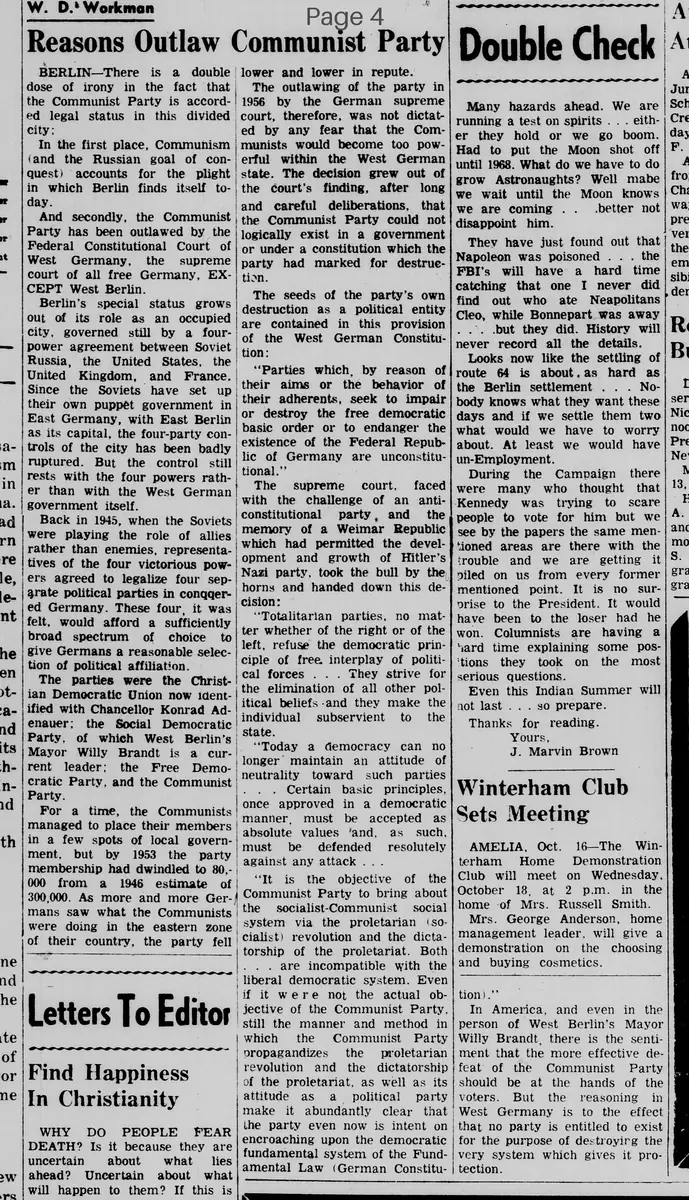
Reasons Outlaw Communist Party
BERLIN - There is a double dose of irony in the fact that the Communist Party is accorded legal status in this divided city.
In the first place, Communism (and the Russian goal of conquest) accounts for the plight in which Berlin finds itself today.
And secondly, the Communist Party has been outlawed by the Federal Constitutional Court of West Germany, the supreme court of all free Germany, EXCEPT West Berlin.
Berlin's special status grows out of its role as an occupied city, governed still by a four-power agreement between Soviet Russia, the United States, the United Kingdom, and France.
Since the Soviets have set up their own puppet government in East Germany, with East Berlin as its capital, the four-party controls of the city has been badly ruptured. But the control still rests with the four powers rather than with the West German government itself.
Back in 1945, when the Soviets were playing the role of allies rather than enemies, representatives of the four victorious powers agreed to legalize four separate political parties in conquered Germany. These four, it was felt, would afford a sufficiently broad spectrum of choice to give Germans a reasonable selection of political affiliation.
The parties were the Christian Democratic Union now identified with Chancellor Konrad Adenauer; the Social Democratic Party, of which West Berlin's Mayor Willy Brandt is a current leader; the Free Democratic Party, and the Communist Party.
For a time, the Communists managed to place their members in a few spots of local government, but by 1953 the party membership had dwindled to 80,000 from a 1946 estimate of 300,000. As more and more Germans saw what the Communists were doing in the eastern zone of their country, the party fell lower and lower in repute.
The outlawing of the party in 1956 by the German supreme court, therefore, was not dictated by any fear that the Communists would become too powerful within the West German state. The decision grew out of the court's finding, after long and careful deliberations, that the Communist Party could not logically exist in a government or under a constitution which the party had marked for destruction.
The seeds of the party's own destruction as a political entity are contained in this provision of the West German Constitution:
"Parties which, by reason of their aims or the behavior of their adherents, seek to impair or destroy the free democratic basic order or to endanger the existence of the Federal Republic of Germany are unconstitutional."
The supreme court, faced with the challenge of an anti-constitutional party, and the memory of a Weimar Republic which had permitted the development and growth of Hitler's Nazi party, took the bull by the horns and handed down this decision:
"Totalitarian parties, no matter whether of the right or of the left, refuse the democratic principle of free interplay of political forces . . . They strive for the elimination of all other political beliefs and they make the individual subservient to the state.
"Today a democracy can no longer maintain an attitude of neutrality toward such parties. Certain basic principles, once approved in a democratic manner, must be accepted as absolute values and, as such, must be defended resolutely against any attack . . .
"It is the objective of the Communist Party to bring about the socialist-Communist social system via the proletarian (socialist) revolution and the dictatorship of the proletariat. Both . . . are incompatible with the liberal democratic system. Even if it were not the actual objective of the Communist Party, still the manner and method in which the Communist Party propagandizes the proletarian revolution and the dictatorship of the proletariat, as well as its attitude as a political party make it abundantly clear that the party even now is intent on encroaching upon the democratic fundamental system of the Fundamental Law (German Constitution)."
BERLIN - There is a double dose of irony in the fact that the Communist Party is accorded legal status in this divided city.
In the first place, Communism (and the Russian goal of conquest) accounts for the plight in which Berlin finds itself today.
And secondly, the Communist Party has been outlawed by the Federal Constitutional Court of West Germany, the supreme court of all free Germany, EXCEPT West Berlin.
Berlin's special status grows out of its role as an occupied city, governed still by a four-power agreement between Soviet Russia, the United States, the United Kingdom, and France.
Since the Soviets have set up their own puppet government in East Germany, with East Berlin as its capital, the four-party controls of the city has been badly ruptured. But the control still rests with the four powers rather than with the West German government itself.
Back in 1945, when the Soviets were playing the role of allies rather than enemies, representatives of the four victorious powers agreed to legalize four separate political parties in conquered Germany. These four, it was felt, would afford a sufficiently broad spectrum of choice to give Germans a reasonable selection of political affiliation.
The parties were the Christian Democratic Union now identified with Chancellor Konrad Adenauer; the Social Democratic Party, of which West Berlin's Mayor Willy Brandt is a current leader; the Free Democratic Party, and the Communist Party.
For a time, the Communists managed to place their members in a few spots of local government, but by 1953 the party membership had dwindled to 80,000 from a 1946 estimate of 300,000. As more and more Germans saw what the Communists were doing in the eastern zone of their country, the party fell lower and lower in repute.
The outlawing of the party in 1956 by the German supreme court, therefore, was not dictated by any fear that the Communists would become too powerful within the West German state. The decision grew out of the court's finding, after long and careful deliberations, that the Communist Party could not logically exist in a government or under a constitution which the party had marked for destruction.
The seeds of the party's own destruction as a political entity are contained in this provision of the West German Constitution:
"Parties which, by reason of their aims or the behavior of their adherents, seek to impair or destroy the free democratic basic order or to endanger the existence of the Federal Republic of Germany are unconstitutional."
The supreme court, faced with the challenge of an anti-constitutional party, and the memory of a Weimar Republic which had permitted the development and growth of Hitler's Nazi party, took the bull by the horns and handed down this decision:
"Totalitarian parties, no matter whether of the right or of the left, refuse the democratic principle of free interplay of political forces . . . They strive for the elimination of all other political beliefs and they make the individual subservient to the state.
"Today a democracy can no longer maintain an attitude of neutrality toward such parties. Certain basic principles, once approved in a democratic manner, must be accepted as absolute values and, as such, must be defended resolutely against any attack . . .
"It is the objective of the Communist Party to bring about the socialist-Communist social system via the proletarian (socialist) revolution and the dictatorship of the proletariat. Both . . . are incompatible with the liberal democratic system. Even if it were not the actual objective of the Communist Party, still the manner and method in which the Communist Party propagandizes the proletarian revolution and the dictatorship of the proletariat, as well as its attitude as a political party make it abundantly clear that the party even now is intent on encroaching upon the democratic fundamental system of the Fundamental Law (German Constitution)."
What sub-type of article is it?
Historical Event
What themes does it cover?
Justice
Moral Virtue
What keywords are associated?
Communist Party
West Germany
Berlin
Outlawed
Constitution
Democracy
Cold War
What entities or persons were involved?
Konrad Adenauer
Willy Brandt
Where did it happen?
Berlin, West Germany
Story Details
Key Persons
Konrad Adenauer
Willy Brandt
Location
Berlin, West Germany
Event Date
1956
Story Details
The Communist Party is outlawed in West Germany by the Federal Constitutional Court for seeking to destroy the democratic order, but remains legal in West Berlin due to its special four-power status post-WWII.